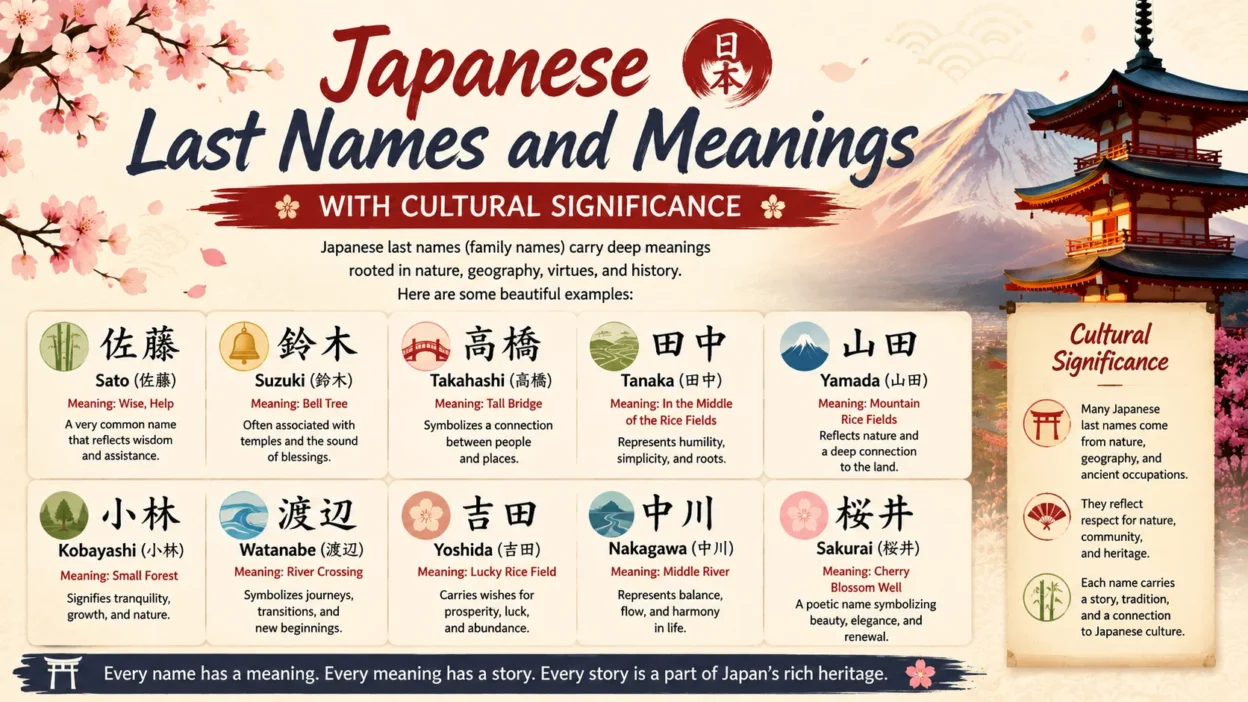
Japanese last names are more than just identifiers. They tell stories of geography, nature, history, and family lineage.
Unlike Western surnames that often come from occupations (Smith, Baker) or patronymics (Johnson, Williamson), Japanese last names and meanings are deeply rooted in the natural world. Most Japanese surnames describe landscapes—rice fields, mountains, rivers, forests, and villages.
In Japan, the surname comes before the given name. For example, Sato Taro means Taro from the Sato family. This emphasizes family identity over individual identity.
This comprehensive guide will explore 500+ Japanese last names and meanings, organized by themes, kanji characters, popularity, and cultural significance. Whether you’re researching your heritage, naming a character, or simply curious, you’ll find everything here.
Why Japanese Last Names Are Unique
Before diving into Japanese last names and meanings, let’s understand what makes them special.
Key Characteristics
| Feature | Explanation |
|---|---|
| Kanji-based | Each name is written with Chinese characters that carry meaning |
| Nature-focused | Most describe landscapes, plants, or natural features |
| Family first | Surname comes before given name in Japan |
| Regional | Many names are tied to specific areas of Japan |
| Oldest first | Japan has hundreds of thousands of distinct surnames |
What Makes Japanese Surnames Different
- Over 100,000 different surnames exist in Japan
- Most Japanese surnames are two kanji characters long
- One-character and three-character surnames also exist
- Women traditionally keep their maiden names but often use husband’s name informally
- The emperor and royal family have no surname — only given names
- Surnames were legally required for all Japanese citizens starting in 1875
The Most Common Japanese Last Names
Here are the most frequently encountered Japanese last names and meanings in Japan today.
Top 10 Japanese Surnames
| Rank | Surname | Kanji | Meaning |
|---|---|---|---|
| 1 | Sato | 佐藤 | Help + wisteria |
| 2 | Suzuki | 鈴木 | Bell tree |
| 3 | Takahashi | 高橋 | High bridge |
| 4 | Tanaka | 田中 | Rice field + middle |
| 5 | Watanabe | 渡辺 | Cross + side |
| 6 | Ito | 伊藤 | This + wisteria |
| 7 | Yamamoto | 山本 | Mountain + base |
| 8 | Nakamura | 中村 | Middle + village |
| 9 | Kobayashi | 小林 | Small forest |
| 10 | Kato | 加藤 | Add + wisteria |
Detailed Meanings of Common Surnames
Sato (佐藤) — The most common Japanese surname. “Sato” combines “sa” (help/assist) and “to” (wisteria). It originated from the Fujiwara clan.
Suzuki (鈴木) — “Suzu” means bell, and “ki” means tree. The name likely comes from a sacred tree where bells were hung in Shinto rituals.
Takahashi (高橋) — “Taka” means high/tall, and “hashi” means bridge. This name describes a family that lived near a high bridge.
Tanaka (田中) — “Ta” means rice field, and “naka” means middle. This describes someone who lived in the middle of a rice paddy.
Watanabe (渡辺) — “Wata” means to cross, and “nabe” means side/area. It refers to a family who lived near a crossing point.
Common Surname Patterns
- Many top surnames end with “to” (wisteria) — connected to Fujiwara clan
- Geographic features dominate: mountain, bridge, field, village
- “Ko” (child) appears frequently in older surnames
- “Shima” (island) is common in coastal regions
- “Mura” (village) appears in rural family names
Nature-Based Japanese Surnames
Most Japanese last names and meanings come from the natural world. These are among the most beautiful.
Mountain & Hill Surnames
| Surname | Kanji | Meaning |
|---|---|---|
| Yamamoto | 山本 | Base of the mountain |
| Yamada | 山田 | Mountain rice field |
| Yamashita | 山下 | Under the mountain |
| Yamauchi | 山内 | Inside the mountain |
| Yamaguchi | 山口 | Mountain mouth/entrance |
| Yamazaki | 山崎 | Mountain cape/peninsula |
| Yamanaka | 山中 | Inside the mountain |
| Yamashiro | 山城 | Mountain castle |
Forest & Tree Surnames
| Surname | Kanji | Meaning |
|---|---|---|
| Kobayashi | 小林 | Small forest |
| Ohayashi | 大林 | Big forest |
| Mori | 森 | Forest |
| Morita | 森田 | Forest rice field |
| Hayashi | 林 | Woods/grove |
| Matsumoto | 松本 | Pine tree base |
| Matsui | 松井 | Pine tree well |
| Sugiyama | 杉山 | Cedar mountain |
| Kikuchi | 菊地 | Chrysanthemum ground |
| Sakurai | 桜井 | Cherry blossom well |
Water & River Surnames
| Surname | Kanji | Meaning |
|---|---|---|
| Kawaguchi | 川口 | River mouth |
| Kawasaki | 川崎 | River cape |
| Kawashima | 川島 | River island |
| Nagata | 永田 | Eternal rice field |
| Nagai | 永井 | Eternal well |
| Mizuno | 水野 | Water field |
| Minagawa | 皆川 | All rivers |
| Ishikawa | 石川 | Stone river |
| Ota | 太田 | Large rice field |
Flower & Plant Surnames
| Surname | Kanji | Meaning |
|---|---|---|
| Hanako | 花子 | Flower child |
| Hanada | 花田 | Flower field |
| Sakura | 桜 | Cherry blossom |
| Sakurai | 桜井 | Cherry blossom well |
| Kikuchi | 菊地 | Chrysanthemum ground |
| Fuji | 藤 | Wisteria |
| Fujita | 藤田 | Wisteria rice field |
| Fujiwara | 藤原 | Wisteria plain |
| Takeda | 竹田 | Bamboo rice field |
| Takeuchi | 竹内 | Inside bamboo |
Nature Name Patterns
- “Yama” (mountain) appears in over 100 Japanese surnames
- “Ta” (rice field) is the most common second character
- “Ki” (tree) indicates ancestral connection to forests
- “Kawa” (river) families lived near water sources
- “Shima” (island) names dominate coastal prefectures
- “Hana” (flower) names are often feminine-leaning
- “Mori” (forest) is a standalone surname but appears in compounds
Geographic & Place-Based Surnames
Many Japanese last names and meanings describe exactly where a family lived.
Village & Settlement Surnames
| Surname | Kanji | Meaning |
|---|---|---|
| Murakami | 村上 | Above the village |
| Murayama | 村山 | Village mountain |
| Murata | 村田 | Village rice field |
| Nakamura | 中村 | Middle village |
| Nakanishi | 中西 | Middle west |
| Nakajima | 中島 | Middle island |
| Okamura | 岡村 | Hill village |
| Kitamura | 北村 | North village |
| Higashimura | 東村 | East village |
| Nishimura | 西村 | West village |
Direction & Position Surnames
| Surname | Kanji | Meaning |
|---|---|---|
| Higashi | 東 | East |
| Nishi | 西 | West |
| Minami | 南 | South |
| Kita | 北 | North |
| Ueda | 上田 | Upper rice field |
| Shita | 下 | Below/under |
| Naka | 中 | Middle |
| Saka | 坂 | Slope |
| Tani | 谷 | Valley |
| Hara | 原 | Field/plain |
Bridge & Path Surnames
| Surname | Kanji | Meaning |
|---|---|---|
| Takahashi | 高橋 | High bridge |
| Hashimoto | 橋本 | Bridge base |
| Ohashi | 大橋 | Big bridge |
| Nakabashi | 中橋 | Middle bridge |
| Shimbashi | 新橋 | New bridge |
| Watabe | 渡部 | Crossing area |
| Watanabe | 渡辺 | Crossing side |
Bullet Points: Place Name Patterns
- “Mura” (village) indicates rural ancestral origins
- “Ura” (cove) is common in coastal fishing communities
- “Saki” (cape/peninsula) appears in maritime prefectures
- “Dani” (valley) is more common in mountainous regions
- “Hara” (plain) families lived in flat agricultural areas
- “Saka” (slope) ancestors lived on hillsides
- “Fuchi” (deep pool) names are rare but poetic
Occupation-Based Japanese Last Names
While less common than nature names, some Japanese last names and meanings come from ancestral jobs.
| Surname | Kanji | Occupation Meaning |
|---|---|---|
| Tono | 殿 | Lord/master |
| Osho | 和尚 | Buddhist priest |
| Kannushi | 神主 | Shinto priest |
| Yakushi | 薬師 | Doctor/pharmacist |
| Kaji | 鍛冶 | Blacksmith |
| Tsuchi | 土 | Potter (earth worker) |
| Kura | 倉 | Warehouse keeper |
| Toneri | 舎人 | Palace servant |
| Kakinomoto | 柿本 | Persimmon base (orchard keeper) |
| Hattori | 服部 | Cloth-making clan |
| Inoue | 井上 | Above the well (well digger/keeper) |
| Kudo | 工藤 | Skilled worker + wisteria |
Occupation Name Patterns
- Most occupational surnames are rare in modern Japan
- “Shi” (master/artisan) appears in skilled trade names
- “Ya” (shop/valley) can indicate a marketplace family
- Many samurai-class surnames became common after 1875
- Buddhist temple-related names are found near religious centers
- Fisherman surnames often contain “ama” (sea) or “iso” (beach)
Beautiful & Aesthetic Japanese Surnames
Some Japanese last names and meanings are simply gorgeous. These sound beautiful and have lovely meanings.
| Surname | Kanji | Meaning | Vibe |
|---|---|---|---|
| Aoyama | 青山 | Blue/green mountain | Serene |
| Kirishima | 霧島 | Mist island | Mysterious |
| Hanazono | 花園 | Flower garden | Delicate |
| Tsukino | 月野 | Moon field | Romantic |
| Hoshino | 星野 | Star field | Dreamy |
| Yukihime | 雪姫 | Snow princess | Elegant |
| Momiji | 紅葉 | Autumn leaves | Warm |
| Asagiri | 朝霧 | Morning mist | Peaceful |
| Kiyomizu | 清水 | Pure water | Clean |
| Hinata | 日向 | Sunny place | Bright |
| Sora | 空 | Sky | Free |
| Umemoto | 梅本 | Plum tree base | Graceful |
Bullet Points: Aesthetic Name Features
- Names with “hime” (princess) sound elegant and noble
- “Ki” (tree) and “hana” (flower) create soft sounds
- Two-character names with nature themes are most pleasing
- “Mi” (beautiful) rarely appears but adds aesthetic value
- Seasonal names (autumn, plum, cherry) are highly valued
Rare & Unique Japanese Last Names
Looking for uncommon Japanese last names and meanings? These are rare, even in Japan.
| Surname | Kanji | Meaning | Rarity |
|---|---|---|---|
| Ichihara | 市原 | City field | Very rare |
| Watari | 渡 | To cross | Uncommon |
| Kaminari | 雷 | Thunder | Extremely rare |
| Arashi | 嵐 | Storm | Very rare |
| Taiyo | 太陽 | Sun | Rare |
| Kumo | 雲 | Cloud | Uncommon |
| Niji | 虹 | Rainbow | Rare |
| Fuyutsuki | 冬月 | Winter moon | Very rare |
| Hisakawa | 久川 | Long river | Uncommon |
| Yozora | 夜空 | Night sky | Extremely rare |
| Shingetsu | 新月 | New moon | Very rare |
| Komorebi | 木漏れ日 | Sunlight through leaves | Extremely rare |
Rare Name Characteristics
- One-character surnames are the rarest (only about 100 exist)
- Three-character surnames are also uncommon
- Abstract concept names (thunder, rainbow) are unusual
- Modern invented surnames exist but aren’t traditional
- Some rare names are protected by small family clans
- Regional dialects create unique local surnames
Japanese Last Names for Characters
If you’re naming a character, here are compelling Japanese last names and meanings by character type.
For Heroic Characters
| Surname | Kanji | Meaning | Why It Works |
|---|---|---|---|
| Hayabusa | 隼 | Falcon | Fast, noble, sharp |
| Tachibana | 橘 | Mandarin orange | Ancient, noble clan |
| Masamune | 政宗 | Righteous ruler | Strong, historical |
| Yoritomo | 頼朝 | Rely on morning | Leadership energy |
| Kenshin | 謙信 | Humble truth | Wise, powerful |
Best For Romantic Characters
| Surname | Kanji | Meaning | Why It Works |
|---|---|---|---|
| Koizumi | 小泉 | Small spring | Gentle, soft |
| Aihara | 相原 | Mutual field | Warm, approachable |
| Shirayuki | 白雪 | White snow | Pure, beautiful |
| Nagisa | 渚 | Beach shore | Peaceful, romantic |
| Kanon | 花音 | Flower sound | Poetic, artistic |
For Mysterious Characters
| Surname | Kanji | Meaning | Why It Works |
|---|---|---|---|
| Kurayami | 暗闇 | Darkness | Secretive, deep |
| Kageyama | 影山 | Shadow mountain | Hidden, powerful |
| Yami | 闇 | Darkness | Mysterious |
| Mayonaka | 真夜中 | Midnight | Dark, intriguing |
| Shi no Mori | 死の森 | Forest of death | Gothic, intense |
For Modern/Urban Characters
| Surname | Kanji | Meaning | Why It Works |
|---|---|---|---|
| Shibuya | 渋谷 | Bitter valley | Trendy, urban |
| Roppongi | 六本木 | Six trees | Sophisticated |
| Akasaka | 赤坂 | Red slope | Elegant, wealthy |
| Ginza | 銀座 | Silver seat | Luxurious |
| Harajuku | 原宿 | Meadow lodge | Youthful, creative |
Dark & Mysterious Japanese Surnames
For a darker aesthetic, these Japanese last names and meanings carry shadowy vibes.
| Surname | Kanji | Meaning | Mood |
|---|---|---|---|
| Kurokami | 黒神 | Black god | Intimidating |
| Kuroi | 黒井 | Black well | Deep, hidden |
| Kurai | 暗井 | Dark well | Gloomy |
| Yamioka | 闇岡 | Dark hill | Mysterious |
| Shinigami | 死神 | Death god | Fatal |
| Akumu | 悪夢 | Nightmare | Disturbing |
| Noroi | 呪い | Curse | Cursed energy |
| Yokai | 妖怪 | Ghost/monster | Supernatural |
| Obake | お化け | Ghost | Haunting |
| Mayu | 魔夢 | Demon dream | Dark fantasy |
Bullet Points: Dark Name Elements
- “Kuro” (black) indicates shadow or mystery
- “Shi” (death) is extremely rare and intense
- “Oni” (demon) appears in some folkloric names
- “Yami” (darkness) is modern-sounding and edgy
- “Kage” (shadow) is popular for ninja-type characters
Japanese Last Names Meaning “Moon”
The moon holds deep cultural significance in Japan. Here are Japanese last names and meanings connected to the moon.
| Surname | Kanji | Meaning | Notes |
|---|---|---|---|
| Tsukino | 月野 | Moon field | Beautiful, poetic |
| Tsukiyama | 月山 | Moon mountain | Strong, natural |
| Mikazuki | 三日月 | Crescent moon | Rare, elegant |
| Mangetsu | 満月 | Full moon | Complete, round |
| Shingetsu | 新月 | New moon | Fresh beginning |
| Tsukikage | 月影 | Moon shadow | Mysterious |
| Tsukiyomi | 月読 | Moon reading | Mythological |
| Kagetsu | 花月 | Flower moon | Romantic |
| Getsumei | 月明 | Moon brightness | Clear, bright |
| Tsukimachi | 月待ち | Waiting for moon | Patient, calm |
Moon Name Patterns
- “Tsuki” (moon) is the most common moon element
- “Getsu” is the Chinese-derived reading for moon
- Moon names are considered feminine and elegant
- Lunar phase names (crescent, full) are very rare
- Moon-related names peaked in popularity during Heian period
Japanese Last Names Meaning “Flower”
Flower-based Japanese last names and meanings are among the most beloved.
| Surname | Kanji | Meaning | Flower Association |
|---|---|---|---|
| Hanazono | 花園 | Flower garden | General flowers |
| Hanabusa | 花房 | Flower chamber | Delicate blooms |
| Sakurai | 桜井 | Cherry blossom well | Cherry |
| Sakuraba | 桜場 | Cherry blossom place | Cherry |
| Kikuchi | 菊地 | Chrysanthemum ground | Chrysanthemum |
| Kikuno | 菊野 | Chrysanthemum field | Chrysanthemum |
| Tsubaki | 椿 | Camellia | Camellia |
| Ayame | 菖蒲 | Iris | Iris |
| Fuji | 藤 | Wisteria | Wisteria |
| Fujita | 藤田 | Wisteria field | Wisteria |
| Momiji | 紅葉 | Autumn leaf | Maple |
| Ran | 蘭 | Orchid | Orchid |
Flower Name Features
- Imperial chrysanthemum names carry nobility
- Cherry blossom (sakura) names are very popular
- Wisteria (fuji) connects to the powerful Fujiwara clan
- Seasonal flower names indicate family history
- Orchid (ran) names are rare and elegant
Japanese Last Names Meaning “Love”
Love-themed Japanese last names and meanings are uncommon but beautiful.
| Surname | Kanji | Meaning | Notes |
|---|---|---|---|
| Aiko | 愛子 | Love child | Very rare |
| Ren | 恋 | Love/romance | Uncommon |
| Koibuchi | 恋渕 | Love deep pool | Extremely rare |
| Aisawa | 愛沢 | Love marsh | Rare |
| Shinko | 心愛 | Heart love | Modern |
| Megumi | 愛 | Blessing/love | Unisex |
| Kaname | 要 | Love pivot | Poetic |
Love Name Notes
- Pure “love” names are rare in traditional surnames
- Most love meanings appear in given names, not surnames
- “Ai” (love) is more common in modern created surnames
- Romantic surnames often use “koi” (romance/love)
Japanese Last Names Meaning “Water”
Water-related Japanese last names and meanings are very common and varied.
| Surname | Kanji | Meaning | Water Type |
|---|---|---|---|
| Mizuno | 水野 | Water field | General water |
| Mizutani | 水谷 | Water valley | Valley water |
| Mizusawa | 水沢 | Water marsh | Wetland |
| Suizu | 水津 | Water port | Harbor |
| Nomizu | 野水 | Field water | Rural water |
| Shimizu | 清水 | Pure water | Clean/clear |
| Kiyomizu | 清水 | Pure water (alt reading) | Sacred |
| Izumi | 泉 | Spring/Fountain | Natural spring |
| Nagisa | 渚 | Shore/beach | Coastline |
| Minato | 港 | Harbor | Port |
| Umi | 海 | Sea | Ocean |
| Nami | 波 | Wave | Ocean wave |
Water Name Patterns
- “Mizu” (water) appears in hundreds of surnames
- “Sawa” (marsh/wetland) indicates ancestral rice farming
- “Numa” (swamp) names are rarer but exist
- Ocean names are concentrated in coastal prefectures
Japanese Last Names Meaning “Forest”
Forest and tree-based Japanese last names and meanings are deeply rooted in Japanese culture.
| Surname | Kanji | Meaning | Tree/Forest Type |
|---|---|---|---|
| Mori | 森 | Forest | Dense forest |
| Morita | 森田 | Forest field | Forest edge |
| Moriyama | 森山 | Forest mountain | Mountain forest |
| Hayashi | 林 | Woods/Grove | Small forest |
| Ohayashi | 大林 | Large woods | Big grove |
| Kobayashi | 小林 | Small forest | Small woods |
| Shinrin | 森林 | Forest (rare) | Deep forest |
| Kodama | 木霊 | Tree spirit | Mythical |
| Ki | 木 | Tree | Single tree |
| Kino | 木野 | Tree field | Open woodland |
Forest Name Features
- “Mori” (forest) suggests dense, ancient woodlands
- “Hayashi” (woods) implies managed or smaller groves
- “Ki” (tree) can stand alone or combine with other elements
- Forest names are most common in heavily wooded prefectures
- “Kodama” has folkloric/spiritual connotations
Japanese Last Names Meaning “Dragon”
Dragon-themed Japanese last names and meanings are rare, powerful, and mythical.
| Surname | Kanji | Meaning | Notes |
|---|---|---|---|
| Ryu | 竜 | Dragon | Very rare standalone |
| Ryuzaki | 竜崎 | Dragon cape | Uncommon |
| Ryutani | 竜谷 | Dragon valley | Rare |
| Tatsu | 辰 | Dragon (zodiac) | Uncommon |
| Tatsumi | 辰巳 | Dragon serpent | Rare |
| Tatsuno | 竜野 | Dragon field | Very rare |
| Seiryuu | 青竜 | Blue dragon | Extremely rare |
| Kairyu | 海竜 | Sea dragon | Extremely rare |
Dragon Name Notes
- Pure dragon surnames are extremely rare in Japan
- Most dragon names are place-based (dragon hill, dragon river)
- “Tatsu” is the native Japanese reading for dragon
- Zodiac-related dragon names are slightly more common
- These names are highly sought after for character naming
How Japanese Last Names Are Formed
Understanding the structure helps you read Japanese last names and meanings on sight.
Common Kanji Combinations
| Position | Common Kanji | Meaning | Example |
|---|---|---|---|
| First character | Yama (山) | Mountain | Yamamoto |
| First character | Kawa (川) | River | Kawaguchi |
| First character | Ta (田) | Rice field | Tanaka |
| First character | Mori (森) | Forest | Morita |
| Second character | Ta (田) | Rice field | Yamada |
| Second character | Moto (本) | Base/origin | Matsumoto |
| Second character | Uchi (内) | Inside | Takeuchi |
| Second character | Shita (下) | Under | Yamashita |
Formation Rules
- Most surnames combine two geographic features
- Pattern: [Feature] + [Location] (Mountain + Base = Yamamoto)
- Pattern: [Feature] + [Feature] (Rice field + Mountain = Tamayama)
- Pattern: [Direction] + [Feature] (East + Village = Higashimura)
- Three-character names are often older aristocratic names
- One-character names are very rare and usually ancient
The History of Japanese Surnames
The story behind Japanese last names and meanings spans centuries.
| Era | Development |
|---|---|
| Before 700 AD | Only imperial family and nobility had clan names (uji) |
| Heian Period (794-1185) | Aristocratic families adopted surnames based on estates |
| Kamakura Period (1185-1333) | Samurai class took surnames from their domains |
| Edo Period (1603-1868) | Commoners still couldn’t have surnames |
| Meiji Restoration (1868) | Government required all citizens to choose surnames |
| 1875 | Every Japanese family legally required to register a surname |
| Modern day | Over 100,000 surnames exist across Japan |
Historical Highlights
- Before 1875, only 10% of Japanese people had surnames
- Commoners chose names based on local geography
- Many families adopted their landlord’s surname
- Some chose auspicious or lucky kanji combinations
- Okinawan and Ainu surnames follow different patterns
- Imperial family remains surname-less today
Regional Variations in Japanese Last Names
Different regions of Japan have distinctive Japanese last names and meanings.
| Region | Characteristics | Example Surnames |
|---|---|---|
| Kanto (Tokyo area) | Many “to” (wisteria) names | Sato, Ito, Kato |
| Kansai (Osaka/Kyoto) | More “kawa” (river) names | Kawaguchi, Ishikawa |
| Kyushu (south) | “Hara” (field) very common | Hara, Harada |
| Tohoku (north) | “Sawa” (marsh) frequent | Sawada, Sawanobori |
| Hokkaido (north island) | Newer, mixed-origin surnames | Various |
| Okinawa | Different language roots | Tamagusuku, Gushiken |
Regional Patterns
- Coastal regions have more “umi” (sea) and “shima” (island) names
- Mountainous prefectures have more “yama” (mountain) names
- Rice-growing areas have many “ta” (rice field) names
- Northern Japan has unique cold-weather nature names
- Okinawan surnames often have four or five syllables
How to Choose a Japanese Last Name
If you’re selecting from Japanese last names and meanings for a character, pen name, or other purpose, consider these factors.
Bullet Points: Selection Guide
- For a traditional character: Choose a common surname like Sato, Suzuki, or Takahashi
- For a nature-loving character: Pick a forest, mountain, or flower name
- For a mysterious character: Go with dark or shadow names
- For a romantic character: Choose moon, cherry blossom, or spring names
- For a modern/urban character: Pick a district name or trendy-sounding surname
- For a historical character: Research samurai clan names or noble family names
- For a fantasy character: Consider rare or mythical-sounding surnames
- For authenticity: Pair the surname with an appropriate given name
- For pronunciation: Ensure it’s easy to read in your target language
Japanese Last Names FAQ
Q. What is the most common Japanese last name?
A. Sato (佐藤) is the most common Japanese surname, with approximately 2 million people bearing the name.
Q. Why do so many Japanese last names end with “ta” (田)?
A. “Ta” means rice field, reflecting Japan’s agricultural heritage. Many families took names from the fields they farmed.
Q. Can Japanese last names be one character only?
A. Yes, but they’re very rare. Examples include Mori (森, forest), Hana (花, flower), and Ki (木, tree).
Q. Do Japanese women change their last names after marriage?
A. Legally, couples must share the same surname. Usually women change to the husband’s name, but men can change to the wife’s.
Q. What is the oldest Japanese last name?
A. Some clan names date back over 1,500 years, including Soga, Mononobe, and Nakatomi.
Q. How do I find the meaning of a specific Japanese last name?
A. Look up the kanji characters. Each character has its own meaning, and the combination tells the story.
Q. Are there Japanese last names meaning “love”?
A. Yes, but they’re uncommon. Aiko (愛子) and Ren (恋) exist but are very rare as surnames.
Q. What Japanese last name means “beautiful”?
A. No common surname directly means “beautiful.” However, names like Kiyomizu (pure water) and Shirayuki (white snow) have beautiful aesthetics.
Q. Why does the Japanese emperor have no last name?
A. The imperial family is believed to be descended from the sun goddess Amaterasu, so they don’t need a surname to identify their clan.
Q. How many Japanese last names exist?
A. Approximately 100,000 to 300,000 different surnames are registered in Japan.
Final Takeaway
Japanese last names and meanings offer a fascinating window into Japan’s culture, history, and relationship with nature.
Three Things to Remember
- Nature is everything: Most Japanese surnames describe landscapes—mountains, rivers, fields, forests, and villages.
- Geography tells history: Where a family lived determined their name. Rice field names dominate agricultural areas. Mountain names come from hilly regions.
- Kanji carries meaning: Each character in a surname contributes to its overall meaning. Understanding the kanji unlocks the name’s story.
Final Thoughts
Whether you’re researching your heritage, naming a character, or simply appreciating the poetry of Japanese last names and meanings, these surnames connect us to something ancient and beautiful.
From the common Sato to the rare Komorebi, every Japanese last name has a story to tell.
Now you know how to read, understand, and appreciate them.

Lillian Hayes is a content writer focused on explaining meanings and language in a simple and clear way. She creates easy-to-understand content that helps readers learn and communicate better.