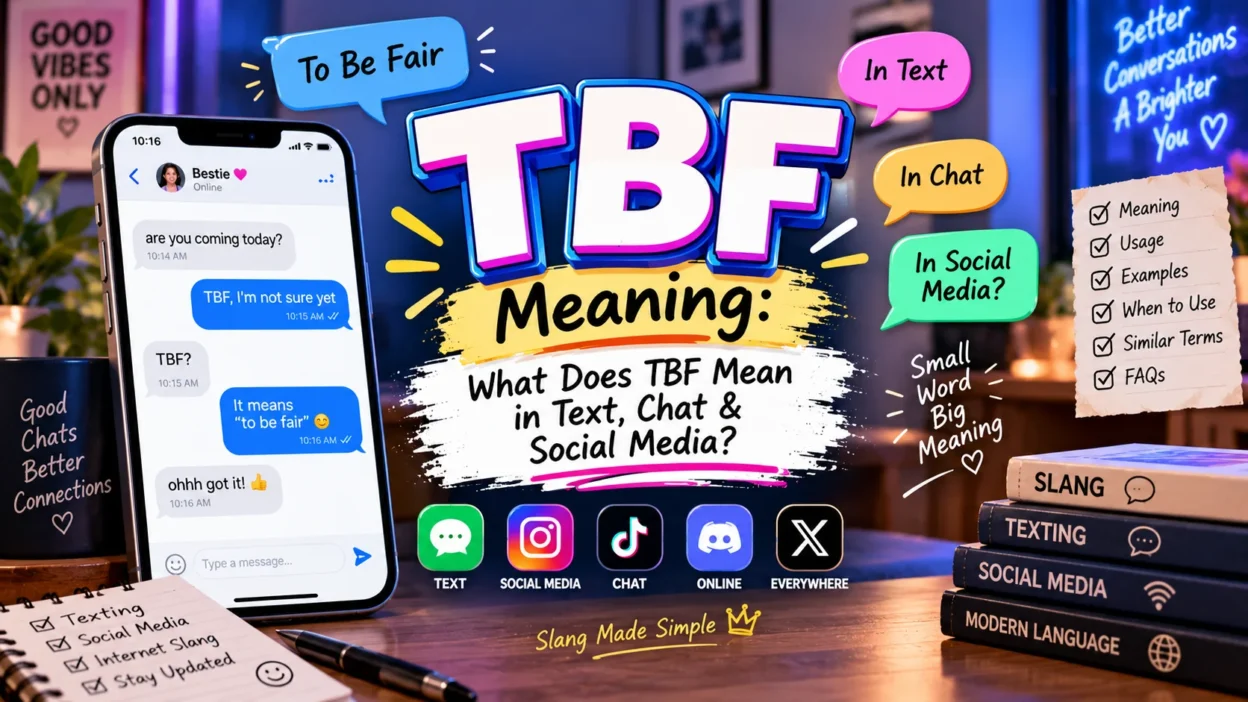
If you have seen TBF in a text message, comment, social media post, or online conversation, you may be wondering what it means. In most casual conversations, TBF means “to be fair.” People use it when they want to add another side to an argument, acknowledge a reasonable point, or make their statement sound more balanced.
For example, someone might say, “TBF, she did warn us.” Here, TBF means “to be fair,” and the speaker is acknowledging something that supports the other person’s position.
TBF is common because it lets people make a quick clarification without typing the entire phrase. You may see it at the beginning, middle, or end of a sentence. Its meaning usually stays the same, although the tone can range from sincere and thoughtful to playful or sarcastic.
What Does TBF Mean?
TBF most commonly means “to be fair.”
People use it when they want to recognize an opposing point, provide additional context, or make a judgment seem more balanced.
| TBF | Full Form | Common Use |
|---|---|---|
| TBF | To Be Fair | Texting and casual conversation |
| TBF, … | To be fair, … | Adding another perspective |
| … TBF | … to be fair | Qualifying a statement |
| TBF though | To be fair, though | Informal disagreement or clarification |
Simple Example
“TBF, the movie wasn’t that bad.”
Meaning:
“To be fair, the movie wasn’t that bad.”
The speaker is adding a more balanced opinion.
TBF Meaning in Text
In texting, TBF is usually shorthand for “to be fair.”
It allows people to express a thought quickly without writing the complete phrase.
For example:
Friend: I can’t believe Jake was late again.
You: TBF, the traffic was terrible.
Here, you aren’t necessarily defending Jake completely. You’re simply pointing out another factor that should be considered.
TBF Meaning on Social Media
On social media, people frequently use TBF when responding to opinions, discussions, reviews, and debates.
Examples include:
- “TBF, this is actually a good idea.”
- “TBF, they played really well.”
- “I didn’t like the ending, but TBF, the story was interesting.”
- “TBF though, nobody expected them to win.”
On platforms where users prefer short comments, TBF works as a convenient way to introduce a different perspective.
What Does TBF Stand For?
In everyday internet language, TBF stands for “to be fair.”
The phrase has a simple purpose: it signals that the speaker is about to recognize something reasonable or add context to what they have already said.
For example:
“I don’t like the restaurant. TBF, the service was excellent.”
The speaker still dislikes the restaurant but acknowledges that the service deserves credit.
How Is TBF Used in a Sentence?
TBF can appear in several positions.
At the Beginning
“TBF, I didn’t give it a proper chance.”
This is one of the most common uses.
In the Middle
“The game was difficult, but TBF, we didn’t practice enough.”
Here, TBF introduces an explanation.
At the End
“He made a good point, TBF.”
This style is especially common in casual online conversations.
| Position | Example |
|---|---|
| Beginning | TBF, she had a good reason. |
| Middle | It was expensive, but TBF, the quality was excellent. |
| End | The result wasn’t bad, TBF. |
TBF Meaning in a Conversation
TBF often helps make a conversation more balanced.
Imagine someone says:
“The teacher gave us way too much homework.”
Another person might respond:
“TBF, we had two weeks to finish it.”
The second person isn’t necessarily saying the first person is completely wrong. They are simply adding another fact to the discussion.
This is one reason TBF is so useful in online conversations.
TBF Meaning in Arguments
During an argument or disagreement, TBF can soften a response.
For example:
“I don’t agree with her decision. TBF, I understand why she made it.”
The speaker maintains their original opinion while recognizing the other side.
This makes TBF useful for:
- Disagreements
- Debates
- Reviews
- Discussions
- Opinions
- Explanations
- Social media arguments
TBF as a Way to Acknowledge Another Side
One of the most useful aspects of TBF is that it signals acknowledgment.
For example:
“He wasn’t very friendly. TBF, he had just started working there.”
The first sentence expresses criticism. The second part gives context.
This makes the statement more nuanced rather than completely one-sided.
TBF Meaning in a Positive Context
TBF doesn’t have to introduce criticism or disagreement.
You can use it to give someone credit.
For example:
“TBF, she did an amazing job on the project.”
Here, the speaker is acknowledging something positive.
Another example:
“TBF, that was probably the best performance of the night.”
The abbreviation simply introduces a fair assessment.
TBF Meaning in a Negative Context
TBF can also introduce criticism or an unfavorable observation.
For example:
“TBF, the service wasn’t very good.”
The speaker may be acknowledging that the service was poor while discussing a larger situation.
The abbreviation itself isn’t positive or negative. The rest of the sentence determines the tone.
TBF Meaning in a Sarcastic Way
Sometimes people use TBF sarcastically, particularly on social media.
For example:
“TBF, arriving three hours late is definitely one way to make an entrance.”
The phrase appears reasonable on the surface, but the speaker may actually be joking about the situation.
Context, punctuation, emojis, and the relationship between the people involved can help reveal whether TBF is sincere or sarcastic.
TBF vs. TBH
TBF and TBH are easy to confuse because both appear frequently in texting.
| Abbreviation | Meaning | Main Purpose |
|---|---|---|
| TBF | To Be Fair | Adds balance or another perspective |
| TBH | To Be Honest | Introduces a candid opinion |
| IMO | In My Opinion | States a personal opinion |
| IMHO | In My Humble Opinion | Gives a personal opinion |
| FWIW | For What It’s Worth | Adds information or an opinion |
Example
TBF:
“TBF, he had a good reason.”
Meaning: The speaker is being fair and acknowledging another factor.
TBH:
“TBH, I didn’t like the movie.”
Meaning: The speaker is giving an honest opinion.
TBF vs. IMO
IMO means “in my opinion.”
It tells the reader that what follows represents the speaker’s personal view.
TBF, on the other hand, usually introduces a balancing point.
Compare:
“IMO, the first movie was better.”
versus:
“TBF, the second movie had better effects.”
The first expresses an opinion. The second acknowledges another side.
TBF vs. FWIW
FWIW means “for what it’s worth.”
People use it when they want to offer information or an opinion that may or may not be useful.
TBF focuses more specifically on fairness or balance.
For example:
“FWIW, I liked the original version.”
“TBF, the remake improved the special effects.”
Both can add context, but they serve different purposes.
Common TBF Examples
Here are some natural examples of how people use TBF:
- TBF, she had a valid reason.
- TBF, I didn’t explain it very well.
- The restaurant was expensive, but TBF, the food was excellent.
- TBF, he did warn everyone beforehand.
- I didn’t like the game, but TBF, the graphics were impressive.
- TBF, they played better in the second half.
- He’s sometimes difficult to work with, TBF.
- TBF though, nobody expected that result.
- The movie was long, but TBF, it was entertaining.
- TBF, you were right about that.
TBF Meaning in Different Contexts
| Context | Meaning | Example |
|---|---|---|
| Texting | To be fair | TBF, you’re right. |
| Social media | To be fair | TBF, this isn’t bad. |
| Gaming | To be fair | TBF, they had better equipment. |
| Group chat | To be fair | TBF, we were late too. |
| Debate | To be fair | TBF, both sides have a point. |
| Reviews | To be fair | TBF, the service was good. |
| Casual conversation | To be fair | TBF, I understand. |
Is TBF Formal or Informal?
TBF is informal.
It works well in:
- Text messages
- Group chats
- Social media
- Online forums
- Gaming chats
- Casual conversations
It is generally not appropriate for formal documents or professional writing.
Instead of writing:
“TBF, the report had some problems.”
a professional version could say:
“To be fair, the report had some limitations.”
Or you could simply state the relevant point directly.
How to Respond to TBF
You don’t need a special response when someone uses TBF.
If you agree, you might say:
- “That’s fair.”
- “Good point.”
- “You’re right.”
- “I agree.”
- “That’s true.”
If you disagree, you can explain your perspective:
“I see your point, but I still think the decision was unfair.”
This keeps the conversation constructive.
Is TBF the Same as “To Be Fair”?
Yes. In texting and social media, TBF is simply an abbreviated form of “to be fair.”
The abbreviation doesn’t normally change the meaning.
“TBF, he tried.”
and
“To be fair, he tried.”
communicate essentially the same idea. The difference is mainly the level of formality.
Other Meanings of TBF
Although “to be fair” is by far the most common meaning in texting and social media, abbreviations can have different meanings in specialized settings.
Depending on the industry or context, TBF can represent other phrases or organizations. If you encounter TBF outside casual communication, check the surrounding context before assuming it means “to be fair.”
For everyday texting, however, TBF = To Be Fair is the meaning you will most likely encounter.
Frequently Asked Questions
What does TBF mean in text?
TBF means “to be fair” in most text messages. People use it to acknowledge another perspective or add balance to a statement.
What does TBF mean on social media?
On social media, TBF usually means “to be fair.” Users often put it at the beginning or end of a comment when they want to recognize another side of an argument.
What does TBF stand for?
TBF most commonly stands for “to be fair.”
Is TBF a slang word?
TBF is best described as an informal internet and texting abbreviation. It is common in casual digital communication.
What does “TBF though” mean?
“TBF though” means “to be fair, though.” Someone usually uses it to add a balancing point or challenge an earlier statement.
Is TBF rude?
No. TBF is not inherently rude. It can actually make a disagreement sound more balanced, although someone’s tone can make any phrase sound sarcastic or dismissive.
What is the difference between TBF and TBH?
TBF = To Be Fair.
TBH = To Be Honest.
TBF introduces a balancing point, while TBH usually introduces a candid opinion.
What is the difference between TBF and IMO?
TBF means “to be fair,” while IMO means “in my opinion.” TBF acknowledges another perspective, while IMO identifies a personal opinion.
Can TBF be used professionally?
You may see TBF in casual workplace chats, but it is better to write “to be fair” in formal emails, reports, and professional documents.
Conclusion
The most common TBF meaning is “to be fair.” People use this abbreviation in texts, chats, social media posts, gaming conversations, and online discussions when they want to acknowledge another perspective or make a statement more balanced.
TBF can appear at the beginning, middle, or end of a sentence. It can introduce a positive observation, provide context for criticism, soften a disagreement, or simply recognize that another person has a valid point.
The abbreviation is closely related to other internet expressions such as TBH, IMO, and FWIW, but each serves a different purpose. TBF specifically focuses on fairness and balance.
In short, when you see “TBF” in a casual message, it usually means “to be fair.” Understanding the surrounding conversation will help you determine exactly what the person is trying to acknowledge or explain.

Lillian Hayes is a content writer focused on explaining meanings and language in a simple and clear way. She creates easy-to-understand content that helps readers learn and communicate better.