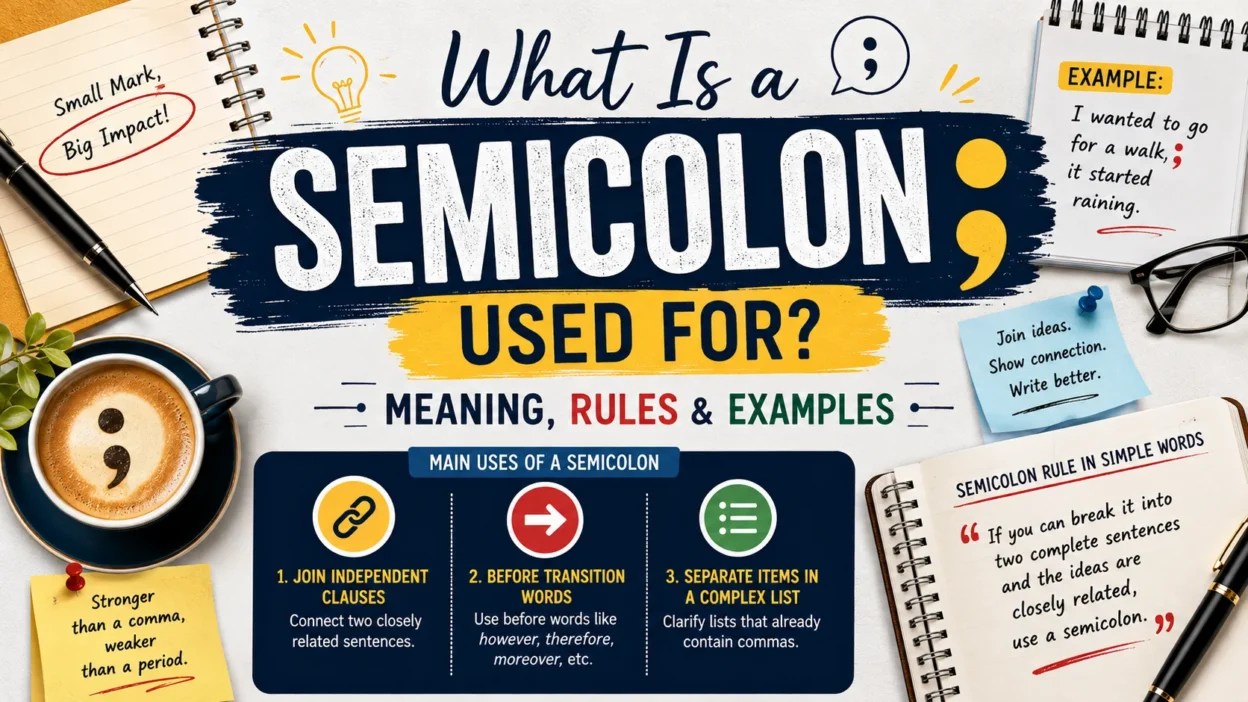
The semicolon (;) is one of the most useful punctuation marks in English, but it can sometimes be confusing to use correctly. It looks like a combination of a comma and a period, and its function falls somewhere between the two. A semicolon can connect closely related ideas, separate independent clauses, and make complicated lists easier to read.
Understanding what a semicolon is used for can help you write clearer and more polished sentences. The most common use is to connect two independent clauses that are closely related in meaning. A semicolon can also appear before transitional words such as however, therefore, moreover, and nevertheless.
Another important use is separating items in a list when those items already contain commas. This prevents confusion and helps readers understand exactly where each item begins and ends.
In this guide, you will learn the main semicolon rules, when to use a semicolon, when not to use one, examples, common mistakes, and the difference between semicolons, commas, colons, and periods.
What Is a Semicolon?
A semicolon (;) is a punctuation mark used to connect closely related ideas or separate complicated items in a series.
The symbol combines the appearance of a period and a comma:
;
A semicolon has two major functions:
- Connecting closely related independent clauses
- Separating items in a complex list
For example, consider this sentence:
I wanted to go for a walk; it started raining.
Both parts are complete thoughts:
- I wanted to go for a walk.
- It started raining.
The semicolon connects them because they are closely related.
What Is a Semicolon Used For?
A semicolon is mainly used when two ideas are closely connected but could also stand as separate sentences.
The most common uses are:
- Joining two independent clauses
- Connecting related thoughts
- Appearing before transitional words
- Separating complicated list items
- Preventing confusion caused by multiple commas
- Improving sentence flow in formal writing
The important thing to remember is that a semicolon is not simply a stronger version of a comma. It has specific grammatical purposes.
Semicolon Rule #1: Join Two Independent Clauses
The most common use of a semicolon is to join two independent clauses.
An independent clause contains a subject and a verb and can stand alone as a complete sentence.
Examples
She studied all night; she passed the exam.
The store was closed; we went somewhere else.
I finished my work; I went home.
He loves reading; his sister prefers movies.
The weather was beautiful; we decided to have a picnic.
In each example, both sides of the semicolon could be complete sentences.
For example:
She studied all night.
She passed the exam.
Because the two thoughts are closely related, they can be joined with a semicolon.
Semicolon Rule #2: Connect Closely Related Ideas
A semicolon is useful when two complete ideas have a clear relationship.
Consider:
The weather was terrible; we canceled the picnic.
The first idea explains the situation, while the second shows what happened as a result.
Other examples include:
I forgot my umbrella; it started raining.
Sarah loves traveling; she visits a new country every year.
The movie was sold out; we watched something else.
He missed the bus; he arrived late.
The project was difficult; the team completed it successfully.
The semicolon keeps the related ideas together without requiring a conjunction.
Semicolon Rule #3: Use a Semicolon Before Transitional Words
Semicolons are commonly used before transitional words and phrases.
Some common transitional words include:
- however
- therefore
- moreover
- nevertheless
- consequently
- furthermore
- instead
- meanwhile
- otherwise
- in addition
The basic structure is:
Independent clause; transitional word, independent clause.
Examples With However
I wanted to attend the event; however, I was unavailable.
The product is expensive; however, it offers excellent quality.
She was tired; however, she continued working.
Examples With Therefore
The road was blocked; therefore, we took another route.
He missed the deadline; therefore, the application was rejected.
The weather was dangerous; therefore, the event was canceled.
Examples With Nevertheless
The journey was difficult; nevertheless, we enjoyed it.
The task took longer than expected; nevertheless, the team finished it.
Remember that a comma usually follows the transitional word.
Correct:
The task was difficult; however, we completed it.
Semicolon Rule #4: Separate Items in a Complex List
Another important use of semicolons is separating items in a list when those items already contain commas.
For a simple list, commas are normally enough:
I bought apples, oranges, bananas, and grapes.
However, a more complicated list can become difficult to read.
For example, consider a list of cities and states:
We visited Dallas, Texas; Phoenix, Arizona; Miami, Florida; and Seattle, Washington.
The semicolons make the individual locations easier to distinguish.
More Examples
The conference included speakers from Austin, Texas; Chicago, Illinois; Denver, Colorado; and Portland, Oregon.
Our customers came from Toronto, Canada; London, England; Sydney, Australia; and Paris, France.
The company has offices in Boston, Massachusetts; New York, New York; Atlanta, Georgia; and Dallas, Texas.
Semicolon Rule #5: Separate Detailed List Items
Semicolons can also organize list items that contain additional descriptions.
For example:
The project requires three things: a detailed plan, which should be completed first; a realistic budget, which should include unexpected expenses; and a timeline, which should identify important deadlines.
Each major item contains additional information and commas. The semicolons create clear boundaries between the items.
Semicolon vs Comma
One of the most common punctuation questions is whether to use a semicolon or a comma.
A comma generally cannot join two independent clauses by itself.
Incorrect:
I was tired, I continued working.
This is known as a comma splice.
There are several ways to correct it.
Using a semicolon:
I was tired; I continued working.
Using a conjunction:
I was tired, but I continued working.
Using a period:
I was tired. I continued working.
The semicolon is useful when you want to keep the two related thoughts together.
Semicolon vs Period
Both semicolons and periods can separate independent clauses, but they create different effects.
Using a period:
The movie ended. We went home.
Using a semicolon:
The movie ended; we went home.
The period creates a stronger break between the ideas.
The semicolon indicates that the ideas are closely connected.
This is why semicolons can be useful when two sentences feel related but you do not want to use a coordinating conjunction.
Semicolon vs Colon
A semicolon and colon have different functions.
A semicolon commonly connects related independent clauses:
I had one goal; I wanted to finish the project.
A colon commonly introduces an explanation, list, example, or clarification:
I had one goal: to finish the project.
Another example:
She packed everything she needed: food, water, clothing, and a flashlight.
The colon introduces the list, while the semicolon would not normally be appropriate in this structure.
Semicolon vs Comma With Conjunctions
Coordinating conjunctions include:
- and
- but
- or
- so
- for
- nor
- yet
When two independent clauses are joined with one of these conjunctions, a comma is normally used.
I wanted to go, but I was too tired.
She studied hard, and she passed the exam.
We could stay home, or we could go out.
A semicolon can connect the clauses without the conjunction:
I wanted to go; I was too tired.
She studied hard; she passed the exam.
However, a semicolon is generally unnecessary before a simple coordinating conjunction.
How Do You Know When to Use a Semicolon?
You can use a simple three-step test.
Step 1: Check the First Part
Ask whether the first part can stand alone as a complete sentence.
Step 2: Check the Second Part
Ask whether the second part can also stand alone as a complete sentence.
Step 3: Check the Relationship
If both are complete sentences and the ideas are closely related, a semicolon may be appropriate.
For example:
The store was closing; we hurried inside.
Both parts can stand alone:
The store was closing.
We hurried inside.
The relationship between the two ideas is clear, so the semicolon works well.
When Should You Not Use a Semicolon?
A semicolon has specific grammatical rules. It should not be used simply because you want a longer pause.
Do Not Separate a Subject and Verb
Incorrect:
My favorite hobbies; are reading and hiking.
Correct:
My favorite hobbies are reading and hiking.
A semicolon should not separate a subject from its verb.
Do Not Separate a Verb and Its Object
Incorrect:
She bought; a new laptop.
Correct:
She bought a new laptop.
The verb and its object should remain together.
Do Not Use a Semicolon Before a Dependent Clause
Incorrect:
I stayed home; because I was sick.
Correct:
I stayed home because I was sick.
The phrase because I was sick is a dependent clause, so a semicolon is not appropriate.
Do Not Use a Semicolon for Every Pause
A semicolon is not simply a replacement for a comma.
Before using one, check the grammatical structure of both sides.
Common Semicolon Mistakes
Mistake 1: Creating a Comma Splice
Incorrect:
The restaurant was crowded, we decided to leave.
Correct:
The restaurant was crowded; we decided to leave.
Or:
The restaurant was crowded, so we decided to leave.
Mistake 2: Using a Semicolon Before Because
Incorrect:
She went home; because she was tired.
Correct:
She went home because she was tired.
Mistake 3: Forgetting the Comma After However
Incorrect:
The task was difficult; however we finished it.
Correct:
The task was difficult; however, we finished it.
Mistake 4: Using a Semicolon Instead of a Colon
Incorrect:
I need three things; milk, bread, and eggs.
Correct:
I need three things: milk, bread, and eggs.
The colon introduces the list.
Mistake 5: Overusing Semicolons
Using too many semicolons can make writing feel unnecessarily complicated.
Instead of connecting every thought with semicolons, use a combination of periods, commas, conjunctions, and other punctuation marks.
Semicolon Examples
Here are some simple examples of correct semicolon usage.
Connecting Related Ideas
The sun was setting; the sky turned orange.
Showing Cause and Result
He missed the bus; he arrived late.
Showing Contrast
She loves summer; her brother prefers winter.
Connecting Actions
I finished my homework; I watched television.
Before However
The project was challenging; however, we completed it on time.
Before Therefore
The store was closed; therefore, we ordered online.
Complex List
Our guests came from Dallas, Texas; Phoenix, Arizona; and Orlando, Florida.
Semicolon Examples in Academic Writing
Semicolons are often useful in academic and formal writing because they allow writers to connect complex ideas clearly.
Examples:
The results were encouraging; however, additional research is needed.
The first experiment produced inconsistent results; the second produced more reliable data.
Several factors influenced the outcome; cost, timing, and available resources were particularly important.
When used correctly, semicolons can make formal writing more organized and readable.
Semicolon Examples in Everyday Writing
You do not need to be writing an academic paper to use a semicolon.
Everyday examples include:
I need to leave soon; my train arrives at six.
It’s getting late; let’s go home.
I called her; she didn’t answer.
We wanted to eat outside; it was too cold.
He forgot his wallet; I paid for lunch.
These examples show how a semicolon can connect two short but related thoughts.
Semicolon Examples in Professional Writing
Semicolons can also be useful in emails, reports, business documents, and workplace communication.
Examples:
The report is almost complete; we only need to review the final section.
The meeting has been moved to Friday; please update your calendar.
The client approved the proposal; the development team can begin work.
The deadline is approaching; all remaining tasks should be completed this week.
Semicolon Examples With However
However is one of the most common transitional words used with semicolons.
Examples:
I wanted to attend; however, I was unavailable.
The hotel was expensive; however, it was worth the price.
She had little experience; however, she learned quickly.
The weather was poor; however, the event continued.
The pattern is:
Independent clause; however, independent clause.
Semicolon Examples With Therefore
Therefore indicates a result or conclusion.
Examples:
The road was closed; therefore, we took another route.
He missed the deadline; therefore, his application was delayed.
The weather was dangerous; therefore, the event was canceled.
The store was closed; therefore, we ordered online.
Semicolon Examples With Nevertheless
Nevertheless introduces a contrast or unexpected result.
Examples:
The journey was difficult; nevertheless, we enjoyed it.
The weather was cold; nevertheless, they continued playing.
The task was challenging; nevertheless, the team completed it.
Semicolon Examples With Moreover
Moreover adds another related point.
Examples:
The hotel was affordable; moreover, it was close to the beach.
She is highly experienced; moreover, she communicates clearly.
The plan saves time; moreover, it reduces costs.
Semicolons in Complex Comparisons
A semicolon can clearly connect two contrasting or comparable ideas.
Examples:
Some people prefer working early; others are more productive at night.
One option is cheaper; the other offers better quality.
Sarah enjoys city life; her brother prefers the countryside.
The first method is faster; the second is more accurate.
Semicolons in Long Sentences
Semicolons can improve readability when a sentence contains two major independent ideas.
For example:
The first phase of the project focused on research and planning; the second phase focused on testing and implementation.
Another example:
The company wanted to expand into new markets; the management team first needed to understand customer demand.
The semicolon creates a clear boundary without completely separating the ideas.
When Are Semicolons Necessary in a List?
Semicolons are not necessary for every list.
Simple List
Use commas for a simple list:
I bought apples, oranges, bananas, and grapes.
Complex List
Use semicolons when the items themselves contain commas:
The winners came from Austin, Texas; Miami, Florida; Seattle, Washington; and Boston, Massachusetts.
This makes the structure much easier to understand.
How Semicolons Improve Writing
When used correctly, semicolons can make writing:
- Clearer
- More organized
- More polished
- More sophisticated
- Easier to follow
- Better suited to complex ideas
However, good writing does not require frequent semicolon use. The goal is clarity, not complexity.
Easy Way to Remember the Semicolon
A simple way to remember the semicolon is:
A semicolon connects two complete thoughts that are closely related.
For example:
I was hungry; I made dinner.
Both sides can stand alone, but the ideas naturally belong together.
If the ideas are not closely connected, a period may be better:
I was hungry. The movie was interesting.
The two sentences are grammatically complete, but their relationship is weak, so a semicolon would not add much value.
Semicolon Rules at a Glance
| Rule | Example |
|---|---|
| Join two independent clauses | I was tired; I kept working. |
| Connect related ideas | She loves music; he loves art. |
| Use before transitional words | It was difficult; however, we succeeded. |
| Separate complex list items | Paris, France; Rome, Italy; Madrid, Spain |
| Do not separate subject and verb | The team is ready. |
| Do not separate verb and object | She bought a book. |
| Do not use before a dependent clause | I left because I was tired. |
| Do not use it as a simple comma | Avoid comma splices. |
Semicolon and Sentence Flow
A semicolon can create a smoother connection between ideas, but it should not be used to make every sentence longer.
For example, this sentence contains too many semicolons:
I woke up early; I made breakfast; I answered emails; I went to work; I attended a meeting; I came home.
A clearer version would be:
I woke up early and made breakfast. Then I answered emails and went to work. After a meeting, I came home.
Using different punctuation creates more natural rhythm.
Frequently Asked Questions
What Is a Semicolon Used For?
A semicolon is mainly used to connect two closely related independent clauses or separate complicated items in a list.
What Is the Main Purpose of a Semicolon?
Its main purpose is to connect complete thoughts that are closely related while keeping them in the same sentence.
Can a Semicolon Replace a Comma?
Not generally. A semicolon has specific grammatical functions and should not simply replace a comma.
Can a Semicolon Connect Two Sentences?
Yes. A semicolon can connect two independent clauses when their ideas are closely related.
Can I Use a Semicolon Before And?
When and connects two independent clauses, a comma is normally used:
I wanted to go, and she wanted to stay.
A semicolon can be used without the conjunction:
I wanted to go; she wanted to stay.
Do You Capitalize After a Semicolon?
Normally, no. The word after a semicolon usually begins with a lowercase letter unless it is a proper noun.
Correct:
I was tired; however, I continued working.
Do You Put a Comma After a Semicolon?
Not automatically. However, transitional words such as however and therefore are normally followed by a comma.
Example:
She was tired; however, she continued working.
What Is the Difference Between a Semicolon and a Colon?
A semicolon connects closely related clauses or separates complex list items. A colon usually introduces a list, explanation, example, or clarification.
Can a Semicolon Separate Items in a List?
Yes. Semicolons are particularly useful when individual list items already contain commas.
Is a Semicolon Stronger Than a Comma?
Yes. A semicolon creates a stronger separation than a comma while still showing a connection between the ideas.
Is a Semicolon Stronger Than a Period?
No. A period generally creates a complete separation, while a semicolon keeps closely related ideas connected.
Can a Semicolon Connect a Dependent Clause?
No. A semicolon should generally connect two independent clauses rather than an independent clause and a dependent clause.
What Punctuation Is Similar to a Semicolon?
Commas, periods, and colons are all related punctuation marks, but they serve different grammatical purposes.
Conclusion
So, what is a semicolon used for? The semicolon is mainly used to connect two closely related independent clauses and to separate complicated items in a list. It provides a stronger separation than a comma while keeping related ideas connected.
The easiest rule to remember is simple: if both sides of the semicolon can stand alone as complete sentences and the ideas are closely related, a semicolon may be appropriate.
Semicolons are also commonly used before transitional words such as however, therefore, moreover, and nevertheless, with a comma following the transitional word. In complicated lists, they help readers distinguish between individual items.
Once you understand these basic rules, semicolons become much easier to use. The goal is not to use them as often as possible, but to use them when they make your writing clearer, smoother, and easier to understand.

Lillian Hayes is a content writer focused on explaining meanings and language in a simple and clear way. She creates easy-to-understand content that helps readers learn and communicate better.