
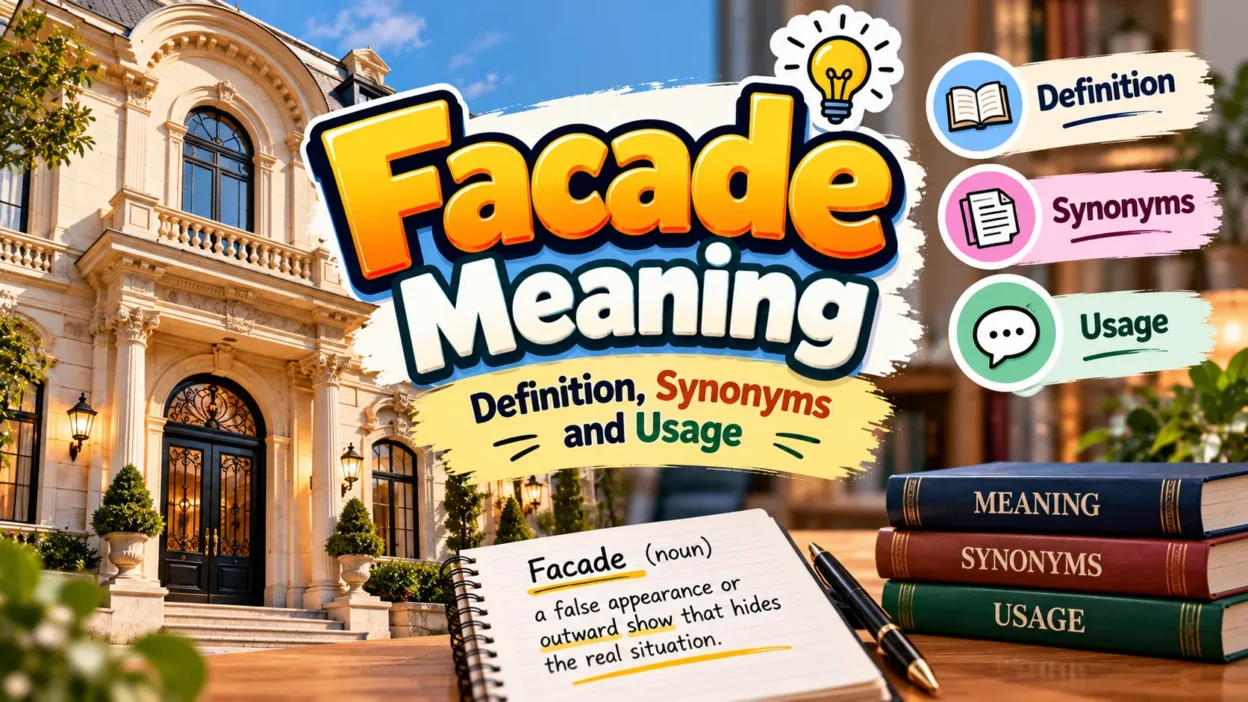
Have you ever heard someone describe a person’s smile as a facade or say that a business is hiding behind a facade? The word facade can describe the outside of a building, but it also has a deeper meaning in everyday English. It often refers to an appearance that hides someone’s real feelings, intentions, or situation.
Understanding the facade meaning helps you recognize the word in conversations, books, movies, news articles, and social media posts. Although it may sound like a complicated vocabulary word, its meaning becomes simple when you look at a few practical examples.
In this guide, you will learn the definition of facade, how to pronounce it, its synonyms and antonyms, common expressions, and how to use it correctly in sentences.
📖 What Does Facade Mean?
The word facade has two main meanings. Literally, it refers to the front or exterior face of a building, especially one designed to look attractive or impressive. Figuratively, it describes an outward appearance that hides what is really happening underneath.
For example, an old building may have a beautiful facade even if its interior needs repairs. Similarly, a person may maintain a cheerful facade while feeling sad or anxious inside.
Here are the two meanings at a glance:
- Literal meaning: The front exterior of a building.
- Figurative meaning: An appearance or behavior that conceals the truth.
- Simple explanation: Something that people see on the outside that may not show the complete reality.
Example: “Behind his confident facade, he was afraid of failing.”
In this sentence, the person appears confident, but his outward behavior hides his fear.
🗣️ How Do You Pronounce Facade?
The word facade is commonly pronounced fuh-SAHD or fuh-SAHDH, with the emphasis on the second syllable.
Its pronunciation can be represented as:
- Syllables: fa-cade
- Phonetic spelling: fə-SAH D
- IPA: /fəˈsɑːd/ in common American English pronunciation
The final letters are not pronounced like the English word “made.” Instead, the word ends with a sound similar to “sod” in some accents.
Example: “The hotel’s facade was decorated with beautiful stonework.”
Learning the pronunciation makes it easier to use the word naturally in conversations.
🏛️ What Is the Literal Meaning of Facade?
In architecture, a facade is the exterior face of a building, particularly the front that people see from the street. Architects and designers often pay special attention to a building’s facade because it contributes to its appearance and character.
A facade may include windows, doors, decorative stone, columns, glass panels, or other architectural details.
Examples include:
- The museum has a grand marble facade.
- Workers restored the historic building’s brick facade.
- The hotel’s glass facade reflects the sunlight.
- The church features a beautifully carved stone facade.
- The modern office building has a minimalist facade.
In this context, the word is neutral. It does not suggest that anything is dishonest or misleading. It simply describes a building’s exterior.
🎭 What Is the Figurative Meaning of Facade?
In everyday language, facade often describes a false or misleading appearance that hides the truth. People may use a facade to conceal their emotions, personal struggles, weaknesses, or intentions.
For instance, someone might act as though everything is perfect even when they are dealing with serious problems. Their behavior creates an outward impression that does not match their private reality.
Consider these examples:
- A facade of happiness: Someone smiles in public while feeling unhappy inside.
- A facade of confidence: A person acts fearless despite feeling nervous.
- A facade of success: Someone presents a successful image while struggling financially.
- A facade of friendship: Someone appears supportive but secretly acts against another person.
- A facade of normality: A family behaves as though everything is fine while facing serious difficulties.
Example: “The company maintained a facade of stability despite its financial problems.”
This sentence means the company appeared stable, but the reality was different.
💡 Facade Meaning in Simple Words
In simple words, a facade is an outside appearance that may hide the truth. When used figuratively, it often suggests that something is not as it seems.
Imagine a person who constantly posts cheerful pictures online but privately feels lonely. Their online image may be described as a facade if it hides their actual emotional experience.
Here are a few easy examples:
- “His smile was a facade.” — He was not genuinely happy.
- “She dropped her facade.” — She stopped pretending and showed her true feelings.
- “Their perfect relationship was a facade.” — The relationship was not as happy as it appeared.
- “The house has an elegant facade.” — The outside of the house looks elegant.
Remember that the context determines the meaning. A facade can be a real architectural feature or a figurative image that conceals reality.
✍️ Facade Meaning in a Sentence
Reading the word in different sentences is one of the easiest ways to understand its usage. The following examples show how facade works in both literal and figurative contexts.
Examples of facade in sentences:
- The historic building has a beautiful stone facade.
- She maintained a calm facade during the difficult meeting.
- His cheerful facade concealed his disappointment.
- The company’s professional facade hid serious internal problems.
- The mansion’s facade was restored to preserve its original design.
- He finally abandoned his facade and admitted that he needed help.
- Their public image was only a facade.
- The architect designed a modern facade for the new library.
- Behind her confident facade, she worried about the future.
- The politician struggled to maintain a facade of control.
- The shop’s colorful facade attracted the attention of passersby.
- His friendly facade disappeared when the negotiations became difficult.
These examples demonstrate that the word often appears with verbs such as maintain, hide, drop, create, and abandon.
❤️ Facade Meaning in Relationships
In relationships, a facade is an outward image that hides a person’s genuine emotions or the actual condition of a relationship. Someone may pretend to be satisfied, confident, or unaffected to avoid conflict or protect their reputation.
For example, a couple might appear happy in public while struggling to communicate privately. Their public image could be described as a facade if it conceals the problems they are experiencing.
Common relationship examples include:
- A facade of happiness: Pretending to be happy in a relationship.
- A facade of indifference: Acting as though you do not care when you actually do.
- A facade of trust: Behaving as if trust exists when doubts remain.
- A facade of perfection: Trying to make a relationship appear flawless.
- A facade of emotional strength: Hiding hurt or vulnerability from a partner.
Example: “He kept up a facade of indifference, but he still cared about her.”
The sentence suggests that his outward behavior did not reflect his real feelings.
However, not every private emotion is a facade. People can choose to keep personal matters private without deliberately misleading anyone.
🧠 Facade Meaning in Psychology
In discussions of psychology and human behavior, facade can describe the image someone presents to other people to hide vulnerability, insecurity, or uncomfortable emotions.
A person might appear confident because they fear being judged if they show uncertainty. Another person might use humor to avoid discussing something painful.
For example:
“Her outgoing facade made it difficult for others to recognize her loneliness.”
This means that her social behavior concealed how she felt internally.
A facade is not a formal psychological diagnosis. It is an everyday word used to describe a difference between outward presentation and inner experience.
People may manage their public image for many reasons, including privacy, social expectations, fear of rejection, or a desire to fit in. The word is most appropriate when the outward image significantly differs from the reality it conceals.
💼 Facade Meaning in Business
In business, a facade can refer to either the exterior of a commercial building or an appearance that hides an organization’s real condition.
For example, a company may appear financially healthy to outsiders while privately facing debt, declining sales, or management difficulties. In that situation, its image of success could be described as a facade.
Common business expressions include:
- A facade of success: An appearance of achievement that hides underlying problems.
- A facade of professionalism: A polished public image that may not reflect internal practices.
- A facade of stability: An appearance that a business is secure when it is facing serious risks.
- A corporate facade: The image a company presents to customers, investors, or the public.
Example: “The startup’s impressive public image was a facade for its growing financial difficulties.”
This sentence suggests that the public image did not reflect the company’s actual circumstances.
The word can sound critical in business writing because it often implies that someone is deliberately creating a misleading impression.
📱 Facade Meaning in Text and Social Media
On social media, facade often describes a carefully created online image that does not show the full reality of someone’s life.
People usually share selected moments, attractive pictures, achievements, and happy experiences. This is not automatically a facade because everyone has the right to choose what they share. The term becomes more appropriate when an image is intentionally used to hide a significantly different reality.
Examples include:
- “Social media can make happiness look like a facade.”
- “His luxury lifestyle was just a facade.”
- “She stopped pretending and let her facade fall.”
- “Their perfect online life was a facade.”
In these examples, the word suggests that the public image may not represent the whole truth.
When you encounter facade in a post or message, consider the context. The writer may be discussing appearances, emotional honesty, deception, or the difference between public and private life.
🔍 Synonyms of Facade
Synonyms are words with similar meanings. The best synonym for facade depends on whether you are discussing a building or a misleading appearance.
Synonyms for the figurative meaning:
- Appearance: The way something looks to others.
- Front: A public image that hides the truth.
- Pretense: Behavior intended to make others believe something that is not true.
- False image: An impression that does not reflect reality.
- Mask: Something that conceals genuine feelings or intentions.
- Show: An outward display that may be artificial.
- Disguise: Something that hides the real nature of a person or situation.
- Illusion: An impression that differs from reality.
- Cover: Something used to conceal another thing.
- Act: Behavior that is performed rather than genuine.
Synonyms for the architectural meaning:
- Exterior
- Front
- Frontage
- Face
- Outside
These words are not always interchangeable. For example, exterior is suitable for a building, while pretense is often a better choice when discussing dishonest behavior.
⚖️ Antonyms of Facade
Antonyms are words with opposite or contrasting meanings. When facade refers to a false appearance, its antonyms emphasize honesty, authenticity, or reality.
Useful antonyms include:
- Reality: The actual state of things.
- Truth: What is genuine or factually correct.
- Authenticity: The quality of being real or genuine.
- Sincerity: Honesty in feelings, words, or actions.
- Transparency: Openness about information, intentions, or circumstances.
- Genuineness: The quality of being sincere and real.
- Candor: Honest and direct expression.
- Truthfulness: The quality of being truthful.
Example: “Instead of maintaining a facade of confidence, she spoke with honesty and sincerity.”
The contrast highlights the difference between hiding feelings and expressing them openly.
These antonyms are most relevant to the figurative meaning. They do not necessarily serve as opposites when facade describes the front of a building.
📝 Facade vs. Front: What Is the Difference?
The words facade and front can have similar meanings, but they are not always used in the same way.
A front is the forward-facing part of something. In figurative language, it can also mean a false appearance designed to hide the truth.
A facade is the exterior face of a building or, figuratively, an outward appearance that conceals reality.
Examples:
- “The front of the house faces the garden.” — This describes the house’s orientation.
- “The facade of the house features decorative columns.” — This describes its exterior design.
- “He put on a friendly front.” — He acted friendly, possibly despite feeling differently.
- “He maintained a facade of friendliness.” — His outward friendliness may have concealed his actual attitude.
In figurative use, both words can suggest concealment. However, facade often sounds more formal or emphasizes a carefully maintained appearance.
🎭 Facade vs. Mask: What Is the Difference?
Both facade and mask can describe something that hides a person’s true feelings or identity.
A facade usually refers to an outward image or appearance that conceals the reality underneath. A mask often emphasizes hiding emotions, personality, or identity.
Examples:
- “Her cheerful facade hid her disappointment.”
- “He wore a mask of confidence to hide his fear.”
- “The company’s image of success was a facade.”
- “She removed her emotional mask and spoke honestly.”
The words overlap, especially in emotional or literary writing. However, mask is often associated with personal feelings, while facade can describe a broader public image, organization, or situation.
🏠 Facade vs. Exterior: What Is the Difference?
In architecture, facade and exterior are closely related, but they have slightly different meanings.
An exterior refers to the outside of a building or object as a whole. A facade usually refers to a particular face of a building, especially the front or a designed elevation.
For example:
- “The exterior of the house needs fresh paint.” — This may refer to the outside surfaces generally.
- “The building’s facade has intricate stone carvings.” — This focuses on a particular architectural face.
- “The exterior walls were damaged by the storm.” — This describes the outer walls.
- “The architect redesigned the main facade.” — This refers to the building’s visible front or elevation.
In everyday conversation, people sometimes use the terms loosely. In architectural descriptions, facade is often more specific.
💬 Common Expressions With Facade
The word facade frequently appears in expressions that describe appearances, concealment, and honesty.
- Maintain a facade: Continue presenting a particular outward image.
- Hide behind a facade: Use an appearance to conceal the truth.
- A facade of happiness: An appearance of happiness that may hide sadness.
- A facade of confidence: Behavior that appears confident but conceals insecurity.
- A facade of normality: An appearance that everything is normal.
- A facade of respectability: An image of being respectable that may hide questionable behavior.
- Drop the facade: Stop pretending and reveal the truth.
- See through the facade: Recognize that an appearance is misleading.
- Tear down the facade: Expose or remove a false image.
- Keep up appearances: Continue acting in a way that preserves a desired public image.
Example: “Eventually, she dropped the facade and admitted that she was struggling.”
This means she stopped pretending that everything was fine and acknowledged her difficulties.
🌟 Real-Life Examples of Facade
The following situations show how the word can be used in everyday life.
At school: A student acts confident before an exam but is actually nervous.
“The student’s confident facade hid his fear of failing.”
At work: A manager presents a department as successful despite serious internal challenges.
“The department’s facade of efficiency concealed several unresolved problems.”
In friendship: Someone pretends to agree with a friend to avoid an uncomfortable conversation.
“Her agreement was a facade because she privately disagreed.”
In architecture: A building has an attractive front with decorative details.
“The old theater’s facade was covered with elaborate carvings.”
In public life: A public figure presents a flawless image while trying to hide personal difficulties.
“The documentary explored the facade of perfection surrounding the celebrity.”
These examples demonstrate that the word can describe ordinary physical structures as well as complex social situations.
📚 Is Facade a Positive or Negative Word?
The word facade can be neutral or negative, depending on its context.
When it refers to architecture, it is generally neutral. A beautiful facade may simply mean that a building has an attractive exterior.
When it describes human behavior or an organization, it often carries a negative implication because it suggests that the visible image hides something important.
Examples:
- Neutral: “The architect designed a striking facade for the library.”
- Negative: “The company’s facade of honesty concealed its misconduct.”
- Emotional: “His facade of strength made it difficult for him to ask for support.”
- Literary: “The novel explores the facade people create to gain social acceptance.”
A figurative facade does not always mean someone has malicious intentions. People sometimes hide their emotions because they feel vulnerable or want to maintain privacy. The surrounding context determines whether the word implies deception, self-protection, or simply a difference between appearance and reality.
✨ How to Use Facade Correctly
To use facade correctly, first determine whether you are describing a building or an outward image that hides something.
For buildings, use the word to describe an exterior face:
- “The architect redesigned the facade.”
- “The facade was made of red brick.”
- “The building’s facade features large windows.”
For figurative meanings, connect it to an appearance or behavior:
- “She maintained a facade of confidence.”
- “He saw through their facade.”
- “The family dropped its facade of perfection.”
Common grammatical patterns include:
- A facade of + noun: A facade of happiness, confidence, or stability.
- Maintain + facade: Maintain a facade of normality.
- Drop + facade: Drop the facade and tell the truth.
- See through + facade: See through someone’s false appearance.
- Behind + facade: Behind the facade of success.
A useful tip is to remember that facade is a noun. It names an exterior or an outward appearance rather than describing an action by itself.
❓ Frequently Asked Questions About Facade
What does facade mean in simple English?
Facade means the outside front of a building or an outward appearance that hides the truth. For example, a person who seems happy but feels sad may be maintaining a facade of happiness.
Does facade mean fake?
Not exactly. The word can describe something that is false or misleading when used figuratively, but its literal architectural meaning simply refers to a building’s exterior face.
What does it mean to drop the facade?
To drop the facade means to stop pretending and show your real feelings, intentions, or circumstances. For example, someone may drop their facade of confidence by admitting that they feel nervous.
What does facade mean in a relationship?
In a relationship, a facade is an outward image that hides the actual feelings or condition of the relationship. For instance, a couple may appear perfectly happy in public while privately experiencing difficulties.
Is facade the same as pretense?
They are similar but not identical. A pretense is an act of pretending or making something seem true when it is not. A facade is the outward appearance that may result from that pretense.
What is another word for facade?
Depending on the context, alternatives include appearance, front, mask, pretense, exterior, frontage, and false image. For a building, exterior or frontage may be suitable. For a misleading appearance, pretense or mask may work better.
How do you pronounce facade?
Facade is commonly pronounced “fuh-SAHD,” with the stress on the second syllable. Its final letters are not pronounced like the ending of “made.”
Can facade be used for a building?
Yes. In architecture, a facade is the front or a particular exterior face of a building. For example, “The historic building has an elegant stone facade.”
Is facade always negative?
No. The architectural meaning is generally neutral. The figurative meaning often suggests concealment or deception, although it can also describe someone hiding vulnerability or private emotions.
What is the opposite of facade?
For the figurative meaning, useful opposites include truth, reality, authenticity, sincerity, and transparency. The most appropriate choice depends on the sentence.
🎯 Conclusion
The word facade means the front or exterior face of a building, but it can also describe an outward appearance that hides the truth. In everyday conversations, it often refers to people or organizations that appear different from their actual circumstances.
For example, a building can have an elegant facade, while a person can maintain a facade of confidence to hide nervousness. Understanding the context helps you recognize which meaning is intended.
Once you learn expressions such as maintain a facade, drop the facade, and see through the facade, you can use this vocabulary word more naturally in conversations, writing, and reading.

Lillian Hayes is a content writer focused on explaining meanings and language in a simple and clear way. She creates easy-to-understand content that helps readers learn and communicate better.