
Have you ever wondered how adding a few letters to the end of a word can change its meaning or turn it into a different part of speech? Words such as careful, happiness, teacher, and reusable all contain suffixes. These small word parts play an important role in English grammar, spelling, vocabulary, and word formation.
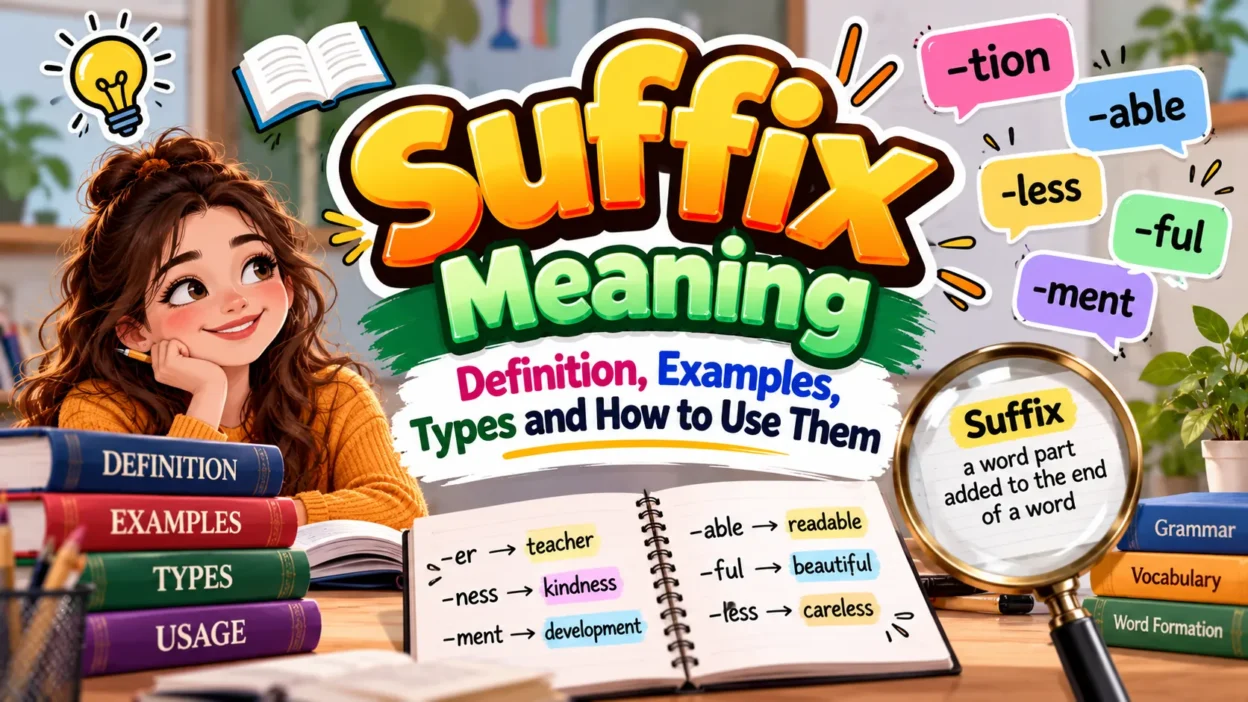
A suffix is a letter or group of letters added to the end of a word or word root to create a new word or change its grammatical function. For example, adding -ful to care creates careful, while adding -ness to happy creates happiness. Similarly, adding -er to teach gives us teacher, a word that describes a person who teaches.
Learning suffixes can help you understand unfamiliar words, improve your spelling, and build a stronger vocabulary. They are especially useful for students learning English, writers improving their grammar, and anyone who wants to understand how words are formed.
In this guide, you’ll discover the meaning of suffix, common suffix examples, different types of suffixes, and the difference between suffixes and prefixes.
📖 What Does Suffix Mean?
A suffix is a word part added to the end of a base word or root word to change its meaning, grammatical role, or both.
For example, the word kindness consists of the base word kind and the suffix -ness. The suffix changes the adjective kind into the noun kindness.
Here are a few more examples:
- Care + -ful = Careful: The suffix -ful means full of or characterized by something.
- Dark + -ness = Darkness: The suffix -ness turns an adjective into a noun.
- Teach + -er = Teacher: The suffix -er identifies a person who performs an action.
- Quick + -ly = Quickly: The suffix -ly forms an adverb from an adjective.
- Hope + -less = Hopeless: The suffix -less means without something.
Suffixes are common in everyday English. Recognizing them helps you identify word patterns and understand how a word functions in a sentence.
🧩 What Is a Suffix in Grammar?
In grammar, a suffix is a type of bound morpheme, meaning it cannot normally function as an independent word in the same way that a complete base word can.
Suffixes attach to existing words or roots to form new words or grammatical forms. They can create nouns, adjectives, adverbs, and verbs, or show grammatical information such as tense and number.
Consider these examples:
- Play → Played: The suffix -ed marks the past tense of the regular verb.
- Book → Books: The suffix -s marks the plural form.
- Happy → Happiness: The suffix -ness forms a noun.
- Modern → Modernize: The suffix -ize forms a verb.
- Slow → Slowly: The suffix -ly forms an adverb.
Not every suffix changes a word’s basic meaning. Some, such as -s and -ed, mainly express grammatical information.
✍️ What Are the Different Types of Suffixes?
English suffixes are commonly divided into two major categories: derivational suffixes and inflectional suffixes. Understanding the difference makes it easier to see how suffixes work.
🌟 Derivational Suffixes
Derivational suffixes create a new word or change the grammatical category of a word. They may also change or add to its meaning.
Examples include:
- -ness: Happy → Happiness
- -ful: Beauty → Beautiful
- -less: Hope → Hopeless
- -ment: Develop → Development
- -er: Teach → Teacher
- -ly: Quick → Quickly
- -ize: Modern → Modernize
- -able: Read → Readable
For example, happy is an adjective, while happiness is a noun. Adding -ness changes the grammatical category of the word.
📚 Inflectional Suffixes
Inflectional suffixes change a word’s grammatical form without creating a new dictionary word or changing its basic word class.
Common examples include:
- -s: Cat → Cats
- -es: Box → Boxes
- -ed: Walk → Walked
- -ing: Read → Reading
- -en: Eat → Eaten
- -er: Tall → Taller
- -est: Tall → Tallest
- -‘s: Girl → Girl’s
For example, walk and walked are both verbs. The suffix -ed indicates past tense rather than creating a different part of speech.
Some suffixes can serve different functions depending on the word. For instance, -er forms a comparative adjective in taller but creates a noun in teacher.
🔤 Common Suffixes and Their Meanings
Learning common suffixes is a practical way to expand your English vocabulary. Many suffixes have recognizable meanings or grammatical functions.
Here are some widely used English suffixes:
- -able: Capable of being — washable, readable
- -al: Relating to — natural, musical
- -ance: State or quality — importance, performance
- -ation: Process or result — education, celebration
- -dom: State or condition — freedom, kingdom
- -er: A person or thing that performs an action — teacher, runner
- -ful: Full of — helpful, joyful
- -hood: State or period of life — childhood, adulthood
- -ic: Relating to — historic, artistic
- -ify: To make or become — simplify, clarify
- -ion: Action, process, or result — action, discussion
- -ish: Somewhat like or relating to — childish, greenish
- -ism: Belief, practice, or system — realism, tourism
- -ist: A person associated with a field or activity — artist, scientist
- -ity: State or quality — activity, purity
- -ive: Having a particular quality — creative, active
- -less: Without — careless, fearless
- -ly: In a particular manner — slowly, carefully
- -ment: Action, process, or result — enjoyment, movement
- -ness: State or quality — kindness, darkness
- -ous: Full of or characterized by — dangerous, famous
- -ship: State, relationship, or position — friendship, leadership
- -ward: In a particular direction — forward, backward
- -y: Characterized by or having — rainy, cloudy
These meanings are useful clues, but the exact meaning of a word depends on the complete word and its context.
📝 Suffix Examples in Words
Suffixes appear in thousands of English words. The following examples show how adding a suffix can change a base word.
- Beauty → Beautiful: The suffix -ful creates an adjective.
- Care → Careless: The suffix -less means without care.
- Friend → Friendship: The suffix -ship describes a relationship.
- Dark → Darken: The suffix -en forms a verb meaning to become or make dark.
- Create → Creation: The suffix -ion forms a noun.
- Enjoy → Enjoyment: The suffix -ment forms a noun.
- Comfort → Comfortable: The suffix -able forms an adjective.
- Child → Childhood: The suffix -hood describes a stage of life.
- Weak → Weaken: The suffix -en forms a verb.
- Use → Useful: The suffix -ful creates an adjective.
Notice that suffixes do not all work in exactly the same way. Some describe a quality, some identify a person or process, and others change the grammatical role of a word.
🏷️ Noun Suffixes: Examples and Meanings
Noun suffixes help form words that name people, objects, conditions, qualities, actions, or ideas.
Common noun-forming suffixes include:
- -ness: Kindness, happiness, sadness
- -ment: Movement, agreement, enjoyment
- -tion: Creation, education, celebration
- -sion: Decision, confusion, revision
- -ity: Ability, equality, curiosity
- -ance: Importance, appearance, performance
- -ence: Difference, confidence, existence
- -er: Teacher, worker, painter
- -or: Actor, visitor, creator
- -ist: Artist, scientist, specialist
- -ship: Friendship, leadership, membership
- -hood: Childhood, adulthood, neighborhood
- -dom: Freedom, wisdom, kingdom
- -ism: Realism, tourism, criticism
For example, perform is a verb, while performance is a noun. The suffix helps turn an action into the name of an event, result, or activity.
🎨 Adjective Suffixes: Examples and Meanings
Adjective suffixes form words that describe people, places, objects, and ideas. They can express qualities, possibilities, relationships, or conditions.
Common adjective suffixes include:
- -ful: Beautiful, useful, hopeful
- -less: Careless, fearless, useless
- -able: Comfortable, readable, enjoyable
- -ible: Visible, flexible, sensible
- -ous: Famous, dangerous, nervous
- -al: Natural, personal, cultural
- -ic: Historic, artistic, energetic
- -ive: Creative, attractive, effective
- -y: Rainy, cloudy, messy
- -ish: Childish, greenish, selfish
- -ent: Different, confident, dependent
- -ant: Important, pleasant, significant
For example, danger is a noun, while dangerous is an adjective. The adjective describes something that presents danger.
🏃 Verb Suffixes: Examples and Meanings
Verb suffixes can turn nouns or adjectives into verbs that express an action, change, or process.
Some common verb-forming suffixes are:
- -ize: Modernize, organize, realize
- -ify: Simplify, clarify, identify
- -en: Widen, strengthen, brighten
- -ate: Activate, motivate, educate
Examples in sentences:
- “The company plans to modernize its website.”
- “Can you simplify this explanation?”
- “The curtains will darken the room.”
- “The teacher wants to motivate the students.”
These suffixes help create verbs that describe making something a certain way, causing a change, or carrying out an action.
⚡ Adverb Suffixes: Examples and Meanings
Adverbs can describe how, when, where, or how often an action happens. One of the most recognizable adverb-forming suffixes is -ly.
Examples include:
- Quick → Quickly
- Careful → Carefully
- Quiet → Quietly
- Slow → Slowly
- Happy → Happily
- Easy → Easily
- Sudden → Suddenly
- Gentle → Gently
- Honest → Honestly
- Basic → Basically
Consider the sentence, “She spoke softly.” The word softly is an adverb describing how she spoke.
However, not every word ending in -ly is an adverb. Words such as friendly, lovely, and lonely are usually adjectives.
🔢 Inflectional Suffixes in English
English has eight commonly recognized inflectional suffixes, grouped according to the grammatical information they express.
- Plural -s: Dog → Dogs
- Third-person singular -s: Work → Works
- Past tense -ed: Jump → Jumped
- Past participle -en: Break → Broken
- Present participle -ing: Walk → Walking
- Comparative -er: Small → Smaller
- Superlative -est: Small → Smallest
- Possessive -‘s: Student → Student’s
These suffixes help show number, tense, comparison, possession, and other grammatical relationships.
For example, in “The students’ books are on the desk,” the plural noun students and the possessive marker in students’ work together to show that the books belong to more than one student.
🆚 Suffix vs. Prefix: What’s the Difference?
A suffix and a prefix are both word parts added to another word, but they appear in different positions.
A prefix comes at the beginning of a word, while a suffix comes at the end.
Examples of prefixes:
- Un- + happy = Unhappy
- Re- + write = Rewrite
- Dis- + agree = Disagree
- Pre- + view = Preview
Examples of suffixes:
- Kind + -ness = Kindness
- Help + -ful = Helpful
- Teach + -er = Teacher
- Quick + -ly = Quickly
Prefixes often change a word’s meaning, such as happy becoming unhappy. Suffixes may change a word’s meaning or grammatical category, such as happy becoming happiness.
Both are important tools for understanding word formation.
🔍 Suffix vs. Root Word: What’s the Difference?
A root word is the main part of a word that carries its central meaning. A suffix is a word part added to the end of a base or root.
For example, in helpful, help is the base and -ful is the suffix. Together, they form an adjective meaning willing or able to provide help.
More examples include:
- Care + -less = Careless
- Hope + -ful = Hopeful
- Kind + -ness = Kindness
- Teach + -er = Teacher
- Quick + -ly = Quickly
Identifying the base and suffix can help you work out the meaning of unfamiliar words. However, some words have spelling changes or historical forms that make their structure less obvious.
✏️ Spelling Rules for Adding Suffixes
Adding a suffix sometimes changes the spelling of the original word. Learning these common patterns can help you avoid mistakes.
🔤 Drop the Final E
Some words ending in a silent e drop that letter before adding a suffix beginning with a vowel.
Examples:
- Make → Making
- Hope → Hoping
- Create → Creating
- Use → Usable
However, this is not a universal rule. The spelling depends on the suffix and the word.
📝 Change Y to I
When a word ends in a consonant followed by y, the y often changes to i before certain suffixes.
Examples:
- Happy → Happiness
- Easy → Easily
- Beauty → Beautiful
This rule does not apply when the suffix begins with i, as in hurrying from hurry.
📚 Double the Final Consonant
Some short words double their final consonant before a vowel-initial suffix, especially when the final syllable is stressed.
Examples:
- Run → Running
- Big → Bigger
- Stop → Stopped
- Hot → Hottest
The exact rule depends on syllable structure, stress, and spelling conventions.
✍️ Keep the Original Spelling When Appropriate
Many words accept suffixes without changing their base spelling.
Examples:
- Help → Helpful
- Care → Careful
- Fear → Fearless
- Enjoy → Enjoyment
Learning these patterns gradually makes spelling unfamiliar words easier.
🧠 Why Are Suffixes Important?
Suffixes help readers and writers understand how words work. They can reveal whether a word is a noun, verb, adjective, or adverb, and they often provide clues about meaning.
Here are several reasons to learn suffixes:
- Improve vocabulary: Recognize connections between related words.
- Understand unfamiliar words: Use word parts as clues to meaning.
- Strengthen spelling: Learn common spelling changes when adding endings.
- Improve grammar: Identify parts of speech in sentences.
- Support reading comprehension: Understand how a word functions in context.
- Improve writing: Choose the correct word form for a sentence.
- Build language skills: Recognize patterns that appear across many English words.
For students, suffixes are particularly useful because learning one suffix can help unlock the meaning of many different words.
📝 Practice Exercise: Identify the Suffix
Test your understanding by identifying the suffix in each word. Try answering before checking the solutions.
- 1. Happiness
- 2. Careless
- 3. Teacher
- 4. Slowly
- 5. Movement
- 6. Readable
- 7. Modernize
- 8. Stronger
Answers:
- Happiness — -ness
- Careless — -less
- Teacher — -er
- Slowly — -ly
- Movement — -ment
- Readable — -able
- Modernize — -ize
- Stronger — -er
Notice that -er has different functions in teacher and stronger. In teacher, it forms a noun describing a person who teaches. In stronger, it marks the comparative form of an adjective.
❓ Frequently Asked Questions About Suffixes
What is a suffix in simple words?
A suffix is a letter or group of letters added to the end of a word to create a new word or change its grammatical form. For example, adding -ness to kind creates kindness.
What is an example of a suffix?
In the word helpful, -ful is the suffix. It is added to help to create an adjective.
What are the four common types of suffixes?
Suffixes can be grouped in different ways, but common grammatical categories include noun-forming, adjective-forming, verb-forming, and adverb-forming suffixes. Another important distinction is between derivational and inflectional suffixes.
Is -ly a suffix?
Yes. The suffix -ly commonly forms adverbs, such as quickly and carefully. It can also appear in adjectives, including friendly and lovely.
What is the difference between a suffix and a prefix?
A prefix is added to the beginning of a word, while a suffix is added to the end. For example, un- is a prefix in unhappy, and -ness is a suffix in happiness.
Does a suffix always change the meaning of a word?
Not always. Some suffixes create new words or change their grammatical category, while others mainly show grammatical information. For example, -ed in walked indicates past tense.
What is a suffix in grammar?
In grammar, a suffix is a bound morpheme attached to the end of a word or root. It can form new words or express grammatical information such as tense, number, or comparison.
What are examples of noun suffixes?
Common noun suffixes include -ness, -ment, -tion, -ity, -ance, -er, and -ship. Examples include kindness, movement, education, and friendship.
Can one suffix have different meanings?
Yes. The suffix -er, for example, can identify a person who performs an action in teacher or mark a comparison in taller. Its function depends on the word.
Why should students learn suffixes?
Suffixes help students build vocabulary, recognize parts of speech, understand unfamiliar words, improve spelling, and write more accurately.
🌟 Conclusion: Understand Words Through Suffixes
A suffix is a word part added to the end of a base or root word. It can create a new word, change the grammatical category, or express information such as tense, number, and comparison.
Examples such as kindness, careful, teacher, and quickly show how a small group of letters can make a meaningful difference. By learning common suffixes and their functions, you can recognize word patterns, improve spelling, and expand your English vocabulary.
The key idea is simple: a prefix comes before a word, while a suffix comes after it. Understanding this difference makes English grammar and word formation easier to learn.

Lillian Hayes is a content writer focused on explaining meanings and language in a simple and clear way. She creates easy-to-understand content that helps readers learn and communicate better.