
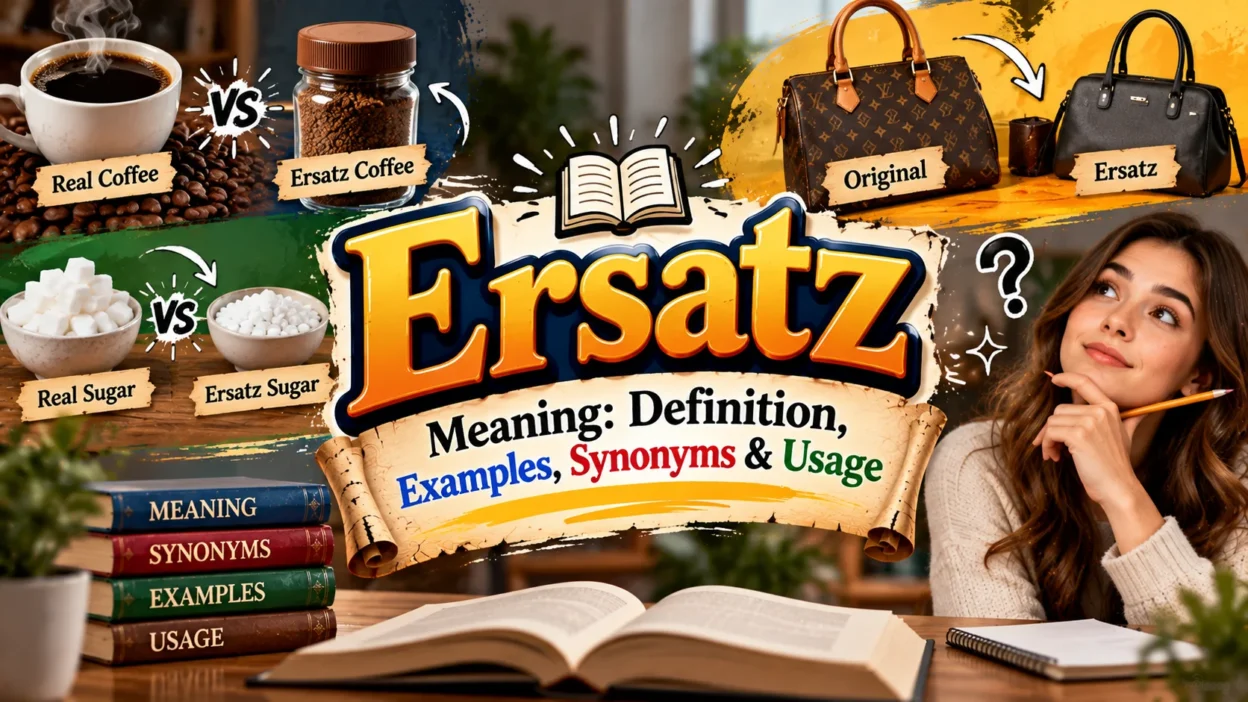
Have you ever come across the word ersatz in a book, article, product review, or online conversation and wondered what it means? Although it may look unfamiliar, the word describes something many people encounter in everyday life: a substitute that imitates something real, original, or more desirable.
Ersatz means an artificial, inferior, or imitation substitute for something genuine. It is often used when a replacement resembles the original but lacks its quality, authenticity, or essential character. For example, an ersatz leather jacket may look like real leather but be made from synthetic materials.
The word can describe products, experiences, emotions, and even relationships. Depending on the context, it may sound neutral, critical, or dismissive. In this guide, you will learn the meaning of ersatz, its origin, pronunciation, synonyms, examples, and how to use it naturally in American English.
📖 What Does Ersatz Mean?
The word ersatz is an adjective that describes something used as a substitute for another thing, especially when the replacement is considered artificial, inferior, or less authentic than the original.
It is commonly used when an imitation attempts to reproduce the appearance, function, or experience of something genuine without fully matching its quality.
For example, a company might sell ersatz coffee made from ingredients other than traditional coffee beans. A critic might describe a movie as an ersatz version of a classic because it copies the original without capturing its appeal.
Consider these examples:
- The restaurant served ersatz crab made from imitation seafood.
- His expensive-looking watch was an ersatz version of a luxury brand.
- The resort offered an ersatz tropical experience inside a shopping mall.
- The movie felt like an ersatz copy of a much better film.
- She disliked the ersatz leather because she preferred the texture of genuine leather.
In each sentence, the word suggests that something is serving as a replacement or imitation rather than being the authentic original.
However, ersatz does not always mean that a substitute is useless or poorly made. Its negative tone often comes from the comparison with the original, rather than from the substitute’s practical performance alone.
🗣️ How to Pronounce Ersatz
Ersatz is generally pronounced AIR-sahts in American English, with some variation in pronunciation across dictionaries and English-speaking regions.
The word has two syllables, and the emphasis usually falls on the first syllable.
- Word: Ersatz
- Pronunciation: AIR-sahts
- Part of speech: Adjective
- Primary meaning: An imitation or substitute, often inferior to the original
- Origin: German
Because the spelling may not be familiar to English learners, listening to an audio dictionary can help you recognize its pronunciation.
In a sentence, you might say, “The store sold an ersatz version of the designer handbag.” The adjective describes the handbag as an imitation rather than the authentic product.
🌍 What Is the Origin of Ersatz?
The word ersatz comes from German, where it is related to the idea of replacement or substitution. It entered English through the use of substitute materials and products, particularly during periods when genuine goods were scarce.
The term became especially familiar in English during the world wars, when shortages encouraged the use of alternatives for materials, food, and other necessities. Substitute products were sometimes made from less expensive or more readily available ingredients.
Over time, the word developed a broader meaning. It came to describe not only practical replacements but also imitations that seem artificial, unconvincing, or inferior to the original.
Today, ersatz can be used in discussions about food, fashion, entertainment, culture, technology, and personal experiences. Its historical background explains why it often carries a critical tone, even when the substitute is functional.
💡 Ersatz Meaning in Everyday English
In everyday English, ersatz usually describes a substitute that tries to reproduce something genuine. It is more specific than the general word replacement because it often suggests that the substitute lacks the authenticity or quality of the original.
Imagine that a coffee shop runs out of its usual coffee and serves a different drink made from roasted grains. You might call it an ersatz coffee if it imitates coffee but does not taste or feel the same.
Similarly, an imitation designer bag might resemble an expensive handbag without being made by the original brand. Calling it ersatz emphasizes its imitation quality.
Here are some everyday situations where the word may appear:
| Situation | Example | Intended Meaning |
|---|---|---|
| Food | Ersatz cheese | A substitute for traditional cheese |
| Fashion | Ersatz leather | A synthetic material used instead of genuine leather |
| Entertainment | Ersatz comedy | An imitation that fails to capture the original’s appeal |
| Luxury goods | Ersatz jewelry | Jewelry that imitates a more valuable or authentic item |
| Travel | Ersatz beach resort | An artificial experience resembling a real beach destination |
| Culture | Ersatz nostalgia | An imitation of a supposedly authentic past |
The key idea is substitution, often accompanied by a sense that the replacement is less genuine or convincing.
✍️ Ersatz in a Sentence: 15 Examples
Sentence examples make it easier to understand how ersatz works in different contexts. Notice how the word frequently expresses criticism or skepticism about a substitute.
- The restaurant served ersatz cheese made from vegetable oils.
- He bought an ersatz leather jacket instead of one made from genuine leather.
- The sequel felt like an ersatz version of the original movie.
- The hotel offered an ersatz tropical atmosphere with artificial palm trees.
- She rejected the ersatz designer handbag because she wanted the authentic product.
- The beverage was an ersatz coffee substitute made from roasted grains.
- The company’s advertising promised luxury, but the product felt ersatz.
- The theme park created an ersatz version of a historic European village.
- His imitation smile seemed like an ersatz expression of happiness.
- The imitation perfume offered an ersatz version of a popular fragrance.
- Critics described the show as ersatz nostalgia designed to attract older viewers.
- The artificial flowers provided an ersatz version of a fresh spring garden.
- The small screen offered an ersatz theater experience at home.
- The restaurant’s ersatz lobster dish looked convincing but tasted different.
- She wanted genuine friendship rather than an ersatz connection based on convenience.
In each example, ersatz describes a replacement or imitation. The surrounding sentence reveals whether the substitute is being criticized for its quality, authenticity, or artificial nature.
🔄 Synonyms for Ersatz
Several English words can replace ersatz, but they do not all carry exactly the same meaning. Some emphasize imitation, while others focus on quality, authenticity, or function.
Common Synonyms
- Imitation: Something made to resemble another thing.
- Artificial: Made by humans rather than occurring naturally.
- Synthetic: Produced through chemical or industrial processes.
- Fake: Not genuine or authentic.
- Counterfeit: Made to imitate something genuine, often with the intention to deceive.
- Substitute: Something used in place of another thing.
- Replacement: Something that takes the place of another item.
- Imitation-quality: Describing a product that copies the appearance or features of another.
- Inferior: Lower in quality or value.
- Unconvincing: Not believable or convincing.
Which Synonym Fits Best?
The best synonym depends on the sentence.
Use substitute when you simply mean something used in place of another item. Use synthetic when describing a material produced artificially. and Use fake or counterfeit when authenticity is the main concern, although counterfeit often implies deceptive imitation.
Also Use inferior when the focus is on lower quality rather than imitation. Ersatz is especially useful when you want to communicate both the idea of a substitute and the impression that it falls short of the genuine article.
⚖️ Ersatz vs. Fake: What’s the Difference?
Ersatz and fake can overlap, but they are not always interchangeable.
Fake generally means that something is not genuine or authentic. It can suggest deliberate deception, especially when someone tries to pass an imitation off as the real thing.
Ersatz focuses on something being used as a substitute or imitation, often with an implication that it is inferior or less authentic. It does not necessarily mean that anyone is trying to deceive someone.
For example, synthetic leather used openly in an affordable jacket may be described as ersatz leather. A counterfeit designer handbag sold as an authentic branded product would more naturally be called fake or counterfeit.
The distinction is important because an ersatz product may be a legitimate alternative, while a counterfeit product is generally designed to imitate a genuine product deceptively.
🆚 Ersatz vs. Substitute: What’s the Difference?
A substitute is anything that takes the place of another item, person, or ingredient. The word is usually neutral and does not automatically imply inferior quality.
Ersatz, by contrast, often carries a negative or skeptical tone. It suggests that the substitute imitates the original but does not offer the same authenticity or quality.
For example, a plant-based milk can be a substitute for dairy milk without being considered inferior. Calling it ersatz may suggest that the speaker views it as an artificial or less satisfying imitation.
Compare these sentences:
- “We used a substitute for butter in the recipe.” This is a neutral statement.
- “The dish tasted like an ersatz version of the original.” This suggests that the imitation did not measure up.
Choose substitute when you want neutral wording. Choose ersatz when the imitation or its perceived shortcomings are important to your meaning.
🧠 Is Ersatz Always Negative?
Ersatz often has a negative connotation, but it does not always mean that a product is worthless or ineffective.
The word can be used descriptively when discussing historical substitutes, artificial materials, or alternatives created because the original was unavailable. In these situations, it may simply identify an imitation or replacement.
For example, an ersatz ingredient might be useful during a shortage. A synthetic material might provide a practical alternative to an expensive natural material.
However, in reviews and literary criticism, the word frequently expresses disappointment. Describing a movie as ersatz may suggest that it copies another film without delivering the same emotional impact.
Therefore, the tone depends on the context. The word always suggests substitution or imitation, but the degree of criticism varies.
📚 How to Use Ersatz Correctly
Because ersatz is somewhat formal and less common than words such as fake or substitute, it is most effective when its specific meaning adds value to a sentence.
Use it when you want to describe a replacement that imitates something genuine, especially when the imitation seems artificial or inferior.
Good usage:
“The restaurant served ersatz crab in its seafood salad.”
This sentence identifies a substitute that imitates crab.
Another example:
“The film was criticized as ersatz nostalgia.”
This suggests that the film attempted to recreate the feeling of an earlier era but did so in an artificial or unconvincing way.
Less suitable usage:
“I need an ersatz pen because I lost mine.”
In this situation, replacement pen or another pen is more natural. The word ersatz would sound unnecessarily formal unless the replacement were an imitation of a particular type of pen.
A useful rule is to reserve ersatz for situations where the idea of imitation or reduced authenticity matters.
❓ Frequently Asked Questions About Ersatz Meaning
What does ersatz mean in simple words?
Ersatz means an imitation or substitute for something genuine, often one considered artificial or inferior. For example, ersatz leather is a substitute for genuine leather.
Is ersatz a negative word?
Usually, it carries a negative or critical tone because it often suggests that an imitation does not match the original. However, it can also be used descriptively when discussing substitutes created because genuine materials are unavailable.
What is an example of ersatz?
“His ersatz leather jacket looked stylish but did not feel like genuine leather.” In this sentence, ersatz describes an imitation material used instead of the original.
Is ersatz the same as fake?
Not exactly. Fake means not genuine and can imply deception. Ersatz describes a substitute or imitation, often one that lacks the quality or authenticity of the original, without necessarily implying dishonesty.
What is the opposite of ersatz?
Depending on the context, possible opposites include genuine, authentic, real, original, and natural. For example, genuine leather is an opposite of ersatz leather when the latter refers to a synthetic imitation.
Is ersatz a noun or an adjective?
In modern English, ersatz is most commonly used as an adjective. It describes a substitute or imitation, as in “ersatz coffee” or “an ersatz experience.”
Where does the word ersatz come from?
Ersatz comes from German and is associated with replacement or substitution. It entered English through the use of substitute goods and materials, especially during periods of shortages.
Is ersatz commonly used in American English?
Ersatz is recognized in American English, particularly in journalism, criticism, literature, and more formal writing. In casual conversation, people are more likely to say fake, imitation, or substitute.
🎯 Conclusion
The word ersatz means an imitation or substitute for something genuine, often with the suggestion that the replacement is artificial or inferior. It can describe food, clothing, entertainment, products, and experiences that attempt to reproduce the original.
Although ersatz is often critical, it does not automatically mean that a substitute is useless or deceptive. The word is most useful when you want to emphasize that something is an imitation that may fall short of the real thing.
Remember the central distinction: a substitute simply takes the place of something else, while an ersatz substitute often carries an added sense of imitation or reduced authenticity.

Lillian Hayes is a content writer focused on explaining meanings and language in a simple and clear way. She creates easy-to-understand content that helps readers learn and communicate better.