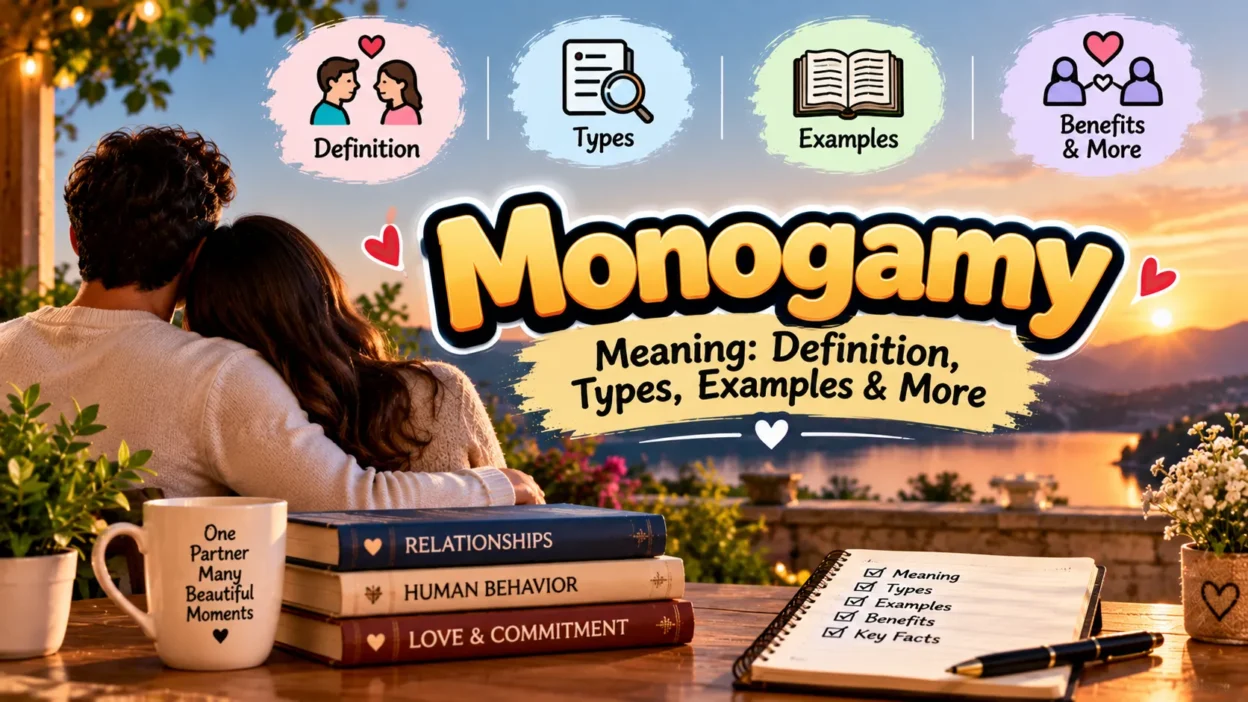
Monogamy meaning refers to a relationship or marriage in which a person has one partner at a time. The term is commonly used when discussing marriage, romantic relationships, dating, and commitment. In many cultures, monogamy is considered a traditional relationship structure, although expectations and practices can differ depending on personal values, religion, and society.
Understanding the meaning of monogamy can help clarify conversations about commitment, exclusivity, and relationship boundaries. It is also useful to know how monogamy differs from polygamy, polyamory, and other relationship arrangements.
💍 What Does Monogamy Mean?
Monogamy means having one spouse or romantic partner at a time. In marriage, it generally describes a union between two people who are married exclusively to each other. In dating, it usually means that both partners agree not to pursue romantic or sexual relationships with other people.
The word monogamy comes from Greek roots: mono, meaning one, and gamos, meaning marriage. Although the term originally relates to marriage, people also use it to describe exclusive romantic relationships outside marriage.
For example, if two people agree to date only each other and do not have other romantic partners, they are practicing monogamy.
❤️ Examples of Monogamy in Everyday Life
Monogamy can appear in different stages of a relationship, from dating to marriage. The exact expectations depend on what both partners agree to.
Here are some simple examples:
- A married couple who remain exclusive to each other.
- Two people who agree to date only each other.
- A couple who establish clear boundaries against romantic involvement with other people.
- Two partners who choose a long-term, exclusive relationship without getting married.
- A couple who mutually commit to sexual and romantic exclusivity.
Example sentence: “They chose monogamy because they wanted a relationship built around mutual commitment and exclusivity.”
Monogamy does not automatically guarantee a healthy relationship. Trust, communication, respect, and shared expectations are also important.
🔎 What Are the Different Types of Monogamy?
The term monogamy can describe more than one kind of commitment. Researchers and relationship discussions often distinguish between social and sexual monogamy.
1. Social Monogamy
Social monogamy describes two people who form a shared partnership, such as living together, raising children, sharing responsibilities, or presenting themselves as a couple.
And Social monogamy does not necessarily mean that the partners are sexually exclusive. The nature of their relationship depends on their agreements and behavior.
2. Sexual Monogamy
Sexual monogamy means that two partners agree to have sexual relationships only with each other. This arrangement often includes clear expectations about sexual exclusivity and relationship boundaries.
3. Marital Monogamy
Marital monogamy refers to marriage between two people at a time. In societies where monogamous marriage is the norm, each spouse is generally expected to have only one legal spouse at a time.
4. Serial Monogamy
Serial monogamy occurs when a person has one exclusive partner at a time but enters new exclusive relationships after previous ones end.
For example, someone might have a long-term relationship, separate from that partner, and later enter another exclusive relationship. Each relationship is monogamous, even though the person has had multiple partners over their lifetime.
⚖️ Monogamy vs. Polygamy: What Is the Difference?
Monogamy and polygamy describe different approaches to marriage and partnership.
| Feature | Monogamy | Polygamy |
|---|---|---|
| Basic meaning | One spouse at a time | Multiple spouses |
| Marriage structure | Two spouses | More than two spouses |
| Common forms | Exclusive marriage or partnership | Polygyny or polyandry |
| Cultural acceptance | Common in many societies | Accepted or practiced in some societies |
| Legal status | Legally recognized in many countries | Laws vary, and plural marriage is prohibited in many jurisdictions |
Polygamy has different forms. Polygyny refers to a man having multiple wives, while polyandry refers to a woman having multiple husbands.
Monogamy and polygamy concern marital structures. Polyamory, by contrast, generally refers to having or pursuing multiple consensual romantic relationships, which may or may not involve marriage.
💬 Monogamy vs. Polyamory
Monogamy and polyamory differ mainly in the number of romantic relationships a person may have at the same time.
In a monogamous relationship, partners agree to romantic exclusivity. In a polyamorous relationship, people may have multiple romantic relationships with the knowledge and consent of everyone involved.
Neither term alone tells you whether a relationship is healthy. Honesty, informed consent, communication, and respect for boundaries matter in either arrangement.
👫 Is Monogamy the Same as Being Faithful?
Monogamy and faithfulness are related, but they are not exactly the same.
Monogamy describes a relationship structure in which a person has one partner at a time. Faithfulness means honoring the commitments and boundaries agreed upon with that partner.
For many monogamous couples, faithfulness includes romantic and sexual exclusivity. However, couples may have different boundaries, so it is important to discuss expectations rather than assume both partners define fidelity in exactly the same way.
A person can describe their relationship as monogamous, but maintaining that agreement requires honesty and mutual commitment.
🌍 Why Do People Choose Monogamy?
People choose monogamy for many personal, cultural, religious, and practical reasons. There is no single explanation that applies to everyone.
Common reasons include:
- Emotional exclusivity: Some people feel most comfortable building a romantic bond with one partner.
- Commitment: A couple may value making a long-term commitment to each other.
- Shared values: Partners may prefer the same relationship structure because of their beliefs or upbringing.
- Family goals: Some couples choose monogamy while planning a family or sharing household responsibilities.
- Clear boundaries: Exclusivity can make expectations easier to communicate for people who prefer this arrangement.
- Personal preference: Some people simply feel happier in a one-to-one relationship.
Monogamy is a personal relationship choice for many people, but cultural and legal expectations also influence how it is practiced.
📖 Monogamy in a Sentence: Usage Examples
The word monogamy is a noun. It is commonly used in conversations about relationships, marriage, culture, and human behavior.
Here are examples showing how to use it naturally:
- “Monogamy is an important part of their understanding of marriage.”
- “They discussed monogamy before deciding to become an exclusive couple.”
- “Some people prefer monogamy because they value romantic exclusivity.”
- “The book examines the history of monogamy across different cultures.”
- “They agreed that monogamy was the right relationship structure for them.”
- “Their conversation about monogamy helped them clarify their expectations.”
- “Serial monogamy involves having one exclusive partner at a time across successive relationships.”
These examples show that the term can describe personal choices as well as broader social and cultural practices.
🧠 Is Monogamy Natural?
Whether monogamy is natural is a complex question that involves biology, psychology, culture, and personal behavior.
Humans form a variety of relationship arrangements. Some people prefer long-term exclusive partnerships, while others choose consensual non-monogamous relationships. Human societies have also developed different marriage customs throughout history.
Biological tendencies do not determine what every person should choose. Individual preferences, cultural influences, personal values, and relationship circumstances all contribute to how people approach commitment.
Rather than assuming that one arrangement suits everyone, it is more useful to consider whether a relationship structure is consensual, respectful, and compatible with the people involved.
❓ Frequently Asked Questions About Monogamy
What is the simple meaning of monogamy?
Monogamy means having one spouse or romantic partner at a time. In a romantic relationship, it usually involves an agreement to remain exclusive.
Does monogamy mean only one partner for life?
Not necessarily. A person may practice serial monogamy by having one exclusive partner at a time across different relationships. Monogamy does not automatically mean staying with the same person for an entire lifetime.
What is a monogamous relationship?
A monogamous relationship is one in which two partners agree to be romantically exclusive. Depending on their agreement, this may also include sexual exclusivity.
What is the opposite of monogamy?
Polygamy is commonly presented as the opposite of monogamy in discussions about marriage because it involves having multiple spouses. Non-monogamy is a broader term for relationship arrangements that are not exclusively monogamous.
Can someone be monogamous without being married?
Yes. Unmarried couples can practice monogamy by agreeing to have an exclusive romantic relationship.
Is monogamy the same as celibacy?
No. Monogamy means having one partner at a time, while celibacy generally means abstaining from sexual activity. A monogamous couple may have a sexual relationship, depending on their choices and circumstances.
What does serial monogamy mean?
Serial monogamy means having one exclusive romantic partner at a time and entering another exclusive relationship after the previous one ends.
Is monogamy a choice?
For many people, monogamy is a personal choice shaped by their preferences, values, beliefs, and circumstances. Others may experience it as a cultural or religious expectation. People can discuss their preferences to determine whether they are compatible.
✅ Conclusion
The meaning of monogamy is straightforward: having one spouse or romantic partner at a time. It commonly involves exclusivity, commitment, and agreed-upon relationship boundaries. The term can refer to marriage, dating, sexual exclusivity, or successive exclusive relationships, depending on the context.
Understanding the difference between monogamy, polygamy, and polyamory can make conversations about relationships clearer. Ultimately, a healthy relationship depends on honest communication, mutual consent, trust, and shared expectations.

Lillian Hayes is a content writer focused on explaining meanings and language in a simple and clear way. She creates easy-to-understand content that helps readers learn and communicate better.