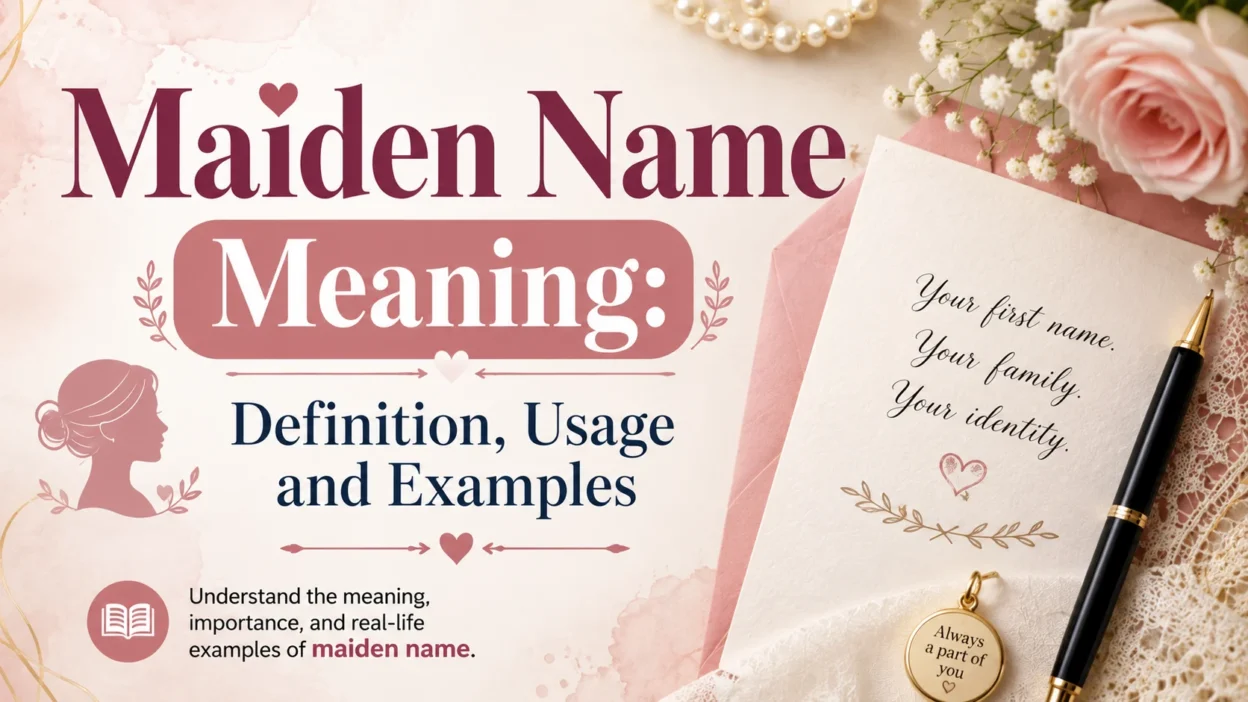
The term maiden name is commonly used in legal documents, genealogy research, family history records, and everyday conversations. While many people encounter the phrase when filling out forms or researching ancestry, not everyone fully understands what a maiden name means or why it is important.
Traditionally, a maiden name refers to the surname a woman is born with before marriage. In many cultures, women have historically adopted their spouse’s surname after marriage, making their original family surname their maiden name. Today, naming practices vary widely, and many women choose to keep their birth surname, hyphenate their names, or adopt other naming arrangements. However, the term maiden name remains widely used in official records and family history research.
Understanding the meaning of maiden name can help when completing legal paperwork, tracing family ancestry, verifying identity, or exploring genealogy. Whether you’re researching your family tree or simply curious about the term, this guide explains everything you need to know about maiden names, their history, usage, and significance.
Quick Answer
A maiden name is a woman’s family surname before marriage. If a woman changes her surname after marriage, her original birth surname is referred to as her maiden name.
Meaning Overview Table
| Aspect | Meaning |
|---|---|
| Term | Maiden Name |
| Definition | A woman’s surname before marriage |
| Pronunciation | MAY-dən NAYM |
| Part of Speech | Noun Phrase |
| Common Usage | Legal, genealogical, and personal records |
| Context | Family history and identity |
What Does Maiden Name Mean?
A maiden name is the last name a woman receives at birth and uses before marriage.
Example
Suppose a woman is born as:
Sarah Johnson
After marriage, she changes her surname to:
Sarah Miller
In this case:
- Current surname: Miller
- Maiden name: Johnson
The maiden name remains an important part of personal identity and historical records.
Definition of Maiden Name
Dictionary Definition
A maiden name is:
The surname that a woman uses before marriage, especially if she later adopts her spouse’s surname.
Simple Definition
It is simply a woman’s original family name before marriage.
Origin of the Term Maiden Name
The word maiden originally referred to an unmarried young woman.
Etymology
The term comes from Old English words related to:
- Young woman
- Virgin
- Unmarried female
Because women traditionally changed their surnames after marriage, the phrase “maiden name” developed to identify the surname used before marriage.
Pronunciation of Maiden Name
Maiden name is pronounced:
MAY-dən NAYM
Phonetic spelling:
MAY-duhn NAYM
Why Are Maiden Names Important?
Maiden names serve several important purposes.
Identity Verification
Many official documents ask for a maiden name to verify identity.
Genealogy Research
Family historians use maiden names to trace family lines.
Legal Records
Birth certificates, marriage licenses, and other records often include maiden names.
Medical History
Healthcare providers may use maiden names when researching family medical histories.
How Maiden Names Are Used Today
Although naming traditions have evolved, maiden names remain relevant.
Government Forms
Many forms request:
- Current surname
- Maiden name
Banking Records
Financial institutions may require maiden names for verification.
Passport Applications
Some passport and immigration records request maiden names.
Family Tree Research
Genealogists often rely on maiden names to identify ancestors.
Examples of Maiden Names
Example 1
Birth Name:
Emily Brown
Married Name:
Emily Davis
Maiden Name:
Brown
Example 2
Birth Name:
Jessica Wilson
Married Name:
Jessica Anderson
Maiden Name:
Wilson
Example 3
Birth Name:
Rebecca Taylor
Married Name:
Rebecca Smith
Maiden Name:
Taylor
Maiden Name vs Married Name
| Term | Meaning |
|---|---|
| Maiden Name | Surname before marriage |
| Married Name | Surname after marriage |
| Birth Name | Original legal name at birth |
| Family Name | Shared surname within a family |
| Surname | Last name |
Maiden Name in Different Cultures
Naming customs vary around the world.
United States
Many women traditionally adopt their spouse’s surname.
United Kingdom
The term maiden name remains widely used.
Canada
Both traditional and modern naming practices are common.
Spain
Women often retain their birth surnames after marriage.
Latin America
Multiple surnames are commonly used.
Iceland
Patronymic naming systems reduce the need for maiden name distinctions.
Modern Alternatives to Maiden Names
Today, many women choose different approaches to surnames after marriage.
Keeping the Birth Surname
Some women continue using their original surname.
Hyphenated Surnames
Example:
Emma Johnson-Smith
Combined Family Names
Some couples create entirely new surnames.
Shared Birth Surnames
In some cultures, surname changes are uncommon.
Maiden Name in Genealogy
Genealogists consider maiden names extremely important.
Why?
Because family records are often organized by birth surname.
Benefits
Maiden names help researchers:
- Trace family lineage
- Identify ancestors
- Connect family branches
- Verify historical records
Maiden Name in Legal Documents
Common documents that may request a maiden name include:
Birth Certificates
May reference the mother’s maiden name.
Marriage Certificates
Typically record both maiden and married names.
Divorce Records
Often reference maiden names.
Immigration Documents
May require all previous legal names.
Tax Records
Can include maiden names for verification purposes.
Maiden Name in Security Questions
Some institutions use maiden names as identity verification questions.
Example
“What is your mother’s maiden name?”
This question is commonly used for account recovery and security purposes.
Common Uses of the Phrase Maiden Name
The phrase appears in:
- Government forms
- Passport applications
- Genealogy websites
- Medical records
- Insurance paperwork
- Marriage records
- Family history research
Related Terms
Birth Name
The legal name given at birth.
Family Name
The surname shared by family members.
Surname
Another word for last name.
Married Name
Surname adopted after marriage.
Given Name
A person’s first name.
Examples Table
| Example | Meaning |
|---|---|
| Emma Johnson → Emma Clark | Johnson is the maiden name |
| Sarah Brown → Sarah White | Brown is the maiden name |
| Olivia Taylor → Olivia Green | Taylor is the maiden name |
| Hannah Wilson → Hannah Parker | Wilson is the maiden name |
| Grace Thomas → Grace Hall | Thomas is the maiden name |
| Rebecca Adams → Rebecca King | Adams is the maiden name |
| Emily Scott → Emily Young | Scott is the maiden name |
| Sophia Lewis → Sophia Ward | Lewis is the maiden name |
| Chloe Walker → Chloe Brooks | Walker is the maiden name |
| Ava Hill → Ava Reed | Hill is the maiden name |
Related Terms Table
| Related Term | Meaning |
|---|---|
| Surname | Last name |
| Family Name | Shared family identifier |
| Birth Name | Original legal name |
| Married Name | Name after marriage |
| Genealogy | Family history research |
| Lineage | Family ancestry |
| Heritage | Cultural background |
| Identity | Personal identification |
| Ancestor | Family predecessor |
| Descendant | Family successor |
| Marriage Record | Official marriage document |
| Legal Name | Official recognized name |
| Family Tree | Genealogical chart |
| Census Record | Population document |
| Heritage Research | Family history study |
Common Mistakes
| Mistake | Correct Understanding |
|---|---|
| Maiden name means first name | It refers to the surname |
| Only older women have maiden names | Anyone born with a surname has one |
| Maiden name disappears after marriage | It remains part of personal history |
| Every woman changes her surname | Many choose not to |
| Maiden name and birth name are always identical | Birth names can include more than surnames |
| All countries use maiden names similarly | Customs vary globally |
| Maiden names are only for genealogy | They have legal uses too |
| Married name replaces history | Maiden names remain important |
| Men have maiden names | The term traditionally applies to women |
| The term is outdated everywhere | It is still widely used |
Related Questions
What is a maiden name?
A maiden name is a woman’s surname before marriage.
Is a maiden name the same as a birth name?
Not exactly. A birth name includes the entire legal name given at birth, while a maiden name specifically refers to the surname.
Why do forms ask for a maiden name?
It helps verify identity and connect historical records.
Can a woman keep her maiden name after marriage?
Yes. Many women choose to keep their original surname.
FAQs
What is an example of a maiden name?
If Anna Brown becomes Anna Davis after marriage, Brown is her maiden name.
Does everyone have a maiden name?
The term traditionally applies to women and refers to their birth surname.
Is a maiden name a legal name?
It can be part of a person’s legal history and official records.
Why is my mother’s maiden name important?
It is commonly used for identity verification and genealogy research.
Can a maiden name be changed?
A person may legally change their surname, but historical records still reflect the original maiden name.
Is maiden name used on passports?
Some passport applications request maiden names for identification purposes.
Do all women change their surnames after marriage?
No. Many women keep their birth surname.
Is maiden name still relevant today?
Yes. It remains important for legal, medical, and genealogical purposes.
Conclusion
A maiden name is a woman’s original family surname before marriage and remains an important part of personal identity, legal documentation, and family history. Although modern naming practices vary widely, the concept of a maiden name continues to play a significant role in genealogy, identity verification, official records, and historical research.
Understanding the meaning of maiden name can help individuals navigate legal forms, trace ancestry, and better appreciate family heritage. Whether used in genealogy projects, government paperwork, or personal history research, maiden names continue to serve as valuable links to family origins and cultural identity.

Lillian Hayes is a content writer focused on explaining meanings and language in a simple and clear way. She creates easy-to-understand content that helps readers learn and communicate better.