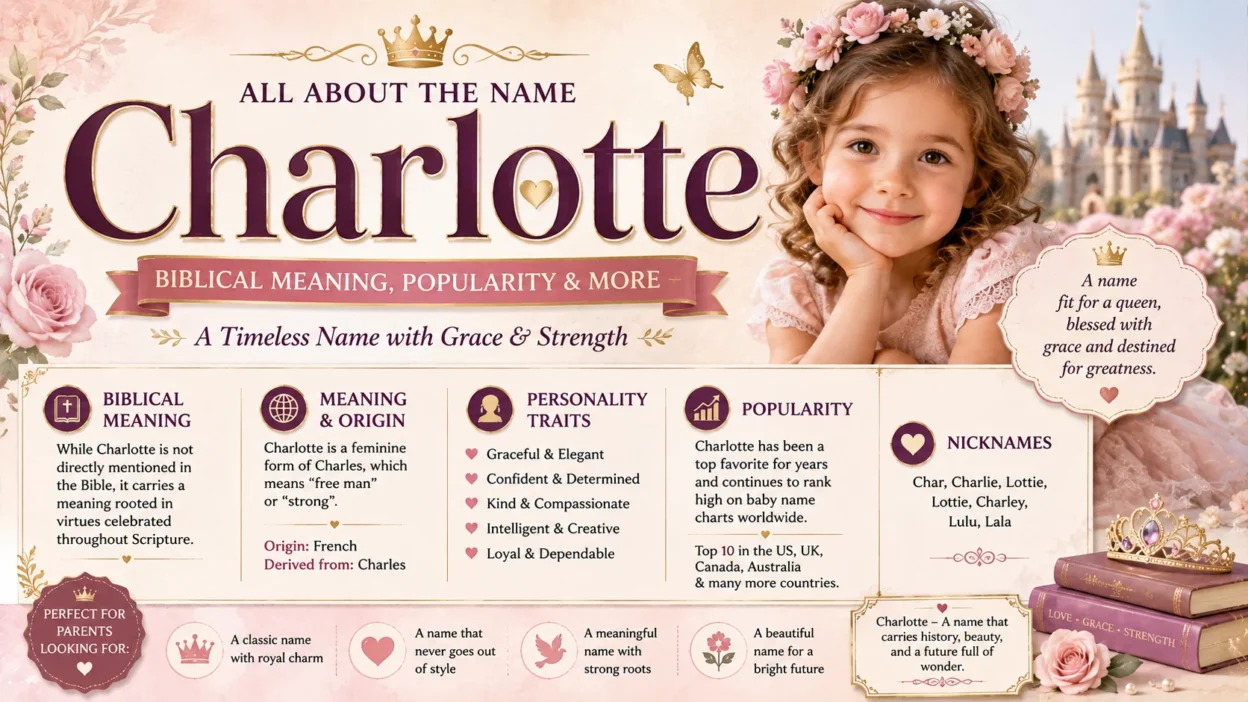
The Charlotte name meaning is commonly associated with free person or free woman. It is the feminine form of Charles, a classic name with Germanic origins. Charlotte has a long history across Europe and has remained popular because it combines elegance, tradition, and a timeless feminine style.
The name developed from the masculine Germanic name Karl or Charles, which is generally associated with the idea of a free person. Charlotte became established as a feminine form in French and other European naming traditions before gaining widespread popularity in English-speaking countries.
Charlotte also has strong royal associations. Several European royals have carried the name, and Princess Charlotte of Wales, daughter of William, Prince of Wales, and Catherine, Princess of Wales, has helped keep the name highly visible in modern culture.
Although Charlotte is not a biblical name, parents sometimes look for a spiritual interpretation based on its traditional meaning. Ideas such as freedom, dignity, independence, and strength can provide meaningful symbolic connections.
This guide explores the Charlotte name meaning, origin, history, biblical connection, spiritual interpretation, personality, popularity, pronunciation, nicknames, variations, and related names.
Quick Answer: What Does the Name Charlotte Mean?
| Feature | Details |
|---|---|
| Name | Charlotte |
| Meaning | Free person; free woman |
| Origin | Germanic |
| Gender | Feminine |
| Masculine Form | Charles |
| Pronunciation | SHAR-lət |
| Syllables | 2 |
| Language Forms | Carla, Carlota, Carlotta, Karla |
| Style | Classic, elegant, royal |
| Main Associations | Freedom, independence, grace, strength |
| Biblical Status | Not a biblical name |
Charlotte is the feminine form of Charles and ultimately traces back to Germanic naming traditions associated with the meaning free person.
What Does Charlotte Mean?
Charlotte traditionally means free person or free woman.
The name is the feminine form of Charles, which developed from Germanic names related to Karl or Karal.
The traditional interpretation connects the name with:
- Freedom
- Independence
- Personal strength
- Dignity
- Self-determination
Because Charlotte is a feminine form of Charles, its meaning is closely connected to the history of that name.
Charlotte Name Origin
Charlotte has Germanic roots, although the modern feminine form became especially established through French and European naming traditions.
The historical development is generally understood as:
Germanic Karl → Charles → Charlotte
The masculine form Charles became widely established in Europe, while Charlotte developed as its feminine counterpart.
The French form Charlotte eventually became common in English-speaking countries as well.
Charlotte Name Etymology
Charlotte ultimately connects to the Germanic name Karl or related forms.
The traditional meaning is generally interpreted as:
free person
The name became associated with Charles through French naming traditions, and Charlotte developed as the feminine form.
Because historical names often changed pronunciation and spelling as they moved between languages, the exact linguistic development includes several stages.
Is Charlotte a Biblical Name?
No, Charlotte is not a biblical name.
The name does not appear as a personal name in the Old Testament or New Testament. Its origins are European and Germanic rather than Hebrew, Aramaic, or Greek.
However, Charlotte has been used extensively by Christian families, particularly in Europe and English-speaking countries.
It is therefore useful to distinguish between:
- Biblical name: Charlotte is not one.
- Christian-used name: Yes.
- Biblical meaning: Charlotte has no direct biblical meaning.
- Spiritual interpretation: Freedom and independence can provide symbolic spiritual themes.
Does Charlotte Have a Biblical Meaning?
Charlotte does not have a direct biblical meaning because the name does not come from the Bible.
Its traditional meaning of free person comes from its Germanic linguistic roots.
However, freedom is an important concept in Christian theology, which allows families to give Charlotte a symbolic spiritual interpretation.
For example, parents may associate Charlotte with:
- Spiritual freedom
- Dignity
- Strength
- Independence
- Grace
- Courage
- Hope
These are symbolic connections, not definitions given by Scripture.
Charlotte Name Spiritual Meaning
Although Charlotte has no official biblical spiritual meaning, its association with freedom can create a meaningful spiritual interpretation.
A Christian family might interpret Charlotte as:
A free and courageous woman who lives with dignity, strength, and grace.
The idea of freedom appears in several Christian teachings, including the concept of spiritual freedom and freedom from sin.
This does not mean that Charlotte literally means spiritual freedom. Instead, the traditional meaning provides a foundation for a personal interpretation.
Is Charlotte a Christian Name?
Charlotte is not a biblical name, but it can certainly be considered a traditional Christian-used name.
The name has been used by Christian families and European royalty for centuries. Its historical connection with European Christian culture gives it a strong traditional character.
If you specifically want a name that appears in Scripture, Charlotte would not meet that requirement.
If you want a classic feminine name with European history and a positive meaning, Charlotte is a strong option.
Charlotte Name Personality
A name does not determine a person’s actual personality. However, names often develop cultural associations based on their history, meaning, sound, and famous bearers.
Charlotte is commonly associated with:
- Elegance
- Independence
- Confidence
- Kindness
- Intelligence
- Grace
- Strength
- Creativity
- Warmth
- Determination
Personality Associations
| Trait | Association |
|---|---|
| Elegant | Classic feminine style |
| Independent | Meaning connected with freedom |
| Strong | Royal and historical associations |
| Intelligent | Literary and cultural associations |
| Graceful | Traditional feminine image |
| Confident | Modern popularity |
| Creative | Literary associations |
| Warm | Friendly sound |
| Determined | Connection with independence |
| Distinguished | Long royal history |
These are cultural associations rather than scientific personality predictions.
Charlotte Name Popularity
Charlotte has become one of the most popular girls’ names in the United States.
According to recent U.S. naming data, Charlotte has remained among the country’s top girls’ names in recent years. Its popularity reflects the broader revival of traditional names with vintage and royal associations.
Charlotte is especially appealing because it offers several qualities parents often look for:
- Familiar but elegant
- Traditional but modern
- Easy to pronounce
- Internationally recognized
- Several nickname options
- Strong historical associations
Why Is Charlotte So Popular?
Several factors have contributed to Charlotte’s popularity.
1. Classic History
Charlotte has been used for centuries, giving it a strong historical foundation.
2. Royal Associations
The name has been carried by members of European royal families.
3. Literary Connection
Charlotte is also strongly associated with literature, particularly the beloved children’s novel Charlotte’s Web.
4. Attractive Nicknames
Parents can use nicknames such as Charlie, Lottie, Lotte, and Char.
5. International Appeal
Charlotte works naturally across several European languages and cultures.
6. Vintage Revival
Modern parents have shown strong interest in classic names that feel traditional without sounding outdated.
Charlotte and Royal History
Charlotte has a strong royal history.
One notable historical figure was Queen Charlotte, the wife of King George III of Great Britain. She became queen consort in the 18th century and was the mother of 15 children.
The name has also been used by European princesses and other members of royal families.
In modern Britain, Princess Charlotte of Wales is one of the most recognizable people with the name.
Her public presence has contributed to Charlotte’s continued association with:
- Royalty
- Grace
- Tradition
- Elegance
- Modern femininity
Charlotte and Literature
Charlotte is also strongly connected with literature.
One of the most famous fictional Charlottes is the spider in Charlotte’s Web, the classic children’s novel by E. B. White.
Charlotte the spider is often associated with:
- Friendship
- Loyalty
- Intelligence
- Compassion
- Sacrifice
This literary connection gives the name an additional warm and gentle image.
Charlotte Pronunciation
In American and British English, Charlotte is generally pronounced:
SHAR-lət
It has two syllables.
The pronunciation is straightforward, which contributes to its international usability.
Charlotte Nicknames
Charlotte offers many nickname possibilities.
Charlie
Charlie is one of the most popular modern nicknames for Charlotte.
Lottie
Lottie gives the name a cute and vintage feel.
Lotte
Lotte is a shorter European-style variation.
Char
Char is a simple and modern nickname.
Charly
Charly provides a casual spelling variation.
Lotta
Lotta can work as a playful nickname in some cultures.
Charli
Charli gives the traditional name a more contemporary feel.
Charlotte Name Variations
Charlotte has related forms in several languages.
| Language | Related Form |
|---|---|
| English | Charlotte |
| French | Charlotte |
| German | Karla / Carla |
| Italian | Carlotta |
| Spanish | Carlota |
| Portuguese | Carlota |
| Scandinavian | Karla |
| Czech | Karla |
| Polish | Karolina |
| Dutch | Carla |
The exact relationship between these names can vary by language and historical naming tradition.
Charlotte Middle Names
Charlotte works well with many different middle names.
Classic Combinations
- Charlotte Elizabeth
- Charlotte Grace
- Charlotte Rose
- Charlotte Anne
- Charlotte Jane
- Charlotte Marie
- Charlotte Louise
- Charlotte Victoria
- Charlotte Catherine
- Charlotte Margaret
Modern Combinations
- Charlotte Mae
- Charlotte Quinn
- Charlotte Sage
- Charlotte Blair
- Charlotte June
- Charlotte Wren
- Charlotte Ivy
- Charlotte Skye
- Charlotte Jade
- Charlotte Reese
Elegant Combinations
- Charlotte Eleanor
- Charlotte Josephine
- Charlotte Isabelle
- Charlotte Vivienne
- Charlotte Genevieve
- Charlotte Beatrice
- Charlotte Juliette
- Charlotte Madeleine
- Charlotte Celeste
- Charlotte Evangeline
Names Similar to Charlotte
If you like Charlotte, you may also like these classic girls’ names:
- Eleanor
- Amelia
- Elizabeth
- Caroline
- Victoria
- Katherine
- Margaret
- Josephine
- Beatrice
- Caroline
- Adelaide
- Clara
- Lucy
- Evelyn
- Violet
Sister Names for Charlotte
Charlotte pairs beautifully with other classic feminine names.
Classic Sister Names
- Charlotte and Eleanor
- Charlotte and Amelia
- Charlotte and Alice
- Charlotte and Elizabeth
- Charlotte and Clara
- Charlotte and Grace
- Charlotte and Rose
- Charlotte and Lucy
Modern Sister Names
- Charlotte and Isla
- Charlotte and Ivy
- Charlotte and Hazel
- Charlotte and Nora
- Charlotte and Ruby
- Charlotte and Maeve
Brother Names for Charlotte
For a brother, consider:
- Henry
- William
- James
- Charles
- Edward
- George
- Arthur
- Theodore
- Oliver
- Benjamin
These names share Charlotte’s traditional and sophisticated style.
Is Charlotte an Old-Fashioned Name?
Charlotte has a vintage history, but it does not feel outdated.
Instead, it is often considered a classic revival name.
A classic name can remain attractive because it has:
- Historical depth
- Familiar pronunciation
- Established spelling
- Cultural recognition
- Cross-generational appeal
Charlotte fits all of these characteristics.
Is Charlotte a Strong Name?
Yes. Charlotte combines elegance with strength.
Its traditional meaning of free person suggests independence and self-determination, while its royal history adds associations with confidence and leadership.
At the same time, the sound of Charlotte remains soft and feminine.
This combination makes the name feel both strong and graceful.
Is Charlotte a Good Baby Name?
Charlotte is a strong choice if you want a name that is:
- Classic
- Feminine
- Elegant
- Historically significant
- Easy to pronounce
- Internationally recognizable
- Suitable for different ages
- Rich in nickname options
Its meaning of free person also gives it a positive and empowering quality.
Charlotte Name Meaning: Positive Traits
If you are looking for positive qualities associated with Charlotte, consider:
- Freedom
- Independence
- Confidence
- Grace
- Strength
- Intelligence
- Kindness
- Loyalty
- Courage
- Creativity
These qualities come from the name’s meaning and its cultural and historical associations.
Famous People Named Charlotte
Queen Charlotte
Queen Charlotte was the wife of King George III and became an important figure in British royal history.
Princess Charlotte of Wales
Princess Charlotte is a member of the British royal family and daughter of William, Prince of Wales, and Catherine, Princess of Wales.
Charlotte Brontë
- Charlotte Brontë was an influential English novelist best known for Jane Eyre.
Charlotte Church
- Charlotte Church is a Welsh singer, actress, and television personality.
These figures have helped give Charlotte associations with literature, music, royalty, and culture.
Common Questions About Charlotte
What does the name Charlotte mean?
Charlotte traditionally means free person or free woman. It is the feminine form of Charles and has Germanic roots.
What is the origin of Charlotte?
Charlotte ultimately comes from Germanic naming traditions through the name Charles and its earlier forms.
Is Charlotte a biblical name?
No. Charlotte does not appear in the Bible. Its origin is European and Germanic.
What is the spiritual meaning of Charlotte?
Charlotte has no official biblical spiritual meaning. Symbolically, its association with freedom can represent independence, dignity, courage, and spiritual freedom.
Is Charlotte a Christian name?
Charlotte is not a biblical name, but Christians have used it extensively throughout European history.
What does Charlotte mean in Hebrew?
Charlotte does not have a native Hebrew meaning because it is a Germanic name. Any Hebrew interpretation should be treated as a symbolic association rather than its actual etymology.
Is Charlotte a royal name?
Yes. Charlotte has a long connection with European royalty, including Queen Charlotte and modern British royalty.
What are the nicknames for Charlotte?
Popular nicknames include Charlie, Lottie, Lotte, Char, Charli, Charly, and Lotta.
Is Charlotte a popular girl name?
Yes. Charlotte has remained highly popular in the United States and other English-speaking countries.
What is the male version of Charlotte?
The masculine counterpart is Charles. Related forms include Carl, Karl, and Carlos.
Frequently Asked Questions
1. What does Charlotte mean spiritually?
Charlotte has no direct biblical spiritual meaning. Its traditional meaning of free person can symbolically represent freedom, independence, dignity, courage, and strength.
2. Is Charlotte mentioned in the Bible?
No. Charlotte does not appear as a personal name in either the Old Testament or New Testament.
3. Is Charlotte a biblical girl name?
No. Charlotte is a classic European name rather than a biblical name.
4. What does Charlotte mean in the Bible?
The Bible does not define Charlotte because the name does not occur in Scripture. Its traditional meaning comes from Germanic roots associated with freedom.
5. Is Charlotte a good name for a baby girl?
Yes. Charlotte offers a combination of classic history, elegant sound, international recognition, positive meaning, and versatile nickname options.
6. What names are similar to Charlotte?
Names with a similar classic style include Eleanor, Amelia, Elizabeth, Caroline, Victoria, Josephine, Beatrice, Clara, and Margaret.
7. What is the nickname for Charlotte?
The most familiar nicknames include Charlie, Lottie, Lotte, Char, and Charli.
8. What is the male equivalent of Charlotte?
The masculine counterpart is Charles, which shares the same historical naming family.
Conclusion
The Charlotte name meaning is traditionally free person or free woman, and the name ultimately traces back to Germanic roots associated with Charles. Over centuries, Charlotte developed into a beloved feminine name across Europe and eventually became one of the most recognizable classic names in English-speaking countries.
Charlotte is not a biblical name, so it does not have a direct biblical meaning. However, its traditional association with freedom can provide a meaningful spiritual interpretation centered on independence, dignity, courage, and strength.
The name also carries impressive historical and cultural associations. From Queen Charlotte and European royalty to Charlotte Brontë and the beloved character in Charlotte’s Web, the name has appeared across royalty, literature, entertainment, and popular culture.
With its elegant sound, rich history, familiar pronunciation, and charming nicknames such as Charlie and Lottie, Charlotte offers a balance of tradition and modern appeal. It is a particularly appealing choice for parents who want a feminine name that feels graceful, strong, and timeless.

Lillian Hayes is a content writer focused on explaining meanings and language in a simple and clear way. She creates easy-to-understand content that helps readers learn and communicate better.