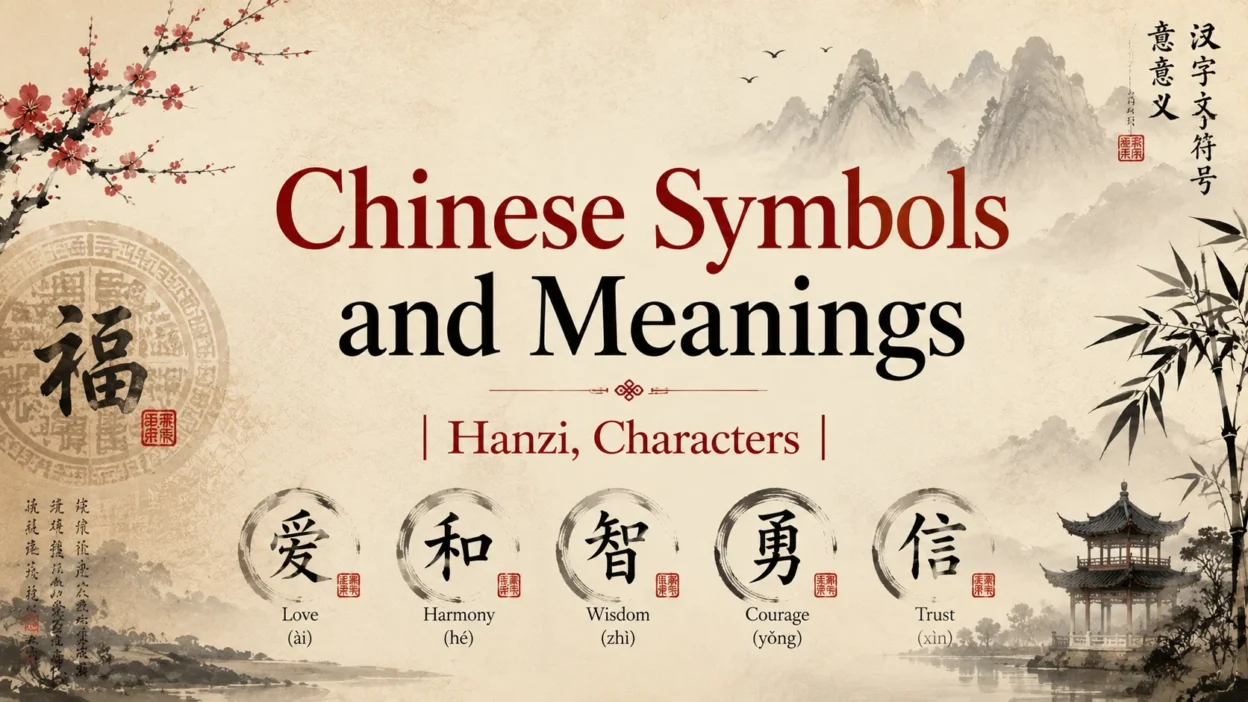
A single Chinese character can tell an entire story.
Unlike alphabetic writing systems where letters have no meaning on their own, each Chinese character (Hanzi) carries its own meaning, history, and energy. A symbol isn’t just a word — it’s a window into thousands of years of philosophy, culture, and art.
From the graceful curves of “love” (爱) to the powerful strokes of “dragon” (龙), Chinese symbols and meanings have captivated people around the world. They appear on tattoos, home decor, jewelry, and artwork. But using them correctly requires understanding — not just their dictionary definition, but their cultural weight.
This complete guide explores the most popular Chinese symbols, their hidden meanings, proper usage, and common mistakes to avoid. Whether you’re getting a tattoo, decorating your home, or simply curious about Chinese culture, you’ll find everything you need here.
Understanding Chinese Characters
Before diving into specific Chinese symbols and meanings, let’s understand how these characters work.
| Aspect | Explanation |
|---|---|
| Name | Hanzi (汉字) — literally “Han characters” |
| Age | Over 3,000 years of continuous use |
| Type | Logographic — each character represents a word or concept |
| Number | 50,000+ total characters; 3,000 for basic literacy |
| Components | Radicals (meaning hints) + phonetic (sound hints) |
How Chinese Characters Are Formed
There are six main ways Chinese characters are created:
| Type | Description | Example |
|---|---|---|
| Pictographs | Drawings of objects | 日 (sun), 月 (moon), 山 (mountain) |
| Ideographs | Abstract concepts | 上 (up), 下 (down), 一 (one) |
| Compound Ideographs | Combined meanings | 明 (bright) = sun + moon |
| Phonetic Compounds | Sound + meaning | 妈 (mother) = woman + horse sound |
| Mutual Explanatory | Related concepts | 考 (old) and 老 (aged) |
| Borrowed Characters | Sound borrowed for another word | 来 (come) originally meant “wheat” |
Traditional vs Simplified Chinese
| System | Where Used | Characteristics |
|---|---|---|
| Traditional | Taiwan, Hong Kong, Macau, overseas communities | More strokes, older form |
| Simplified | Mainland China, Singapore | Fewer strokes, adopted 1950s-60s |
💡 This guide includes both forms where relevant.
The Most Popular Chinese Symbols
Here are the most commonly recognized Chinese symbols and meanings worldwide.
| Symbol | Simplified | Traditional | Pinyin | Primary Meaning |
|---|---|---|---|---|
| 爱 | 爱 | 愛 | ài | Love |
| 福 | 福 | 福 | fú | Luck, blessing |
| 和 | 和 | 和 | hé | Peace, harmony |
| 龙 | 龙 | 龍 | lóng | Dragon |
| 寿 | 寿 | 壽 | shòu | Longevity |
| 囍 | 囍 | 囍 | shuāng xǐ | Double happiness |
| 家 | 家 | 家 | jiā | Family, home |
| 忍 | 忍 | 忍 | rěn | Patience, endurance |
| 义 | 义 | 義 | yì | Righteousness, justice |
| 道 | 道 | 道 | dào | The Way (Tao) |
| 禅 | 禅 | 禪 | chán | Zen meditation |
| 梦 | 梦 | 夢 | mèng | Dream |
| 美 | 美 | 美 | měi | Beauty |
| 安 | 安 | 安 | ān | Peace, safety |
| 康 | 康 | 康 | kāng | Health |
Chinese Symbols for Love
Love is one of the most requested Chinese symbols and meanings, especially for tattoos.
爱 (Ài) — Love ❤️
| Aspect | Information |
|---|---|
| Simplified | 爱 |
| Traditional | 愛 |
| Meaning | Love, affection, to like |
| Components | 爫 (claw/hand) + 冖 (cover) + 心 (heart) + 友 (friend) |
| Traditional breakdown | 心 (heart) is visible in the center |
The traditional character 愛 contains a “heart” (心) in the middle — a beautiful reminder that love comes from the heart.
情 (Qíng) — Deep Feeling
| Aspect | Information |
|---|---|
| Symbol | 情 |
| Meaning | Emotion, feeling, passion, affection |
| Components | 忄 (heart radical) + 青 (green/blue, phonetic) |
恋 / 戀 (Liàn) — Romantic Love
| Aspect | Information |
|---|---|
| Simplified | 恋 |
| Traditional | 戀 |
| Meaning | Romantic love, attachment, longing |
| Usage | Used for passionate, romantic love |
Difference Between 爱 and 情
| Symbol | Meaning | Usage |
|---|---|---|
| 爱 (Ài) | Love as a verb | “I love you” — 我爱你 (wǒ ài nǐ) |
| 情 (Qíng) | Feeling, emotion | “Romantic feelings” — 爱情 (àiqíng) |
⚠️ Tattoo Warning: 爱 is very common in tattoos, but make sure it’s written correctly. The traditional 愛 contains a “heart” (心) — many prefer this version for its deeper meaning.
Chinese Symbols for Family
Family is central to Chinese culture. These Chinese symbols and meanings reflect that deep value.
家 (Jiā) — Family, Home 🏠
| Aspect | Information |
|---|---|
| Symbol | 家 |
| Meaning | Family, home, household |
| Components | 宀 (roof) + 豕 (pig) |
| Cultural note | In ancient China, families who owned pigs were settled and prosperous |
孝 (Xiào) — Filial Piety
| Aspect | Information |
|---|---|
| Symbol | 孝 |
| Meaning | Filial piety, respect for parents and ancestors |
| Components | 耂 (old) + 子 (child) |
| Cultural note | One of the most important virtues in Chinese culture |
父母 (Fùmǔ) — Parents
| Symbol | Meaning |
|---|---|
| 父 (fù) | Father |
| 母 (mǔ) | Mother |
| 父母 (fùmǔ) | Parents |
子 (Zǐ) — Child, Son
| Aspect | Information |
|---|---|
| Symbol | 子 |
| Meaning | Child, son, seed |
| Usage | Appears in many family-related words |
Chinese Symbols for Strength & Power
These Chinese symbols and meanings represent inner and outer strength.
力 (Lì) — Power, Strength 💪
| Aspect | Information |
|---|---|
| Symbol | 力 |
| Meaning | Power, strength, force, ability |
| Usage | Often combined: 力量 (lìliang) = strength |
龙 / 龍 (Lóng) — Dragon 🐉
| Aspect | Information |
|---|---|
| Simplified | 龙 |
| Traditional | 龍 |
| Meaning | Dragon — power, wisdom, good fortune, imperial authority |
| Cultural note | In Chinese culture, dragons are benevolent and powerful — unlike Western dragons |
The dragon is one of the most powerful Chinese symbols and meanings. It represents:
- Imperial power (emperors wore dragon robes)
- Good luck and prosperity
- Wisdom and strength
- Yang (masculine) energy
武 (Wǔ) — Martial, Warrior 🥋
| Aspect | Information |
|---|---|
| Symbol | 武 |
| Meaning | Martial, military, warrior |
| Components | 止 (stop) + 戈 (dagger) |
| Usage | 武术 (wǔshù) — martial arts |
强 / 強 (Qiáng) — Strong
| Aspect | Information |
|---|---|
| Simplified | 强 |
| Traditional | 強 |
| Meaning | Strong, powerful, better |
刚 / 剛 (Gāng) — Firm, Hard
| Aspect | Information |
|---|---|
| Simplified | 刚 |
| Traditional | 剛 |
| Meaning | Firm, hard, strong, just |
Chinese Symbols for Happiness & Luck
These are among the most beloved Chinese symbols and meanings worldwide.
福 (Fú) — Luck, Blessing 🧧
| Aspect | Information |
|---|---|
| Symbol | 福 |
| Meaning | Good fortune, luck, blessing, happiness |
| Components | 礻 (spirit) + 畐 (full, abundant) |
| Usage | Often displayed upside down — “dao” (upside down) sounds like “arrive” |
The 福 symbol is everywhere during Chinese New Year. Families paste it on their doors to invite good fortune.
囍 (Shuāng Xǐ) — Double Happiness 💑
| Aspect | Information |
|---|---|
| Symbol | 囍 |
| Meaning | Double happiness, marital bliss |
| Origin | Two combined 喜 (happiness) characters |
| Usage | Weddings, anniversaries, romantic occasions |
Double Happiness is the ultimate wedding symbol in Chinese culture. You’ll see it everywhere at Chinese weddings — on invitations, decorations, and wedding favors.
喜 (Xǐ) — Happiness
| Aspect | Information |
|---|---|
| Symbol | 喜 |
| Meaning | Happiness, joy, pleasure |
| Components | 士 (scholar) + 口 (mouth) + 廿 (twenty) + 口 (mouth) |
| Cultural note | Represents joy expressed through song |
乐 / 樂 (Lè) — Joy
| Aspect | Information |
|---|---|
| Simplified | 乐 |
| Traditional | 樂 |
| Meaning | Joy, happiness, pleasure |
| Note | Same character as “music” (music brings joy) |
Chinese Symbols for Peace & Harmony
These Chinese symbols and meanings represent balance and tranquility.
和 (Hé) — Peace, Harmony ☮️
| Aspect | Information |
|---|---|
| Symbol | 和 |
| Meaning | Peace, harmony, together, gentle |
| Components | 禾 (grain) + 口 (mouth) |
| Cultural note | Harmony is a core Confucian value |
The concept of “harmony” (和) is central to Chinese philosophy. A harmonious family, society, and world are the ultimate goals.
安 (Ān) — Peace, Safety
| Aspect | Information |
|---|---|
| Symbol | 安 |
| Meaning | Peace, safety, calm, secure |
| Components | 宀 (roof) + 女 (woman) |
| Meaning | A woman under a roof — home is safe and peaceful |
平 (Píng) — Flat, Peaceful
| Aspect | Information |
|---|---|
| Symbol | 平 |
| Meaning | Flat, level, peaceful, equal |
| Usage | 和平 (hépíng) — peace |
静 / 靜 (Jìng) — Quiet, Still
| Aspect | Information |
|---|---|
| Simplified | 静 |
| Traditional | 靜 |
| Meaning | Quiet, still, calm, peaceful |
Chinese Symbols for Wealth & Prosperity
These Chinese symbols and meanings attract abundance.
富 (Fù) — Wealth, Rich
| Aspect | Information |
|---|---|
| Symbol | 富 |
| Meaning | Wealth, rich, abundant |
| Components | 宀 (roof) + 畐 (full, abundant) |
| Meaning | A full house — abundance |
财 / 財 (Cái) — Money, Wealth
| Aspect | Information |
|---|---|
| Simplified | 财 |
| Traditional | 財 |
| Meaning | Money, wealth, riches |
| Components | 贝 (shell/money) + 才 (talent) |
禄 (Lù) — Prosperity, Emolument
| Aspect | Information |
|---|---|
| Symbol | 禄 |
| Meaning | Prosperity, official’s salary, good fortune |
| Usage | One of the three star gods (Fu, Lu, Shou) |
金 (Jīn) — Gold, Metal 🥇
| Aspect | Information |
|---|---|
| Symbol | 金 |
| Meaning | Gold, metal, money, wealth |
Chinese Symbols for Longevity
寿 / 壽 (Shòu) — Longevity 🎂
| Aspect | Information |
|---|---|
| Simplified | 寿 |
| Traditional | 壽 |
| Meaning | Long life, longevity, birthday |
| Usage | Used for birthdays, elder respect |
The 寿 symbol is often given as a gift for elderly relatives. It represents the wish for a long, healthy life.
福禄寿 (Fú Lù Shòu) — Three Star Gods
| Symbol | Meaning |
|---|---|
| 福 (Fú) | Fortune, luck |
| 禄 (Lù) | Prosperity, salary |
| 寿 (Shòu) | Longevity |
Together, these three symbols represent a complete blessed life: luck, wealth, and long life.
Chinese Symbols for Friendship
友 (Yǒu) — Friend
| Aspect | Information |
|---|---|
| Symbol | 友 |
| Meaning | Friend, friendship |
| Components | Two hands helping each other |
谊 / 誼 (Yì) — Friendship
| Aspect | Information |
|---|---|
| Simplified | 谊 |
| Traditional | 誼 |
| Meaning | Friendship, relationship |
朋友 (Péngyou) — Friend
| Symbol | Meaning |
|---|---|
| 朋 (péng) | Friend (originally two strings of shells — money) |
| 友 (yǒu) | Friend |
| 朋友 | Friend, friends |
Chinese Symbols for Beauty
美 (Měi) — Beautiful 🌸
| Aspect | Information |
|---|---|
| Symbol | 美 |
| Meaning | Beautiful, pretty, good |
| Components | 羊 (sheep) + 大 (big) |
| Meaning | “Big sheep” — ancient Chinese found sheep beautiful |
丽 / 麗 (Lì) — Beautiful
| Aspect | Information |
|---|---|
| Simplified | 丽 |
| Traditional | 麗 |
| Meaning | Beautiful, elegant |
漂亮 (Piàoliang) — Pretty, Beautiful
| Symbol | Meaning |
|---|---|
| 漂 (piào) | Float, elegant |
| 亮 (liàng) | Bright, clear |
| 漂亮 | Beautiful, pretty, good-looking |
The Four Gentlemen (Noble Plants)
In Chinese art and calligraphy, four plants represent the four seasons and noble virtues.
| Plant | Symbol | Meaning | Season |
|---|---|---|---|
| 梅 (Méi) — Plum Blossom | 梅 | Resilience, perseverance | Winter |
| 兰 (Lán) — Orchid | 蘭 | Elegance, refinement | Spring |
| 竹 (Zhú) — Bamboo | 竹 | Flexibility, integrity | Summer |
| 菊 (Jú) — Chrysanthemum | 菊 | Humility, nobility | Autumn |
竹 (Zhú) — Bamboo 🎋
| Aspect | Information |
|---|---|
| Symbol | 竹 |
| Meaning | Bamboo — flexibility, strength, integrity |
| Why it’s noble | Bends in wind but never breaks |
梅 (Méi) — Plum Blossom 🌸
| Aspect | Information |
|---|---|
| Symbol | 梅 |
| Meaning | Plum blossom — resilience, hope, perseverance |
| Why it’s noble | Blooms in winter, first flower of spring |
Chinese Zodiac Animal Symbols
The 12 Chinese zodiac animals are among the most recognized Chinese symbols and meanings.
| Animal | Symbol | Pinyin | Years (recent) |
|---|---|---|---|
| Rat | 鼠 | shǔ | 2008, 2020 |
| Ox | 牛 | niú | 2009, 2021 |
| Tiger | 虎 | hǔ | 2010, 2022 |
| Rabbit | 兔 | tù | 2011, 2023 |
| Dragon | 龙 / 龍 | lóng | 2012, 2024 |
| Snake | 蛇 | shé | 2013, 2025 |
| Horse | 马 / 馬 | mǎ | 2014, 2026 |
| Goat | 羊 | yáng | 2015, 2027 |
| Monkey | 猴 | hóu | 2016, 2028 |
| Rooster | 鸡 / 雞 | jī | 2017, 2029 |
| Dog | 狗 | gǒu | 2018, 2030 |
| Pig | 猪 / 豬 | zhū | 2019, 2031 |
Yin-Yang Symbol ☯️ Meaning
阴阳 / 陰陽 (Yīn Yáng) — The Ultimate Balance ☯️
| Aspect | Information |
|---|---|
| Symbol | ☯️ |
| Chinese | 阴阳 (simplified), 陰陽 (traditional) |
| Meaning | Interconnected duality of opposite forces |
| Origin | Taoism (Daoism) — ancient Chinese philosophy |
The Meaning of Yin-Yang
| Force | Yin (阴) | Yang (阳) |
|---|---|---|
| Meaning | Dark, feminine, passive | Light, masculine, active |
| Examples | Moon, earth, night, winter | Sun, heaven, day, summer |
| Represents | Receptive, cool, soft | Creative, warm, hard |
What Yin-Yang Teaches
| Lesson | Explanation |
|---|---|
| Interdependence | Nothing exists without its opposite |
| Balance | Too much of anything is harmful |
| Change | Everything flows and transforms |
| Harmony | Opposites can coexist peacefully |
💡 The small dot of opposite color in each half shows that nothing is purely yin or purely yang — everything contains a seed of its opposite.
Double Happiness Symbol (囍)
囍 (Shuāng Xǐ) — Double Happiness 💑
| Aspect | Information |
|---|---|
| Symbol | 囍 |
| Meaning | Double happiness, marital bliss |
| Construction | Two 喜 (happiness) characters side by side |
| Usage | Weddings, anniversaries, romance |
Where You’ll See 囍
| Occasion | Examples |
|---|---|
| Weddings | Invitations, decor, cakes, favors |
| Anniversary | Celebration decorations |
| Home decor | Couple’s bedroom artwork |
| Gifts | Wedding presents |
Fu Symbol (福)
福 (Fú) — Fortune, Luck 🧧
| Aspect | Information |
|---|---|
| Symbol | 福 |
| Meaning | Good fortune, luck, blessing, happiness |
| Usage | Especially common during Lunar New Year |
Why Fu Is Displayed Upside Down
| Tradition | Meaning |
|---|---|
| Upside down | “Dao le” (upside down) sounds like “arrives” |
| Full meaning | “Fortune arrives” |
Families paste the 福 symbol upside down on their doors to invite good fortune to “arrive” at their home.
Shou Symbol (寿)
寿 / 壽 (Shòu) — Longevity
| Aspect | Information |
|---|---|
| Simplified | 寿 |
| Traditional | 壽 |
| Meaning | Long life, longevity |
When to Use Shou
| Occasion | Examples |
|---|---|
| Birthdays | Especially 60th, 70th, 80th, 90th |
| Elderly gifts | Clothing, artwork, decor |
| Tomb sweeping day | Honoring ancestors |
Lu Symbol (禄)
禄 (Lù) — Prosperity, Salary
| Aspect | Information |
|---|---|
| Symbol | 禄 |
| Meaning | Prosperity, official’s salary, good fortune |
| Usage | Career success, financial stability |
Fu, Lu, Shou Together
| Symbol | Meaning |
|---|---|
| 福 (Fú) | Fortune |
| 禄 (Lù) | Prosperity |
| 寿 (Shòu) | Longevity |
Together, these three symbols represent the complete blessed life. You’ll often see them together in Chinese art.
Chinese Numbers & Their Meanings
Numbers carry deep symbolic meaning in Chinese culture.
| Number | Symbol | Pinyin | Meaning |
|---|---|---|---|
| 1 | 一 | yī | Unity, beginning, individuality |
| 2 | 二 | èr | Double, balance, partnership |
| 3 | 三 | sān | Growth, life, “many” |
| 4 | 四 | sì | Unlucky (sounds like “death”) |
| 5 | 五 | wǔ | Center, balance, five elements |
| 6 | 六 | liù | Smooth, lucky, good fortune |
| 7 | 七 | qī | Together, union |
| 8 | 八 | bā | Extremely lucky (sounds like “wealth”) |
| 9 | 九 | jiǔ | Eternal, long-lasting (sounds like “forever”) |
Lucky Numbers
| Number | Why It’s Lucky |
|---|---|
| 8 | Sounds like “wealth” (发 – fā) |
| 6 | Sounds like “smooth” (流 – liú) |
| 9 | Sounds like “eternal” (久 – jiǔ) |
Unlucky Number
| Number | Why It’s Unlucky |
|---|---|
| 4 | Sounds like “death” (死 – sǐ) |
Many Chinese buildings skip the 4th floor, similar to Western buildings skipping the 13th.
Colors in Chinese Symbolism
Colors carry powerful meanings in Chinese culture.
| Color | Symbol | Meaning |
|---|---|---|
| Red | 红 (hóng) | Luck, happiness, celebration, prosperity |
| Yellow | 黄 (huáng) | Imperial power, earth, royalty |
| Gold | 金 (jīn) | Wealth, success, prosperity |
| White | 白 (bái) | Death, mourning, purity (opposite of Western) |
| Black | 黑 (hēi) | Water, north, depth, evil (traditionally) |
| Green | 绿 (lǜ) | Growth, harmony, health, environment |
| Blue | 蓝 (lán) | Healing, trust, immortality |
| Purple | 紫 (zǐ) | Divinity, spirituality, royalty |
Color Warnings
| Color | Warning |
|---|---|
| White | Never give white flowers or white envelopes for happy occasions (funerals only) |
| Red | The luckiest color — used for weddings, New Year, celebrations |
| Black | Associated with funerals and mourning |
Chinese Symbol Tattoo Warnings
Chinese character tattoos are popular worldwide, but they often go wrong. Here’s what you need to know.
Common Tattoo Mistakes
| Mistake | Why It’s a Problem |
|---|---|
| Incorrect stroke order | Looks like a child wrote it |
| Missing strokes | Changes the meaning completely |
| Using simplified characters | Traditional often looks more artistic |
| Random characters | No grammatical connection — just a word list |
| Wrong font | Computer fonts look unnatural on skin |
Examples of Famous Tattoo Fails
| Intended Meaning | Actual Meaning |
|---|---|
| “Love and strength” | Random characters that make no sense |
| “Warrior” | “Barbecue” (depending on font) |
| “Dragon” | “Snail” (if strokes are wrong) |
Safe Tattoo Advice
| Tip | Explanation |
|---|---|
| Consult a native speaker | Don’t trust online translators |
| Use traditional characters | 愛 instead of 爱 (contains the “heart” radical) |
| Research the font | Calligraphy looks better than computer fonts |
| One or two characters maximum | Grammatical phrases rarely work as tattoos |
| Consider cultural respect | Some symbols are sacred, not decorative |
Most Popular (and Safe) Tattoo Symbols
| Symbol | Meaning | Safety |
|---|---|---|
| 爱 (traditional) | Love | Safe |
| 福 | Luck | Safe |
| 龙 | Dragon | Safe |
| 和 | Peace | Safe |
| 忍 | Patience | Safe |
| 道 | The Way | Safe |
Chinese Symbols FAQ
Q. What is the most popular Chinese symbol?
A. The most recognized Chinese symbols worldwide are 福 (fú — luck), 爱 (ài — love), and 龙 (lóng — dragon).
Q. What Chinese symbol means strength?
A. 力 (lì) means strength and power. 强 (qiáng) means strong.
Q. What Chinese symbol means family?
A. 家 (jiā) means family or home. It shows a pig under a roof — a settled, prosperous household.
Q. What Chinese symbol means peace?
A. 和 (hé) means peace and harmony. 安 (ān) means peace and safety.
Q. What is the difference between simplified and traditional Chinese?
A. Traditional characters (used in Taiwan, Hong Kong) have more strokes and are older. Simplified (used in mainland China) have fewer strokes and were adopted in the 1950s-60s to improve literacy.
Q. Is it disrespectful to get a Chinese symbol tattoo?
A. Generally no, as long as it’s done correctly and respectfully. However, avoid sacred or religious symbols (like Buddhist mantras) unless you understand their significance.
Q. What does a red envelope symbolize?
A. A red envelope (红包 — hóngbāo) contains money and is given during holidays and weddings. Red symbolizes luck; the money brings prosperity.
Q. What does the dragon symbolize in Chinese culture?
A. The dragon (龙 — lóng) represents power, wisdom, good fortune, and imperial authority. Unlike Western dragons, Chinese dragons are benevolent.
Q. Why is the number 8 lucky?
A. Eight (八 — bā) sounds like the word for “wealth” (发 — fā). People pay extra for phone numbers, license plates, and addresses with many 8s.
Q. Why is the number 4 unlucky?
A. Four (四 — sì) sounds like the word for “death” (死 — sǐ). Many buildings skip the 4th floor, similar to Western skipping the 13th.
Final Takeaway
Chinese symbols and meanings offer a window into one of the world’s oldest continuous civilizations. Each character carries history, philosophy, and beauty.
Three Things to Remember
- Context is everything — A symbol’s meaning changes based on surrounding characters and cultural context.
- Traditional vs simplified matters — Traditional characters often contain deeper meaning (like the “heart” in 愛).
- Respect the culture — If you’re getting a tattoo or using Chinese symbols, research properly. Incorrect usage is both disrespectful and embarrassing.
Quick Reference Card
| Symbol | Meaning | Pinyin |
|---|---|---|
| 爱 | Love | ài |
| 福 | Luck | fú |
| 家 | Family | jiā |
| 和 | Peace | hé |
| 龙 | Dragon | lóng |
| 寿 | Longevity | shòu |
| 囍 | Double happiness | shuāng xǐ |
| 道 | The Way | dào |
| 美 | Beauty | měi |
| 忍 | Patience | rěn |
Lillian Hayes is a content writer focused on explaining meanings and language in a simple and clear way. She creates easy-to-understand content that helps readers learn and communicate better.