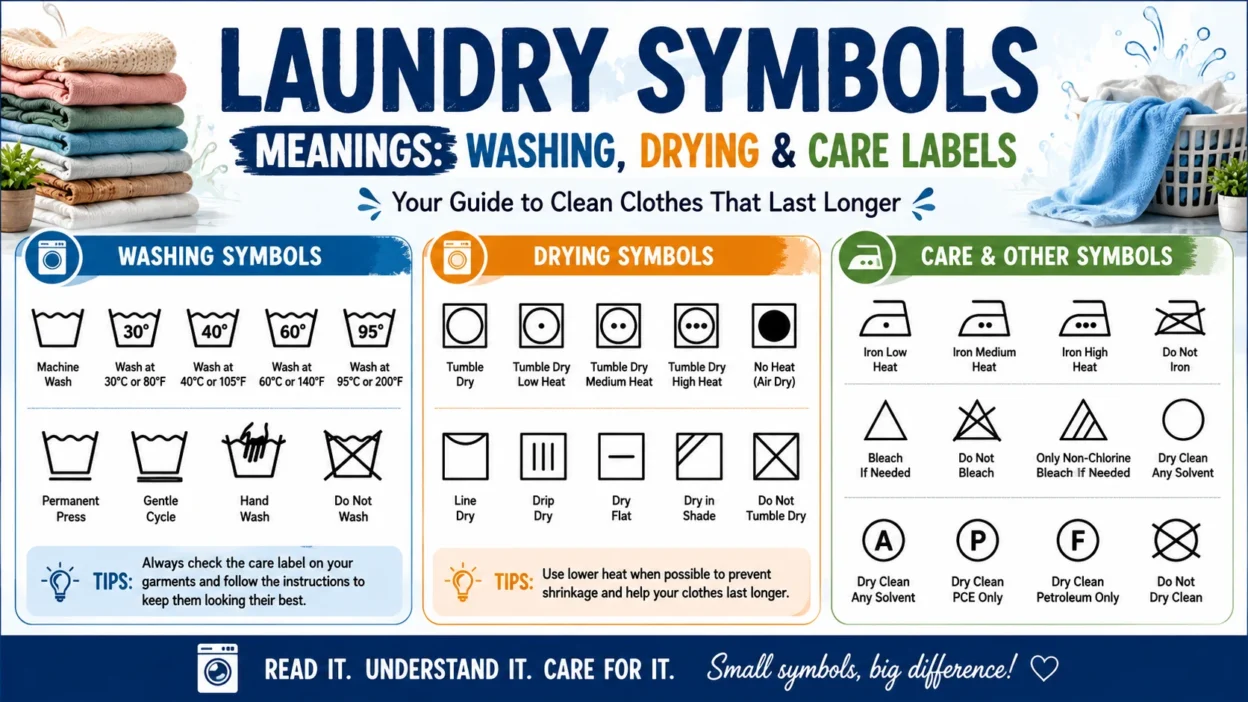
Understanding laundry symbols meanings can save your clothes from shrinking, fading, stretching, or becoming damaged during washing and drying. Those small icons found on clothing care labels may seem confusing at first, but they provide essential instructions that help garments last longer and maintain their appearance.
From washing and bleaching symbols to drying, ironing, and professional cleaning instructions, each symbol serves a specific purpose. Ignoring these care labels can lead to costly mistakes, such as ruining delicate fabrics or causing permanent damage to favorite clothing items.
Whether you’re doing laundry for the first time or simply want to improve your clothing care routine, learning laundry symbols is one of the easiest ways to protect your wardrobe. This guide explains the most common laundry symbols, what they mean, and how to follow them correctly. By the end, you’ll be able to read care labels confidently and make better decisions when washing, drying, ironing, and caring for clothes.
Quick Answer
Laundry symbols are standardized icons printed on clothing care labels that tell you how to properly wash, dry, bleach, iron, and clean garments. Following these symbols helps prevent shrinking, fading, fabric damage, and premature wear while extending the life of your clothing.
Meaning Overview
| Aspect | Meaning |
|---|---|
| Definition | Care instructions for clothing and fabrics |
| Origin | International textile care labeling systems |
| Usage | Garment care and maintenance |
| Context | Washing, drying, ironing, bleaching, and cleaning |
| Purpose | Protect fabrics and extend garment life |
What Are Laundry Symbols?
Laundry symbols are universal icons used on clothing labels to communicate proper care instructions. Instead of relying on written instructions in multiple languages, manufacturers use these symbols to provide guidance that can be understood worldwide.
Most care labels contain five categories of symbols:
- Washing
- Bleaching
- Drying
- Ironing
- Professional cleaning
Each category helps consumers understand how to care for specific fabrics and garments.
Why Laundry Symbols Matter
Ignoring care instructions can result in:
- Shrunk clothing
- Fabric damage
- Color fading
- Misshapen garments
- Weakened fibers
- Reduced garment lifespan
Understanding laundry symbols helps you:
- Protect clothing investments
- Maintain fabric quality
- Preserve colors
- Save money on replacements
- Improve overall laundry results
Washing Symbols Explained
Wash Tub Symbol
The wash tub icon indicates washing instructions.
Plain Wash Tub
A plain tub filled with water means the garment can be machine washed.
Wash Tub With Number
The number indicates the maximum water temperature.
| Symbol | Meaning |
|---|---|
| 30°C | Cold wash |
| 40°C | Warm wash |
| 50°C | Moderately warm wash |
| 60°C | Hot wash |
| 95°C | Very hot wash |
Wash Tub With Hand
This symbol means hand washing is recommended.
Hand-wash garments should be cleaned gently using mild detergent and cool water.
Wash Tub With One Line Underneath
Indicates a permanent press cycle.
This setting reduces wrinkles and provides gentler agitation.
Wash Tub With Two Lines Underneath
Represents a delicate or gentle cycle.
Suitable for:
- Silk
- Lace
- Delicate fabrics
- Lightweight garments
Crossed-Out Wash Tub
A crossed-out wash tub means do not wash.
Such garments may require professional dry cleaning.
Bleaching Symbols Explained
Empty Triangle
An empty triangle means bleach can be used when needed.
Triangle With Two Diagonal Lines
Only non-chlorine bleach is allowed.
This is common for colored garments.
Crossed-Out Triangle
Do not bleach under any circumstances.
Using bleach may permanently damage the fabric.
Drying Symbols Explained
Square Symbol
The square represents drying instructions.
Square With Circle
Indicates tumble drying instructions.
One Dot Inside Circle
Tumble dry on low heat.
Two Dots Inside Circle
Tumble dry on medium heat.
Three Dots Inside Circle
Tumble dry on high heat.
Crossed-Out Circle Inside Square
Do not tumble dry.
Air drying is recommended.
Square With Horizontal Line
Lay flat to dry.
Ideal for sweaters and knitted garments.
Square With Vertical Lines
Line dry or hang dry.
Common for shirts, dresses, and lightweight fabrics.
Square With Three Vertical Lines
Drip dry without wringing.
Useful for delicate materials.
Square With Curved Line
Hang dry naturally.
Ironing Symbols Explained
Iron Symbol
The iron icon provides ironing instructions.
One Dot
Low temperature ironing.
Suitable for:
- Silk
- Nylon
- Delicate synthetics
Two Dots
Medium temperature ironing.
Suitable for:
- Polyester
- Wool blends
Three Dots
High temperature ironing.
Suitable for:
- Cotton
- Linen
Crossed-Out Iron
Do not iron.
Heat may damage the fabric.
Iron With Steam Crossed Out
Do not use steam while ironing.
Professional Cleaning Symbols
Circle Symbol
Represents professional dry cleaning instructions.
Circle With Letter
Specific letters indicate solvents used by professional cleaners.
Common letters include:
- P
- F
- W
These symbols are primarily intended for professional cleaning services.
Crossed-Out Circle
Do not dry clean.
Alternative cleaning methods should be used.
Laundry Symbols for Common Fabrics
Cotton
Most cotton garments:
- Machine washable
- Medium to high heat drying
- Medium to high heat ironing
Wool
Wool often requires:
- Cold water
- Gentle cycle
- Flat drying
- Low heat ironing
Silk
Silk typically requires:
- Hand washing
- Gentle detergent
- Air drying
- Low heat ironing
Polyester
Polyester usually allows:
- Machine washing
- Medium heat drying
- Low to medium ironing
Linen
Linen generally supports:
- Machine washing
- Air drying
- High heat ironing
Most Common Laundry Symbol Mistakes
| Mistake | Correct Approach |
|---|---|
| Ignoring care labels | Always check labels first |
| Using hot water for all clothes | Follow temperature instructions |
| Tumble drying everything | Check drying symbols |
| Bleaching colored fabrics | Verify bleach symbol |
| Using high heat on delicate items | Follow ironing dots |
| Washing wool like cotton | Use gentle care |
| Drying sweaters on hangers | Lay flat to dry |
| Overlooking hand-wash symbols | Hand wash when required |
| Assuming all clothes are machine washable | Check labels carefully |
| Ignoring dry-clean-only instructions | Follow professional cleaning guidance |
Laundry Symbols by Category
Washing Symbols
- Machine wash
- Hand wash
- Do not wash
- Gentle cycle
- Delicate cycle
Bleaching Symbols
- Bleach allowed
- Non-chlorine bleach only
- Do not bleach
Drying Symbols
- Tumble dry
- Line dry
- Lay flat to dry
- Drip dry
- Do not tumble dry
Ironing Symbols
- Low heat
- Medium heat
- High heat
- Do not iron
Professional Cleaning Symbols
- Dry clean
- Wet clean
- Do not dry clean
Tips for Reading Care Labels
Read Labels Before First Wash
Always check care instructions before laundering new garments.
Separate Fabrics
Different materials require different care methods.
Use Correct Water Temperature
Hot water may shrink some fabrics while cold water may not remove certain stains effectively.
Avoid Excessive Heat
Heat is one of the most common causes of fabric damage.
Follow Drying Instructions
Proper drying helps maintain shape and fit.
Related Questions
What is the most important laundry symbol?
The washing symbol is often the most important because it determines whether a garment can be machine washed, hand washed, or requires professional cleaning.
What does a crossed-out tumble dryer symbol mean?
It means the garment should not be placed in a tumble dryer because heat may damage the fabric.
What does the triangle symbol mean on clothes?
The triangle represents bleaching instructions.
Why do some clothes say hand wash only?
Delicate fabrics may become damaged by machine agitation and require gentler cleaning methods.
FAQs
Are laundry symbols the same worldwide?
Most laundry symbols follow international standards and are widely recognized around the world.
What does one dot mean on a laundry symbol?
One dot usually indicates low heat or low temperature settings.
Can I ignore care labels?
Ignoring care labels increases the risk of shrinking, fading, stretching, and damaging clothing.
What symbol means do not wash?
A crossed-out wash tub means the garment should not be washed normally.
What does a square with a circle mean?
It refers to tumble drying instructions.
Why are laundry symbols used instead of words?
Symbols provide universal instructions regardless of language.
What happens if I use the wrong water temperature?
Incorrect temperatures may cause shrinking, fading, or fabric damage.
Are dry-clean-only clothes always required to be dry cleaned?
In most cases, yes. Following the care label helps prevent damage.
Conclusion
Understanding laundry symbols meanings is one of the easiest ways to extend the life of your clothing and keep garments looking their best. These small icons provide valuable guidance about washing, drying, bleaching, ironing, and professional cleaning. By following care labels correctly, you can avoid common laundry mistakes such as shrinking fabrics, fading colors, and damaging delicate materials.
Although laundry symbols may seem complicated at first, they become easy to recognize with practice. Learning the meaning behind each symbol helps you make smarter laundry decisions and protect your wardrobe investment. Whether you’re caring for cotton shirts, wool sweaters, silk blouses, or synthetic fabrics, knowing how to interpret care labels ensures your clothing remains in excellent condition for years to come.

Lillian Hayes is a content writer focused on explaining meanings and language in a simple and clear way. She creates easy-to-understand content that helps readers learn and communicate better.