
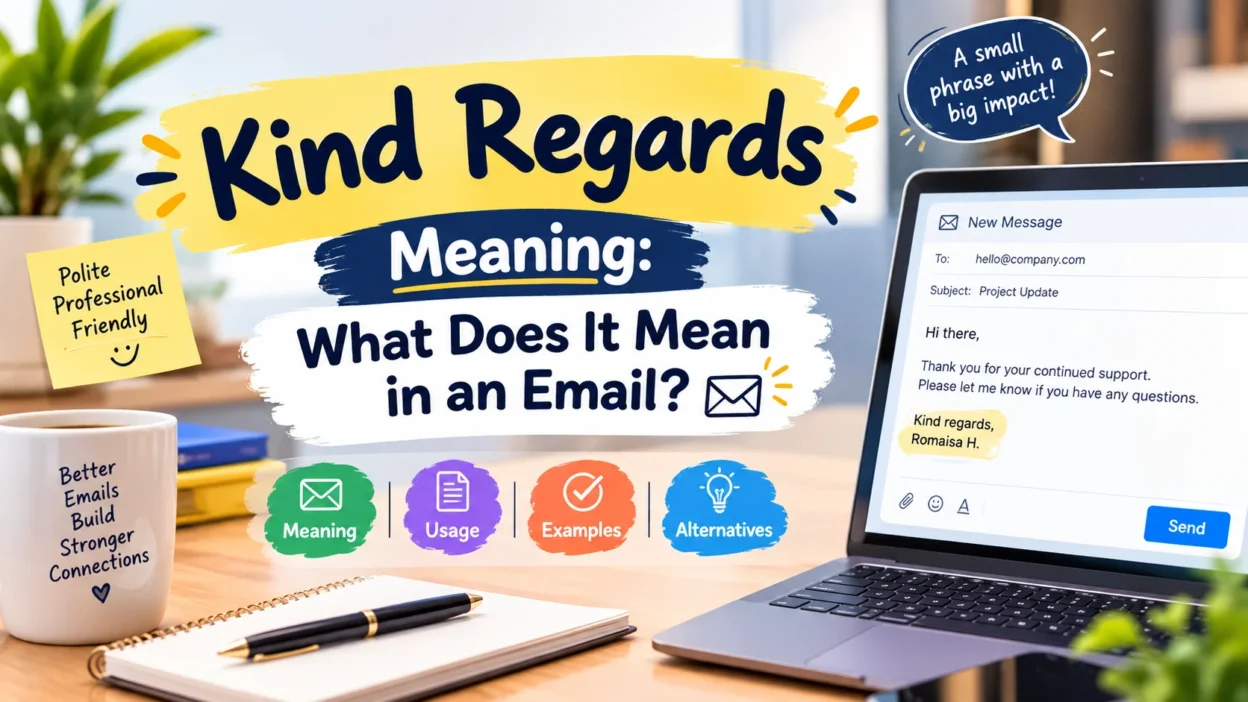
Have you ever received an email that ended with the words Kind regards and wondered what they really mean? This common expression appears in business emails, professional messages, job applications, customer service conversations, and everyday correspondence. It helps writers end their messages politely without sounding overly formal or distant.
The kind regards meaning is a polite way to express goodwill, respect, and friendliness toward the person receiving your message. People typically write it at the end of an email or letter, just before their name. Although it communicates warmth and professionalism, it does not automatically suggest romantic interest or a close personal relationship.
In this guide, you will learn what kind regards means, when to use it, how it compares with best regards and regards, and how to choose the right email sign-off for different situations.
📖 What Does Kind Regards Mean?
Kind regards is a polite closing phrase that expresses goodwill and respect toward the recipient. People commonly use it at the end of professional emails, formal messages, and polite everyday correspondence.
The expression combines two words. Kind suggests friendliness, consideration, or goodwill, while regards communicates respectful thoughts or greetings. Together, they create a warm but professional way to finish a message.
For example:
Dear Ms. Johnson,
Thank you for providing the information about the available position. I appreciate your time and look forward to hearing from you.
Kind regards,
Alex
In this example, the closing creates a courteous impression without making the email sound overly formal.
| Expression | Meaning |
|---|---|
| Kind regards | A polite, friendly, and professional closing |
| Best regards | A courteous closing that expresses goodwill |
| Regards | A brief, neutral, professional closing |
| Warm regards | A warmer, more personal closing |
| Best wishes | A friendly expression of goodwill |
Although these expressions are similar, they can communicate slightly different levels of warmth and formality.
💼 What Does Kind Regards Mean in an Email?
In an email, kind regards usually signals that the message has ended on a polite and professional note. It shows consideration for the recipient while maintaining appropriate boundaries.
People use it when communicating with coworkers, managers, clients, recruiters, teachers, customers, and professional contacts.
For example, imagine you email a recruiter to ask about the progress of your application. After thanking them for their time, you can end the message with Kind regards followed by your name.
This closing works well because it is respectful without sounding stiff. It also allows you to maintain a friendly tone even when discussing a serious or business-related subject.
Common situations include:
- Following up on a job application
- Replying to a business inquiry
- Thanking someone for their assistance
- Communicating with a manager or colleague
- Contacting a university or organization
- Responding to a customer service representative
- Sending a professional introduction
You do not need to have a close relationship with someone to use kind regards. It is suitable for many professional relationships, including first-time communication.
✍️ How to Use Kind Regards Correctly
The usual placement for kind regards is at the end of an email or letter, after the main message and before your name.
A simple format looks like this:
Kind regards,
Your Name
In a professional email, leave a line between the closing and your name if your email format allows it. You can include your job title, company, or contact information underneath your name when appropriate.
Here is a complete example:
Subject: Request for Further Information
Dear Hiring Manager,
Thank you for reviewing my application. I would appreciate any additional information you can share about the next steps in the recruitment process.
Kind regards,
Sarah Williams
The expression normally appears in lowercase after the first word, except when formatting or sentence position requires something different. In standard email writing, Kind regards, is a natural and widely accepted format.
🤝 Is Kind Regards Formal or Informal?
Kind regards is best described as polite and professional, with a friendly tone. It is less stiff than some traditional formal closings but more professional than casual expressions such as See you or Talk soon.
Its suitability depends on the recipient and the situation. You can use it in formal business correspondence, but it also works in routine emails to people you know.
| Situation | Is Kind Regards Suitable? | Why |
|---|---|---|
| Email to a recruiter | Yes | Professional and courteous |
| Message to your manager | Yes | Respectful without being overly formal |
| Email to a client | Yes | Maintains a professional tone |
| University inquiry | Yes | Appropriate for formal correspondence |
| Email to a coworker | Yes | Friendly and professional |
| Text to a close friend | Usually unnecessary | May sound too formal for casual messaging |
| Romantic message | Possible, but uncommon | Other closings usually feel more personal |
If you are unsure how formal your email should sound, kind regards is generally a safe choice for professional communication.
⚖️ Kind Regards vs. Best Regards
Kind regards and best regards are both common email sign-offs. They communicate respect and goodwill, and in many situations, you can use them interchangeably.
However, kind regards can sound slightly warmer or more considerate, while best regards can feel neutral and professional.
| Feature | Kind Regards | Best Regards |
|---|---|---|
| Tone | Polite, warm, professional | Professional, courteous |
| Formality | Moderately formal | Moderately formal |
| Business emails | Suitable | Suitable |
| First-time contact | Suitable | Suitable |
| Message to a colleague | Suitable | Suitable |
| Main impression | Friendly respect | General goodwill |
Neither closing is universally better. Choose the one that sounds natural for your relationship with the recipient and the overall tone of your message.
📩 Kind Regards vs. Regards
The difference between kind regards and regards is mainly tone.
Kind regards adds a touch of warmth, while regards is shorter and more neutral. Both are acceptable in professional emails, although regards can sometimes sound less personal.
For example:
Kind regards,
Thank you for helping me resolve the issue. I appreciate your support.
Regards,
Please find the requested document attached.
The first version communicates a little more appreciation, while the second keeps the closing brief.
If you want to sound polite without appearing distant, kind regards is often a good choice.
🌷 Kind Regards vs. Warm Regards
Warm regards expresses a more personal level of friendliness than kind regards. It is useful when you have an established professional relationship or want to sound especially appreciative.
Kind regards remains suitable for a wide range of business emails, including first-time contact. Warm regards may feel more natural when writing to a colleague, client, mentor, or someone who has helped you.
| Kind Regards | Warm Regards |
|---|---|
| Polite and professional | Friendly and more personal |
| Works for new contacts | Often suits established contacts |
| Appropriate for routine business messages | Useful for appreciative or relationship-focused messages |
| Neutral warmth | Greater warmth |
Both expressions are professional. The best option depends on how much personal warmth you want to communicate.
💌 Does Kind Regards Mean Someone Likes You?
Not necessarily. When someone ends an email with kind regards, they are usually being polite rather than expressing romantic interest.
The phrase is common in workplaces, educational settings, business conversations, and customer service messages. Someone may use it with people they barely know because it is a conventional professional sign-off.
For example, a recruiter might end an email with Kind regards after arranging an interview. This does not indicate personal attraction; it simply maintains a courteous professional tone.
The meaning may feel more personal when someone uses warm regards in an established relationship, but even that expression does not automatically signal romantic feelings.
To understand someone’s intention, consider the complete message and the relationship rather than relying on the sign-off alone.
👩 What Does Kind Regards Mean From a Woman or Man?
The expression has the same basic meaning regardless of who uses it. A woman or man who signs an email with kind regards is generally communicating politeness, respect, or goodwill.
The context may explain why they chose it.
- At work: They are maintaining a professional tone.
- During a first conversation: They are ending the message courteously.
- After receiving help: They may be expressing appreciation.
- In an ongoing business relationship: They are using a familiar professional sign-off.
- In a personal conversation: They may prefer a polite or slightly formal writing style.
You should not assume that the phrase carries a special meaning based on the sender’s gender.
📝 Kind Regards Email Examples
The following examples show how you can use kind regards in different professional situations.
Example 1: Job Application
Subject: Application for Marketing Assistant Position
Dear Hiring Manager,
I am writing to express my interest in the Marketing Assistant position. I have experience in content creation, research, and digital marketing, and I would welcome the opportunity to discuss my qualifications.
Thank you for your time and consideration.
Kind regards,
Jordan Smith
Example 2: Email to a Manager
Subject: Project Update
Hi Mr. Davis,
I have completed the first draft of the report and attached it for your review. Please let me know if you would like me to make any changes.
Kind regards,
Emily
Example 3: Thank-You Email
Subject: Thank You for Your Assistance
Dear Mr. Brown,
Thank you for taking the time to explain the process and answer my questions. Your guidance was very helpful, and I appreciate your support.
Kind regards,
Michael
Example 4: Customer Service Inquiry
Subject: Request for Order Update
Dear Customer Service Team,
I am contacting you to ask about the status of my order. Could you please provide an update when you have a chance?
Thank you for your assistance.
Kind regards,
Taylor Green
Example 5: Follow-Up Email
Subject: Following Up on Our Conversation
Hello Ms. Lee,
I wanted to follow up on our recent conversation and ask whether there have been any updates. I appreciate your time and look forward to hearing from you.
Kind regards,
Chris
These examples show that kind regards works well when you want to remain courteous without making your email overly formal.
🚫 Common Mistakes When Using Kind Regards
Although kind regards is easy to use, a few simple guidelines can help your emails look more polished.
1. Using it in every casual message
A close friend may find kind regards unusually formal in a quick text. Match your closing to the relationship and communication style.
2. Adding unnecessary punctuation
The standard format is Kind regards, followed by your name. A comma is conventional, although some email styles omit punctuation.
3. Writing the entire phrase in capital letters
Avoid KIND REGARDS in ordinary correspondence. Standard capitalization looks more natural.
4. Treating it as a complete message
Kind regards is a sign-off, not a replacement for the main content of an email. Include your actual request, response, or information before the closing.
5. Assuming it signals affection
The phrase usually communicates professional courtesy. Do not interpret it as romantic interest without other supporting context.
6. Mixing too many closing phrases
Avoid combinations such as Kind regards and best wishes in the same sign-off. Choose one closing that fits your message.
🎯 What Are the Best Alternatives to Kind Regards?
Several alternatives can work depending on the formality and warmth you want to express.
| Email Closing | Best Use |
|---|---|
| Best regards | General professional correspondence |
| Regards | Short, neutral business emails |
| Warm regards | Friendly professional relationships |
| Best wishes | Friendly messages and good wishes |
| Sincerely | Formal letters and official communication |
| Thank you | Messages focused on appreciation |
| Many thanks | Friendly requests or expressions of gratitude |
| All the best | Informal professional relationships |
| Yours sincerely | Traditional formal correspondence in British English when the recipient is named |
| Respectfully | Particularly formal or authority-related communication |
No single closing fits every email. If you are writing to someone for the first time, kind regards or best regards is usually a reliable choice.
❓ Frequently Asked Questions About Kind Regards Meaning
What does kind regards mean in simple words?
Kind regards is a polite way to end an email or letter. It expresses goodwill, respect, and friendliness toward the recipient.
Is kind regards professional?
Yes. It is a widely accepted professional sign-off for business emails, job applications, customer service messages, and workplace communication.
Is kind regards formal or informal?
It is moderately formal. It sounds professional while maintaining a friendly tone, making it suitable for many workplace and business situations.
Is kind regards better than best regards?
Neither is always better. Kind regards can sound slightly warmer, while best regards is a neutral, professional option. Both work well in most business emails.
What is the difference between kind regards and regards?
Kind regards adds warmth and friendliness, while regards is shorter and more neutral. Both are appropriate for professional communication.
Does kind regards mean love?
No. Kind regards generally expresses courtesy and goodwill rather than love or romantic affection. It is commonly used in professional correspondence.
Can I use kind regards with my boss?
Yes. Kind regards is suitable for emails to managers, supervisors, and other senior colleagues. It communicates respect without sounding overly stiff.
Can I use kind regards in a job application?
Yes. It is a suitable closing for a job application email, particularly when you want to maintain a professional and courteous tone.
Should I write Kind Regards or Kind regards?
In standard email formatting, Kind regards, is common. Only the first word is capitalized unless a specific style guide says otherwise.
Can I use kind regards in a text message?
You can, but it may sound overly formal in a casual text. It is more common in emails and written professional correspondence.
What should I write after kind regards?
Write your name after the sign-off. In professional emails, you may also include your job title, organization, and contact details beneath your name.
Is kind regards appropriate for a first email?
Yes. It is a polite and professional closing for first-time contact because it communicates goodwill without assuming a close relationship.
🌟 Final Thoughts on Kind Regards Meaning
The phrase kind regards is a polite, friendly, and professional way to end an email or letter. It expresses respect and goodwill while maintaining an appropriate level of formality.
You can use it when contacting a recruiter, writing to a manager, communicating with a client, thanking someone for assistance, or sending a general business inquiry. Although it sounds warm, it does not automatically imply romantic interest or a close personal relationship.
If you want a reliable email sign-off that balances professionalism with friendliness, kind regards is an excellent choice.

Lillian Hayes is a content writer focused on explaining meanings and language in a simple and clear way. She creates easy-to-understand content that helps readers learn and communicate better.