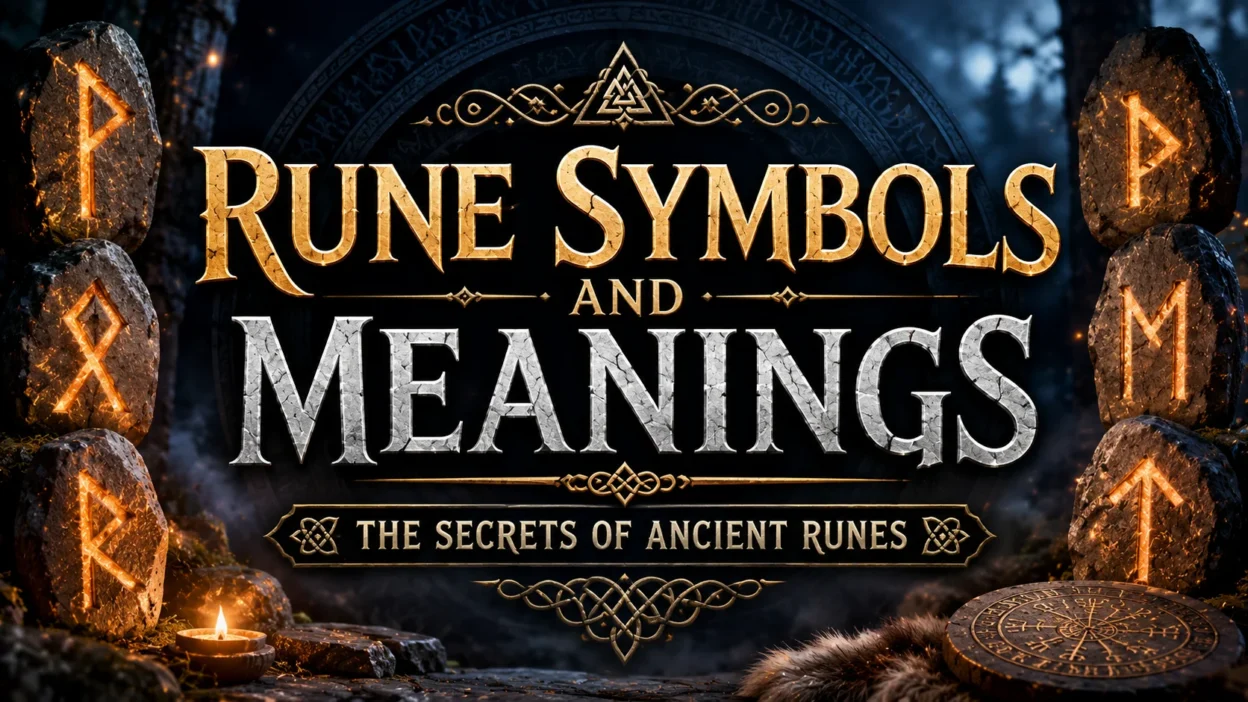
Rune symbols and meanings have fascinated people for centuries. These distinctive characters are use by Germanic peoples before and during the early medieval period, appearing on stones, weapons, jewelry, tools, monuments, and other objects. Today, runes are also popular in historical studies, fantasy, tattoos, jewelry, games, and modern spiritual practices.
However, understanding runes requires separating historical evidence from modern interpretations. Runes were primarily writing characters rather than a universal symbolic code in which every letter had one fixed mystical meaning. Different rune traditions developed over time, and individual runes could have names and associations that provide clues about their historical significance.
The best-known system is the Elder Futhark, consisting of 24 runes. Later traditions include the Younger Futhark and the Anglo-Saxon Futhorc, each with different characters and histories.
This guide explores the major rune symbols, their names, meanings, historical uses, pronunciation, rune alphabets, and modern interpretations.
What Are Rune Symbols?
Runes are characters belonging to several related writing systems used by Germanic-speaking peoples. The earliest known runic inscriptions date to around the 2nd century CE.
The word futhark comes from the first six characters of the Elder Futhark:
F – U – Þ – A – R – K
Unlike the modern alphabet, runic systems are not one single standardized alphabet used throughout all periods and regions.
The major traditions include:
| Rune Tradition | Approx. Period | Number of Runes |
|---|---|---|
| Elder Futhark | c. 150–800 CE | 24 |
| Anglo-Saxon Futhorc | c. 400–1100 CE | 26–33+ |
| Younger Futhark | c. 700–1100 CE | 16 |
| Medieval Runes | c. 1100–1500 CE | Various |
The Elder Futhark is the system most commonly discussed when people search for rune symbols and meanings.
Elder Futhark Rune Symbols and Meanings
The Elder Futhark contains 24 runes divided into three groups traditionally called ættir.
Here is a practical overview:
| Rune | Name | Transliteration | Traditional Meaning / Association |
|---|---|---|---|
| ᚠ | Fehu | F | Cattle, wealth, movable property |
| ᚢ | Uruz | U | Aurochs, strength, vitality |
| ᚦ | Thurisaz | Þ | Giant, thorn |
| ᚨ | Ansuz | A | God, deity |
| ᚱ | Raidho | R | Riding, journey |
| ᚲ | Kenaz | K | Torch |
| ᚷ | Gebo | G | Gift |
| ᚹ | Wunjo | W | Joy |
| ᚺ | Hagalaz | H | Hail |
| ᚾ | Nauthiz | N | Need, necessity |
| ᛁ | Isa | I | Ice |
| ᛃ | Jera | J | Year, harvest |
| ᛇ | Eihwaz | Ï | Yew |
| ᛈ | Perthro | P | Uncertain; possibly a lot or gaming-related term |
| ᛉ | Algiz | Z | Uncertain; traditionally associated with elk in modern interpretations |
| ᛊ | Sowilo | S | Sun |
| ᛏ | Tiwaz | T | Týr |
| ᛒ | Berkano | B | Birch |
| ᛖ | Ehwaz | E | Horse |
| ᛗ | Mannaz | M | Human, person |
| ᛚ | Laguz | L | Water, lake |
| ᛜ | Ingwaz | Ŋ | Ing |
| ᛞ | Dagaz | D | Day |
| ᛟ | Othala | O | Inherited property, estate |
The historical meanings above should not be confuse with modern fortune-telling interpretations. For several runes, especially Perthro, Algiz, and Eihwaz, scholars cannot establish a completely certain original meaning from surviving evidence.
1. Fehu ᚠ — Wealth and Cattle
Fehu is the first rune of Elder Futhark.
Its reconstructed name is associated with cattle or movable wealth. In ancient Germanic societies, livestock represented an important form of wealth and social status.
Modern interpretations often associate Fehu with:
- Wealth
- Prosperity
- Success
- Resources
- Abundance
- Achievement
Historically, however, the rune’s association with cattle and movable property is more important than the modern idea of financial manifestation.
2. Uruz ᚢ — Strength and the Aurochs
Uruz is associated with the aurochs, a large wild ancestor of modern cattle that became extinct.
Because the aurochs was powerful and difficult to domesticate, Uruz has traditionally been connected in modern interpretations with:
- Strength
- Courage
- Vitality
- Endurance
- Physical power
- Transformation
The historical animal association provides the foundation for these later symbolic interpretations.
3. Thurisaz ᚦ — Giant or Thorn
Thurisaz is connected with the Old Germanic word for a giant, particularly a supernatural being associated with Þórr and the giants in later Norse tradition.
The rune is also associated with the word thorn in related rune traditions.
Modern interpretations often connect it with:
- Protection
- Defense
- Conflict
- Force
- Resistance
- Power
Its meaning should be understood within its historical linguistic context rather than as a simple universal symbol of protection.
4. Ansuz ᚨ — God or Deity
Ansuz is generally associated with a word meaning god or deity.
The rune is especially interesting because later Scandinavian rune poems associate the corresponding rune with Óðinn.
Modern symbolic interpretations frequently associate Ansuz with:
- Wisdom
- Communication
- Knowledge
- Inspiration
- Speech
- Divine guidance
Its connection with speech and communication is especially common in modern rune interpretation.
5. Raidho ᚱ — Journey and Riding
Raidho is associated with riding or a journey.
The name comes from a Germanic root connected with riding or travel.
Modern interpretations include:
- Journey
- Movement
- Travel
- Progress
- Direction
- Life path
This makes Raidho particularly popular among people interested in travel symbolism.
6. Kenaz ᚲ — Torch
Kenaz is commonly reconstructed as a word connected with a torch.
A torch naturally provides imagery of light, illumination, and knowledge.
Modern interpretations often associate Kenaz with:
- Creativity
- Knowledge
- Inspiration
- Learning
- Illumination
- Discovery
It is frequently interpreted as the light that makes something previously hidden visible.
7. Gebo ᚷ — Gift
Gebo means gift.
Gift-giving was socially important in ancient Germanic societies, where exchanges could reinforce relationships, alliances, and obligations.
Modern interpretations associate Gebo with:
- Generosity
- Partnership
- Friendship
- Reciprocity
- Love
- Balance
Gebo is also commonly used today as a symbol of exchange and mutual giving.
8. Wunjo ᚹ — Joy
Wunjo is associated with joy or pleasure.
It is often interpreted as one of the more positive runes.
Modern meanings commonly include:
- Happiness
- Joy
- Harmony
- Friendship
- Satisfaction
- Success
The rune can symbolize a sense of belonging and emotional fulfillment in modern interpretations.
9. Hagalaz ᚺ — Hail
Hagalaz means hail.
Hailstorms can arrive suddenly and cause damage, making this rune strongly associated with disruptive natural forces.
Modern interpretations often connect it with:
- Change
- Disruption
- Crisis
- Transformation
- Unexpected events
- Renewal
Rather than simply meaning “bad luck,” Hagalaz is often interpreted as representing unavoidable change.
10. Nauthiz ᚾ — Need
Nauthiz is associated with need, necessity, or constraint.
It represents circumstances in which a person has limited choices.
Modern interpretations include:
- Necessity
- Hardship
- Discipline
- Resistance
- Patience
- Inner strength
The rune can symbolically represent learning through difficult circumstances.
11. Isa ᛁ — Ice
Isa means ice.
Ice represents stillness, coldness, and something temporarily frozen in place.
Modern interpretations commonly associate Isa with:
- Stillness
- Patience
- Pause
- Concentration
- Isolation
- Frozen circumstances
It can symbolize a period in which action is limited and patience becomes important.
12. Jera ᛃ — Year and Harvest
Jera is associated with the year and the cycle of seasons.
Because agricultural life depended heavily on seasonal cycles, the rune has strong associations with harvest and the results of previous work.
Modern interpretations include:
- Harvest
- Reward
- Results
- Cycles
- Patience
- Natural timing
Jera is often understood as a reminder that meaningful results may require time.
13. Eihwaz ᛇ — Yew
Eihwaz is generally associated with the yew tree.
The yew has a long lifespan and was significant in Germanic and European cultural contexts.
Modern rune interpretations often connect Eihwaz with:
- Endurance
- Protection
- Resilience
- Transformation
- Continuity
- Life and death
Its exact historical interpretation is more complicated than many modern rune guides suggest.
14. Perthro ᛈ — Uncertain Meaning
Perthro is one of the Elder Futhark runes whose original meaning is particularly uncertain.
Unlike Fehu or Jera, scholars cannot confidently translate its name from surviving evidence.
Modern interpretations commonly associate Perthro with:
- Mystery
- Fate
- Chance
- Secrets
- Hidden knowledge
- Possibility
These meanings are largely part of modern interpretive traditions rather than securely established historical definitions.
15. Algiz ᛉ — Protection and Uncertain Origin
Algiz has one of the most debated meanings in modern rune literature.
The name and original meaning of the Elder Futhark rune are uncertain. Modern rune systems frequently associate its shape with protection and sometimes with an elk or other animal.
Common modern interpretations include:
- Protection
- Defense
- Awareness
- Guidance
- Connection
- Spiritual safety
It is important to note that these modern associations should not automatically be presented as proven ancient meanings.
16. Sowilo ᛊ — Sun
Sowilo is associated with the sun.
Sun imagery naturally suggests light, energy, warmth, and vitality.
Modern interpretations often include:
- Success
- Energy
- Victory
- Confidence
- Clarity
- Life force
Sowilo is therefore one of the most recognizable positive symbols in modern rune culture.
17. Tiwaz ᛏ — Týr
Tiwaz is named after Týr, a Germanic deity associated in Norse mythology with law, courage, and martial qualities.
Modern interpretations often connect Tiwaz with:
- Justice
- Courage
- Leadership
- Honor
- Sacrifice
- Determination
The rune’s historical connection with Týr gives it a particularly strong warrior and justice-oriented character.
18. Berkano ᛒ — Birch
Berkano is associate with the birch tree.
Trees held important cultural and practical roles in Germanic societies, and birch imagery later became associated with growth and renewal in modern rune interpretation.
Common modern associations include:
- Growth
- Birth
- Renewal
- Fertility
- Healing
- New beginnings
19. Ehwaz ᛖ — Horse
Ehwaz is associated with the horse.
Horses were important for transportation, warfare, agriculture, and status.
Modern interpretations often include:
- Movement
- Partnership
- Trust
- Progress
- Cooperation
- Travel
The horse can represent movement achieved through cooperation between horse and rider.
20. Mannaz ᛗ — Human
Mannaz is associate with human beings or humanity.
Its meaning makes it particularly relevant to ideas of identity, society, and human nature.
Modern interpretations include:
- Humanity
- Identity
- Community
- Intelligence
- Self-awareness
- Cooperation
21. Laguz ᛚ — Water
Laguz is associate with water or a lake.
Water is an important natural element and appears frequently in later symbolic interpretations of runes.
Modern meanings commonly include:
- Intuition
- Emotion
- Flow
- Adaptability
- Dreams
- The unconscious
These broader psychological interpretations are modern additions rather than literal translations.
22. Ingwaz ᛜ — Ing
Ingwaz is associated with Ing, a Germanic deity or ancestral figure.
The historical identity of Ing is not completely clear, but the name appears in early Germanic traditions.
Modern interpretations often associate the rune with:
- Fertility
- Potential
- Growth
- Completion
- Family
- New beginnings
23. Dagaz ᛞ — Day
Dagaz means day.
The contrast between darkness and daylight provides a natural symbolic association with change and illumination.
Modern interpretations include:
- Transformation
- Awakening
- Hope
- Breakthrough
- Clarity
- New beginnings
Dagaz is frequently interprete as the transition from darkness into light.
24. Othala ᛟ — Inherited Property
Othala is associate with inherite property, estate, or ancestral land.
This makes it especially connected with family and heritage.
Modern interpretations often include:
- Heritage
- Ancestry
- Family
- Home
- Tradition
- Belonging
Its historical association with inherited property is more specific than the broad modern idea of “family.”
Rune Symbols for Protection
If you are looking specifically for runes traditionally or popularly associate with protection, several are frequently discuss.
| Rune | Common Modern Association |
|---|---|
| Thurisaz ᚦ | Defense and force |
| Algiz ᛉ | Protection and awareness |
| Eihwaz ᛇ | Endurance and resilience |
| Tiwaz ᛏ | Courage and strength |
| Sowilo ᛊ | Strength and victory |
However, it is important to distinguish modern symbolic interpretations from historically documented meanings.
Rune Symbols for Love
Runes are sometimes use today to represent romantic relationships and emotional connections.
| Rune | Modern Association |
|---|---|
| Gebo ᚷ | Giving, partnership, exchange |
| Wunjo ᚹ | Joy and harmony |
| Berkano ᛒ | Growth and nurturing |
| Ehwaz ᛖ | Partnership and cooperation |
| Ingwaz ᛜ | Fertility and potential |
Gebo is particularly interesting because the historical meaning of gift naturally lends itself to ideas of reciprocity and relationships.
Rune Symbols for Strength
For strength-related symbolism, modern rune interpretations often highlight:
- Uruz ᚢ — physical strength and vitality
- Thurisaz ᚦ — force and resistance
- Tiwaz ᛏ — courage and determination
- Eihwaz ᛇ — endurance
- Sowilo ᛊ — energy and victory
Among these, Uruz is particularly popular because of its association with the powerful aurochs.
Rune Symbols for Wisdom
If you are interested in runes associated with knowledge or wisdom, consider:
Ansuz ᚨ
Associated with gods and later particularly connected with Óðinn, Ansuz is often interpreted as wisdom, communication, and inspiration.
Kenaz ᚲ
The torch imagery makes Kenaz a natural modern symbol for illumination and understanding.
Mannaz ᛗ
Because Mannaz represents humanity, modern interpretations sometimes associate it with intellect and self-awareness.
Rune Symbols for New Beginnings
Several runes can be interpreted through the ideas of growth, cycles, or transformation.
- Jera ᛃ — cycles and harvest
- Berkano ᛒ — birth and growth
- Dagaz ᛞ — transition and awakening
- Ingwaz ᛜ — potential and development
- Sowilo ᛊ — light and renewed energy
These interpretations are especially popular in modern decorative and spiritual contexts.
What Is the Difference Between Elder Futhark and Younger Futhark?
The Elder Futhark contains 24 runes and is the earliest widely recognized Germanic runic alphabet.
The Younger Futhark developed later, particularly during the Viking Age, and contains only 16 primary runes.
Interestingly, the reduction in the number of symbols did not mean the language itself became simpler. Instead, individual Younger Futhark runes could represent multiple sounds.
Younger Futhark is generally divided into:
- Long-branch runes
- Short-twig runes
There was also a later staveless style.
What Is the Anglo-Saxon Futhorc?
The Anglo-Saxon Futhorc developed from earlier runic traditions and was used in England and related contexts.
It expanded beyond the 24-rune Elder Futhark and eventually included more than 28 characters, with some traditions containing over 30.
The additional symbols reflected changes in the sounds of the language.
This demonstrates an important historical point: runes were evolving writing systems, not a fixed collection of mystical symbols.
Were Runes Used for Magic?
There is historical evidence connecting runes with magical and protective practices, but the popular idea that every rune had a fixed magical meaning is much more complicated.
Runic inscriptions appear on objects that may have had practical, commemorative, religious, or magical purposes.
Some historical texts also discuss magical use of runes.
However, modern rune meanings should not automatically be projected backward onto ancient inscriptions.
A rune could function simply as a letter in a written word.
Were Runes Used for Divination?
Modern rune casting is popular, but its relationship with ancient practice requires caution.
There is an ancient written account by the Roman author Tacitus describing Germanic divination involving marked pieces of wood. However, he does not clearly describe the familiar 24-rune Elder Futhark system or the modern practice of drawing rune stones for readings.
Therefore, modern rune divination is best understood as a later interpretive practice influenced by historical runes, rather than a fully documented continuation of an ancient standardized system.
Rune Symbols and Modern Meanings
Today, runes are used in many different ways.
Tattoos
People may choose a rune because of its historical association or modern symbolic interpretation.
Jewelry
Rune symbols appear on necklaces, rings, bracelets, and decorative objects.
Fantasy and Games
Runes are commonly use to create an ancient, magical, or mysterious aesthetic in fictional worlds.
Art and Design
Their angular shapes make runes visually distinctive and suitable for logos, artwork, and typography.
Spiritual Practices
Some modern practitioners use runes for meditation, reflection, or divination.
When using a rune for a meaningful personal symbol, understanding its historical background can help avoid inaccurate claims.
How to Choose a Rune Symbol
The best rune depends on what you want it to represent.
| If You Want to Represent | Rune to Consider |
|---|---|
| Wealth | Fehu ᚠ |
| Strength | Uruz ᚢ |
| Protection | Algiz ᛉ |
| Wisdom | Ansuz ᚨ |
| Journey | Raidho ᚱ |
| Creativity | Kenaz ᚲ |
| Partnership | Gebo ᚷ |
| Happiness | Wunjo ᚹ |
| Change | Hagalaz ᚺ |
| Patience | Nauthiz ᚾ |
| Stillness | Isa ᛁ |
| Harvest | Jera ᛃ |
| Endurance | Eihwaz ᛇ |
| Success | Sowilo ᛊ |
| Courage | Tiwaz ᛏ |
| Growth | Berkano ᛒ |
| Partnership | Ehwaz ᛖ |
| Humanity | Mannaz ᛗ |
| Water / intuition | Laguz ᛚ |
| Potential | Ingwaz ᛜ |
| New beginning | Dagaz ᛞ |
| Heritage | Othala ᛟ |
Frequently Asked Questions
What are rune symbols?
Rune symbols are characters us in historical Germanic writing systems. They were used to write languages before and during the medieval period.
What is the meaning of the rune Fehu?
Fehu is associate with cattle and movable wealth. Modern interpretations commonly connect it with prosperity and abundance.
What rune means protection?
Algiz is commonly associted with protection in modern rune traditions, although its original historical meaning is uncertain.
What rune means strength?
Uruz is commonly associate with strength because its name is connected with the powerful aurochs.
What rune means love?
There is no single ancient rune that literally translates to “love.” Gebo is often use in modern contexts for relationships because its historical meaning is “gift” and it can symbolize reciprocity.
What rune means wisdom?
Modern interpretations frequently associate Ansuz with wisdom, communication, and inspiration because the rune connects with the concept of a god and later became associated with Óðinn.
What rune means luck?
There is no universally established historical rune meaning “luck.” Modern rune traditions may associate Perthro with chance or fate, but its original meaning is uncertain.
What rune means family?
Modern interpretations commonly associate Othala with family, ancestry, heritage, and inherited property. Historically, the rune specifically referred to inherited property or an estate.
What is the most powerful rune?
There is no historically establish “most powerful” rune. Different modern traditions assign different levels of importance to different symbols.
Are rune meanings historically accurate?
Linguistic evidence and medieval rune poems strongly support some meanings, while others remain uncertain. Modern spiritual traditions interpret runes in additional ways, but these interpretations differ from their historically documented meanings.
How many runes are in Elder Futhark?
The Elder Futhark contains 24 runes.
How many runes are in Younger Futhark?
The Younger Futhark contains 16 primary runes.
Is the Viking alphabet called runes?
Yes, Viking-Age Scandinavians used runes. The main runic alphabet of the Viking Age was Younger Futhark, rather than Elder Futhark.
Can I use runes as symbols for tattoos?
Yes, but it is wise to research the specific rune and its historical context first. Some symbols have meanings or modern political associations that may differ from what you intend.
Conclusion
Rune symbols and meanings offer a fascinating window into the languages and cultures of ancient Germanic and Scandinavian societies. The Elder Futhark’s 24 characters include symbols associated with concepts such as wealth, strength, journeys, gifts, joy, necessity, ice, harvest, the sun, courage, growth, humanity, water, transformation, and heritage.
At the same time, rune history is more complicated than many modern lists suggest. Runes were fundamentally writing systems, and not every rune had a fixed mystical meaning. Some meanings are well support by linguistic evidence, while others remain uncertain. Modern interpretations of symbols such as Algiz and Perthro should therefore be treat as later traditions rather than unquestionable ancient facts.
Whether you are researching ancient history, choosing a tattoo, designing artwork, exploring mythology, or simply interested in unusual symbols, learning the historical background makes rune symbolism much more meaningful.
The most useful approach is to appreciate both sides: the historical runes as writing systems and the modern symbolic meanings that have developed around them.
Lillian Hayes is a content writer focused on explaining meanings and language in a simple and clear way. She creates easy-to-understand content that helps readers learn and communicate better.