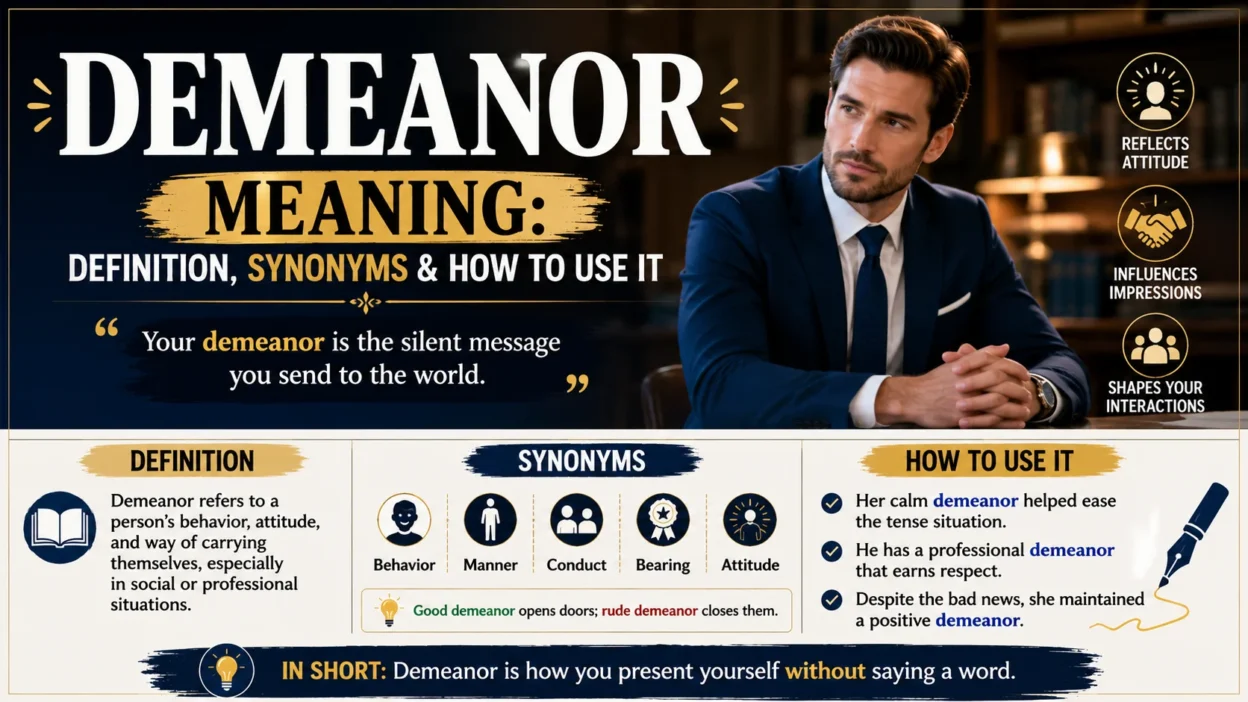
What does demeanor mean? If you have come across this word in a book, conversation, workplace, or formal document, it may sound more complicated than it actually is. Demeanor refers to the way a person behaves, appears, or presents themselves, especially when interacting with other people.
For example, someone who remains relaxed during a stressful situation may be described as having a calm demeanor. A person who smiles, speaks kindly, and makes others feel comfortable may have a friendly demeanor. On the other hand, someone who seems distant or angry could be described as having a cold or hostile demeanor.
The word is commonly used in professional writing, character descriptions, psychology, everyday conversations, and legal contexts. Learning its meaning, synonyms, and correct usage can help you understand and use this useful word with confidence.
What Does Demeanor Mean?
Demeanor means a person’s outward behavior, manner, or appearance, particularly the way they present themselves to other people.
In simple language, demeanor is the way someone comes across to others.
It can include things such as:
- Facial expressions
- Body language
- Tone of voice
- General behavior
- Level of confidence
- Emotional presentation
- Manner of speaking
- Overall attitude
For example:
She has a warm and welcoming demeanor.
This means she behaves in a way that makes people feel comfortable and welcomed.
Another example is:
His serious demeanor made the meeting feel more formal.
Here, demeanor describes the overall impression created by his behavior and appearance.
Demeanor Meaning in Simple Words
The easiest way to understand demeanor is:
Demeanor = the way someone behaves or appears to others.
You can think of it as a person’s outward manner.
Someone’s demeanor might be:
- Friendly
- Calm
- Confident
- Cheerful
- Serious
- Quiet
- Nervous
- Professional
- Warm
- Reserved
- Intimidating
- Aggressive
The word does not necessarily tell you what someone is thinking or feeling internally. Instead, it describes what other people can observe from their behavior and presentation.
Demeanor Pronunciation
Demeanor is pronounced:
duh-MEE-ner
The word has three syllables, with the main stress on MEE.
Knowing the pronunciation can make it easier to use the word confidently in conversations.
Demeanor as a Part of Speech
Demeanor is a noun.
It names the manner or outward behavior of a person.
Example
The teacher’s calm demeanor helped the students relax.
In this sentence, demeanor is the noun describing the teacher’s outward manner.
You would normally use an adjective before demeanor to explain what kind of manner someone has.
Common examples include:
- Calm demeanor
- Friendly demeanor
- Professional demeanor
- Serious demeanor
- Confident demeanor
- Pleasant demeanor
- Reserved demeanor
Examples of Demeanor in Sentences
Here are some natural examples showing how demeanor can be used:
- She has a cheerful demeanor that makes everyone feel welcome.
- His calm demeanor helped everyone remain focused.
- The doctor maintained a professional demeanor throughout the appointment.
- Her friendly demeanor made it easy to start a conversation.
- Despite the pressure, he kept a confident demeanor.
- The manager’s serious demeanor showed that the issue was important.
- The child’s playful demeanor made the entire room smile.
- His quiet demeanor sometimes made people think he was shy.
- The teacher’s patient demeanor encouraged students to ask questions.
- Her warm demeanor made the new employees feel comfortable.
- The actor adopted a mysterious demeanor for the role.
- His nervous demeanor was noticeable during the interview.
- The receptionist’s pleasant demeanor created a welcoming atmosphere.
- She maintained a respectful demeanor during the disagreement.
- His intimidating demeanor initially made the other team uncomfortable.
Common Types of Demeanor
A person’s demeanor can take many forms. The adjective used before the word usually tells you what kind of impression that person gives.
Calm Demeanor
A calm demeanor describes someone who appears relaxed, composed, and emotionally controlled.
Example:
The captain maintained a calm demeanor even during the emergency.
Friendly Demeanor
A friendly demeanor suggests that someone appears approachable, kind, and welcoming.
Example:
Her friendly demeanor made the guests feel comfortable immediately.
Professional Demeanor
A professional demeanor refers to respectful, appropriate, and composed behavior in a workplace or formal environment.
Example:
The employee maintained a professional demeanor while speaking with the customer.
Confident Demeanor
A confident demeanor makes someone appear self-assured and comfortable with themselves.
Example:
His confident demeanor impressed the interview panel.
Warm Demeanor
A warm demeanor suggests kindness, openness, and friendliness.
Example:
The professor’s warm demeanor encouraged students to participate.
Serious Demeanor
A serious demeanor indicates that someone appears focused, formal, or thoughtful.
Example:
The lawyer had a serious demeanor during the discussion.
Reserved Demeanor
A reserved demeanor describes someone who appears quiet, private, or emotionally restrained.
Example:
Although she has a reserved demeanor, she is very friendly once you know her.
Cheerful Demeanor
A cheerful demeanor suggests happiness, optimism, and positive energy.
Example:
His cheerful demeanor brightened the workplace.
Intimidating Demeanor
An intimidating demeanor makes someone appear stern, powerful, or difficult to approach.
Example:
The security guard’s intimidating demeanor discouraged people from entering the restricted area.
Demeanor vs. Behavior
Demeanor and behavior are closely related, but they are not exactly the same.
Behavior refers broadly to what a person does.
Demeanor focuses more on the person’s overall outward manner or impression.
For example:
Behavior:
He shouted during the meeting.
Demeanor:
He had an angry demeanor during the meeting.
The first sentence describes a specific action. The second describes the overall way he appeared or presented himself.
Demeanor vs. Attitude
The words demeanor and attitude can sometimes overlap, but they focus on different things.
Attitude usually refers to someone’s feelings, opinions, or outlook toward something.
Demeanor describes how that person’s attitude or personality appears outwardly.
For example, someone could have a positive attitude toward their job but maintain a serious demeanor while working.
A simple distinction is:
- Attitude = how someone thinks or feels
- Demeanor = how someone appears or behaves outwardly
Demeanor vs. Personality
Personality describes the broader characteristics and tendencies that make someone who they are.
Demeanor describes the way those characteristics are expressed or observed in a particular situation.
For example, someone may naturally have a cheerful personality but display a serious demeanor during an important business meeting.
This means demeanor can change depending on the environment, while personality is generally a broader and more enduring concept.
Demeanor vs. Disposition
Disposition refers to someone’s usual temperament or natural tendency.
Demeanor, on the other hand, focuses more on outward presentation.
For example:
She has a cheerful disposition but a serious demeanor at work.
This sentence shows that a person’s natural temperament and their outward presentation can be different.
Synonyms for Demeanor
Depending on the context, several words can have a similar meaning to demeanor.
Common Synonyms
- Manner
- Behavior
- Conduct
- Bearing
- Disposition
- Attitude
- Presence
- Air
- Appearance
- Composure
- Character
- Style
Not every synonym works in every sentence, so the context matters.
Manner
Manner is one of the closest everyday alternatives.
Demeanor: She has a pleasant demeanor.
Manner: She has a pleasant manner.
Both sentences describe the way she presents herself.
Bearing
Bearing often refers to the way someone carries themselves, including posture, confidence, and manner.
It is especially common in formal descriptions.
Composure
Composure focuses on someone’s ability to remain calm and controlled.
For example:
She maintained her composure during the argument.
This is slightly different from demeanor, because composure specifically emphasizes emotional control.
Positive Words to Describe Someone’s Demeanor
If you want to describe someone positively, these adjectives work well with demeanor:
- Friendly
- Warm
- Calm
- Cheerful
- Confident
- Kind
- Gentle
- Pleasant
- Respectful
- Patient
- Professional
- Approachable
- Reassuring
- Compassionate
- Courteous
- Composed
- Thoughtful
- Welcoming
- Graceful
- Polite
Example
Her kind and approachable demeanor made everyone feel comfortable.
Negative Words to Describe Someone’s Demeanor
When someone’s outward manner is unpleasant or concerning, you might use:
- Cold
- Hostile
- Aggressive
- Rude
- Arrogant
- Nervous
- Irritable
- Distant
- Stern
- Intimidating
- Unfriendly
- Defensive
- Suspicious
- Impatient
- Moody
- Unapproachable
Example
His cold demeanor made it difficult for the team to communicate with him.
Demeanor in Professional Settings
The word demeanor is especially common in workplace communication.
A person’s professional demeanor can influence how coworkers, customers, clients, and employers perceive them.
A professional demeanor may involve:
- Speaking respectfully
- Listening carefully
- Remaining calm
- Showing confidence
- Using appropriate body language
- Treating others courteously
- Staying focused
- Handling disagreements maturely
For example:
The candidate demonstrated a confident and professional demeanor during the interview.
This suggests that the candidate appeared composed, capable, and respectful.
Demeanor in Interviews
Your demeanor can influence the impression you make during a job interview.
A positive interview demeanor might include:
- Making appropriate eye contact
- Sitting comfortably
- Speaking clearly
- Listening carefully
- Remaining composed
- Showing enthusiasm
- Answering respectfully
For example:
She impressed the hiring manager with her calm and confident demeanor.
This does not necessarily mean she felt completely calm internally. It means that she appeared calm and confident from the outside.
Demeanor in Legal Contexts
Demeanor is also frequently used in legal and courtroom settings.
It can refer to a person’s visible behavior, facial expressions, posture, tone, and general presentation while speaking or answering questions.
For example:
The witness maintained a composed demeanor while answering questions.
However, outward behavior should not automatically be interpreted as proof of someone’s honesty, guilt, or innocence. People may appear nervous because of stress, fear, unfamiliar surroundings, or many other reasons.
Demeanor in Character Descriptions
Writers often use demeanor when introducing characters because it quickly communicates how a character appears to others.
For example:
The stranger had a quiet and mysterious demeanor.
This gives readers an immediate impression without requiring a long description.
You can create different character impressions by changing the adjective:
- Mysterious demeanor
- Gentle demeanor
- Stern demeanor
- Playful demeanor
- Elegant demeanor
- Nervous demeanor
- Confident demeanor
- Suspicious demeanor
- Charming demeanor
- Serious demeanor
How to Use Demeanor Correctly
The most common structure is:
adjective + demeanor
Examples:
- Calm demeanor
- Friendly demeanor
- Professional demeanor
- Confident demeanor
- Serious demeanor
- Warm demeanor
- Reserved demeanor
You can also use phrases such as:
“maintain a calm demeanor”
“have a friendly demeanor”
“display a professional demeanor”
“adopt a serious demeanor”
“project a confident demeanor”
These constructions sound natural in both formal and descriptive writing.
Common Phrases With Demeanor
Here are some frequently useful combinations:
| Phrase | Meaning |
|---|---|
| Calm demeanor | Relaxed and composed outward manner |
| Friendly demeanor | Warm and approachable behavior |
| Professional demeanor | Appropriate and respectful workplace manner |
| Confident demeanor | Self-assured outward presentation |
| Serious demeanor | Focused or formal manner |
| Warm demeanor | Kind and welcoming manner |
| Reserved demeanor | Quiet or restrained presentation |
| Pleasant demeanor | Agreeable and enjoyable manner |
| Gentle demeanor | Soft and non-threatening manner |
| Intimidating demeanor | A manner that makes others feel uneasy |
| Hostile demeanor | Unfriendly or aggressive manner |
| Nervous demeanor | Outward signs of anxiety or uneasiness |
Can Demeanor Change?
Yes. A person’s demeanor can change depending on their environment, mood, experiences, and circumstances.
Someone might have a relaxed demeanor with friends but a serious demeanor at work. A normally confident person may appear nervous before an important presentation.
This is why demeanor should generally be understood as a description of how someone appears at a particular time or in a particular situation, rather than a complete description of who they are.
Why Is Demeanor Important?
Demeanor matters because people often form impressions based on visible behavior.
A calm and respectful demeanor can help create trust and make communication easier. A hostile or dismissive demeanor may make people uncomfortable even when the person’s words seem neutral.
In professional settings, a positive demeanor can support:
- Better communication
- Stronger relationships
- Customer confidence
- Teamwork
- Leadership
- Professional credibility
Still, demeanor is only one part of communication. It should not be used to make unfair assumptions about someone’s character or intentions.
Frequently Asked Questions
What does demeanor mean in simple terms?
Demeanor means the way someone behaves, looks, or presents themselves to other people.
What is an example of demeanor?
A person who remains calm, speaks politely, and appears relaxed during a difficult situation can be described as having a calm demeanor.
Is demeanor positive or negative?
Demeanor can be either positive or negative. Someone may have a friendly demeanor, professional demeanor, cold demeanor, or hostile demeanor.
What is a synonym for demeanor?
Common synonyms include manner, behavior, conduct, bearing, disposition, attitude, presence, and composure, although their exact meanings can differ.
What does a calm demeanor mean?
A calm demeanor means that someone appears relaxed, composed, controlled, and not easily disturbed.
What does a friendly demeanor mean?
A friendly demeanor means that someone appears pleasant, approachable, kind, and welcoming.
What does a professional demeanor mean?
A professional demeanor means behaving in a respectful, composed, appropriate, and responsible way, particularly in a workplace or formal environment.
What is the opposite of a friendly demeanor?
Depending on the context, possible opposites include hostile, cold, unfriendly, distant, intimidating, or unapproachable demeanor.
Is demeanor the same as personality?
No. Personality describes a person’s broader characteristics, while demeanor describes how they appear or behave outwardly, especially in a particular situation.
Is demeanor the same as attitude?
Not exactly. Attitude generally refers to someone’s outlook or feelings, while demeanor describes their outward manner and presentation.
Can you use demeanor for animals?
Yes. Demeanor can describe the observable manner or behavior of an animal.
For example:
The dog has a gentle demeanor.
This means the dog appears calm, friendly, and non-aggressive.
Is demeanor a formal word?
Demeanor is somewhat formal but is still widely used in everyday English. It is particularly common in professional, descriptive, legal, and academic writing.
Conclusion
The demeanor meaning is straightforward: it describes the way a person behaves, appears, or presents themselves to others. It focuses on outward manner rather than someone’s private thoughts or feelings.
A person’s demeanor can be calm, friendly, warm, confident, professional, serious, reserved, cheerful, nervous, intimidating, or hostile. The word is useful because it allows you to describe someone’s overall presence without focusing on one specific action.
Understanding the difference between demeanor, behavior, attitude, personality, and disposition also makes the word easier to use accurately. Whether you’re describing someone in a workplace, writing a character, discussing an interview, or simply explaining how a person comes across, demeanor is a precise and useful word.
Ultimately, demeanor is about the impression a person’s outward manner creates. It can change with circumstances, which is why it should describe what someone appears like in a particular situation rather than serve as a complete judgment of their character.

Lillian Hayes is a content writer focused on explaining meanings and language in a simple and clear way. She creates easy-to-understand content that helps readers learn and communicate better.