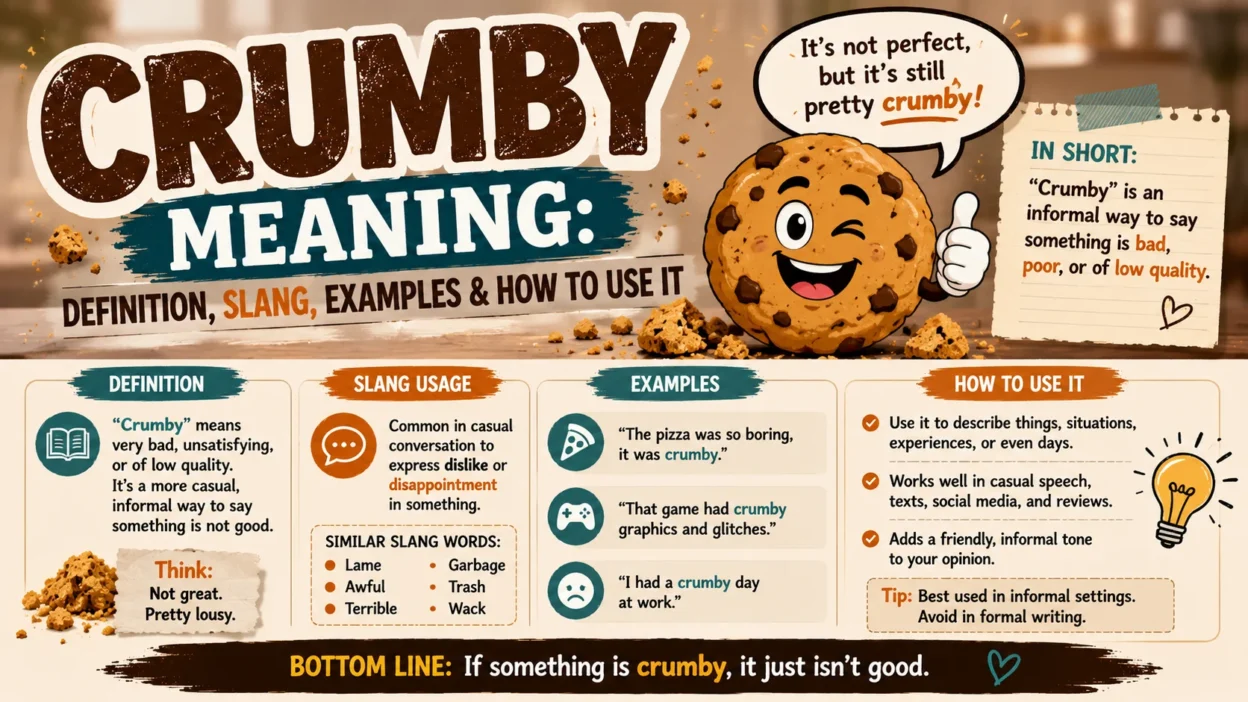
What does crumby mean? The word can be confusing because it has more than one use in English. In its literal sense, crumby describes something that has crumbs on it, contains crumbs, or tends to leave crumbs behind. In informal English, it can also describe something that is bad, unpleasant, disappointing, or low-quality.
For example, if someone says, “The kitchen table is crumby,” they may simply mean that it is covered with crumbs. But if someone says, “That was a crumby experience,” they are expressing disappointment.
The word is especially interesting because it is closely related to crumb, crumbly, and informal words such as crappy. Understanding the differences can help you use crumby naturally instead of relying only on a dictionary definition.
What Does Crumby Mean?
Crumby is an adjective with two main meanings.
The literal meaning relates to crumbs, while the informal meaning describes something poor or unpleasant.
| Meaning | Explanation | Example |
|---|---|---|
| Literal | Containing or covered with crumbs | The table is crumby. |
| Informal | Bad, disappointing, or unpleasant | We had a crumby experience. |
| Informal quality | Inferior or low-quality | That was a pretty crumby product. |
The surrounding words usually make the intended meaning clear.
Crumby Meaning in Simple Words
In simple English:
Crumby = full of crumbs OR, informally, bad or disappointing.
Think about these two examples:
Literal:
“The counter is crumby.”
This means there are crumbs on the counter.
Informal:
“This is a crumby situation.”
This means the situation is unpleasant or disappointing.
So, the same word can refer to either physical crumbs or a negative experience.
Where Does the Word Crumby Come From?
The literal use of crumby comes from the noun crumb, meaning a small piece of bread, cake, cookie, or another food.
The suffix -y is often added to nouns to create adjectives describing something characterized by that noun.
For example:
- Mud → muddy
- Dust → dusty
- Cloud → cloudy
- Crumb → crumby
The informal negative meaning developed as a slang-like extension, allowing crumby to describe something considered poor or unpleasant.
Crumby vs. Crumbly: What’s the Difference?
This is one of the most important distinctions to understand.
Although crumby and crumbly are related, they don’t always communicate the same idea.
| Word | Main Meaning | Example |
|---|---|---|
| Crumby | Containing or covered with crumbs | The table is crumby. |
| Crumbly | Easily breaking into crumbs | The cookie is crumbly. |
| Crumb | A small piece of food | There is a crumb on my plate. |
Crumby
Use crumby when you are focusing on the presence of crumbs.
Example:
The kitchen floor is crumby after breakfast.
Crumbly
Use crumbly when you are describing the texture of something that breaks apart easily.
Example:
The shortbread has a deliciously crumbly texture.
Easy way to remember
Crumby = has crumbs.
Crumbly = makes or breaks into crumbs.
This distinction is especially useful when describing cookies, biscuits, cakes, bread, and pastries.
Crumby Meaning as Slang
In casual English, crumby can mean bad, lousy, disappointing, or unpleasant.
For example:
“I had a crumby day.”
This means:
“I had a bad or unpleasant day.”
Similarly:
“That was a crumby deal.”
means that the deal was poor or disappointing.
This informal use is generally mild and conversational. It is not normally considered profanity.
What Does “Crumby Day” Mean?
A crumby day is an informal way of saying that you had a bad, frustrating, or disappointing day.
For example:
“I missed my bus, forgot my lunch, and lost my keys. What a crumby day!”
Here, crumby has nothing to do with actual food crumbs. It simply expresses frustration.
Some similar expressions include:
- Bad day
- Rough day
- Terrible day
- Unpleasant day
- Frustrating day
- Lousy day
What Does “Crumby Experience” Mean?
A crumby experience means an experience that was poor, disappointing, unpleasant, or unsatisfactory.
For example:
“We had a crumby experience at the hotel.”
The speaker is saying that something about the hotel experience was disappointing.
This could refer to:
- Poor service
- An uncomfortable room
- Long delays
- Unhelpful staff
- Low-quality facilities
- An experience that did not meet expectations
What Does “Crumby” Mean When Describing a Person?
When crumby is used about a person, it can suggest that the person is behaving badly, treating someone unfairly, or being unpleasant.
For example:
“That was a crumby thing to do.”
This means the action was unfair, mean, or disappointing.
It is usually better to interpret this from the context rather than assuming that crumby is directly describing someone’s entire personality.
Examples of Crumby in Sentences
Here are examples covering both the literal and informal meanings:
| Sentence | Meaning of Crumby |
|---|---|
| The kitchen table is crumby. | Covered with crumbs |
| These cookies are really crumby. | Producing lots of crumbs |
| The couch became crumby after the kids ate snacks. | Full of crumbs |
| The floor was crumby after breakfast. | Covered with crumbs |
| We had a crumby experience. | Disappointing experience |
| That was a crumby deal. | Poor or unfair deal |
| I had a crumby day. | Bad day |
| The movie was pretty crumby. | Poor or disappointing |
| They gave us a crumby room. | Low-quality room |
| That was a crumby thing to do. | Mean or unfair action |
Crumby Meaning in Food
When talking about food, crumby usually has a literal meaning.
It can describe something that:
- Has many crumbs
- Leaves crumbs behind
- Is messy to eat
- Contains visible crumbs
For example:
“The cookies were delicious but incredibly crumby.”
This means the cookies produced lots of crumbs while being eaten.
However, if you’re specifically talking about the texture, crumbly may be the better choice.
Food Examples
| Description | Better Word |
|---|---|
| The table has cookie crumbs everywhere. | Crumby |
| The cookie breaks apart easily. | Crumbly |
| The cake leaves crumbs on the plate. | Crumby |
| The biscuit has a delicate texture. | Crumbly |
| The floor is covered with bread crumbs. | Crumby |
Crumby vs. Crappy
In informal English, crumby and crappy can sometimes express similar ideas.
Both may describe something as bad or disappointing, but their tone can differ.
| Word | Tone | Meaning |
|---|---|---|
| Crumby | Mild, casual | Bad or disappointing |
| Crappy | Casual, stronger | Bad, poor, or unpleasant |
| Poor | Neutral/formal | Below expectations |
| Terrible | Strong | Very bad |
| Disappointing | Polite | Fails to meet expectations |
For professional writing, poor, unsatisfactory, or disappointing is usually more appropriate than either crumby or crappy.
Crumby vs. Bad
Bad is a general word, while crumby has a more informal and conversational feel.
Compare:
I had a bad day.
This is neutral and straightforward.
I had a crumby day.
This sounds more casual and expressive.
The second sentence can sound slightly playful, depending on the speaker and situation.
Synonyms for Crumby
The best synonym depends on which meaning you’re using.
When Crumby Means Covered With Crumbs
Possible alternatives include:
- Crumb-covered
- Messy
- Crumb-filled
- Crumb-laden
- Crumbly
However, these aren’t always exact replacements.
When Crumby Means Bad
You could use:
- Poor
- Bad
- Lousy
- Awful
- Unpleasant
- Disappointing
- Inferior
- Substandard
- Unsatisfactory
- Terrible
Quick Synonym Guide
| Crumby Meaning | Useful Synonyms |
|---|---|
| Covered with crumbs | Crumb-covered, messy |
| Producing crumbs | Crumbly, flaky |
| Bad | Poor, lousy |
| Disappointing | Unsatisfactory, disappointing |
| Low-quality | Inferior, substandard |
| Unpleasant | Awful, unpleasant |
Positive or Negative: Is Crumby a Bad Word?
Crumby is usually neutral when it refers to crumbs but negative when used informally to describe quality or experiences.
For example:
Neutral:
“The table is crumby.”
Negative:
“That was a crumby experience.”
It is not generally a swear word or offensive term. The negative meaning is relatively mild.
Is Crumby Formal or Informal?
The literal meaning is straightforward, but the meaning “bad or unpleasant” is informal.
| Context | Is Crumby Appropriate? |
|---|---|
| Casual conversation | ✅ Yes |
| Text messages | ✅ Yes |
| Social media | ✅ Yes |
| Friendly conversation | ✅ Yes |
| Creative writing | ✅ Sometimes |
| Academic writing | ⚠️ Usually avoid |
| Formal business writing | ⚠️ Use a clearer alternative |
| Legal documents | ❌ Avoid |
For formal writing, choose a more precise word such as poor, unsatisfactory, inferior, or disappointing.
How to Use Crumby Naturally
The most natural use depends on the meaning you want.
Literal Use
The table is crumby after breakfast.
Informal Negative Use
We had a crumby experience at the restaurant.
Describing Quality
That was a pretty crumby product for the price.
Describing an Action
That was a crumby thing to do.
The adjective normally works best when the surrounding context makes the intended meaning obvious.
Common Phrases With Crumby
Here are some useful expressions:
- Crumby day
- Crumby experience
- Crumby deal
- Crumby service
- Crumby movie
- Crumby situation
- Crumby job
- Crumby room
- Crumby food
- Crumby table
- Crumby floor
- Crumby kitchen
The first group tends to use the informal negative meaning, while phrases involving tables, floors, kitchens, and food can have the literal meaning.
Common Mistakes With Crumby
Mistake 1: Using Crumby When You Mean Crumbly
If you’re describing something that breaks apart easily, crumbly is usually the better choice.
Less precise:
The cake is crumby.
More precise:
The cake is crumbly.
Mistake 2: Assuming Crumby Always Means Bad
Context matters.
The counter is crumby.
This probably means there are crumbs on the counter.
The service was crumby.
This means the service was poor.
Mistake 3: Using It in Formal Writing
Although people understand crumby, the informal negative meaning may sound too casual for professional writing.
Instead of:
The customer had a crumby experience.
A formal version would be:
The customer had a disappointing experience.
Frequently Asked Questions
What does crumby mean?
Crumby can mean covered with or containing crumbs. Informally, it can also mean bad, disappointing, unpleasant, or low-quality.
Is crumby the same as crumbly?
No. Crumby generally describes something that has or leaves crumbs, while crumbly describes something that breaks apart easily into crumbs.
What does crumby mean in slang?
In informal English, crumby can mean bad, lousy, disappointing, or unpleasant.
Is crumby a bad word?
No. It is not generally considered profanity. Its negative meaning is mild and informal.
What does “crumby day” mean?
A crumby day means a bad, frustrating, or unpleasant day.
What does “crumby experience” mean?
It means an experience that was poor, disappointing, or unsatisfactory.
What is a synonym for crumby?
Depending on the context, synonyms include crumb-covered, messy, poor, lousy, disappointing, inferior, and unsatisfactory.
Can crumby describe food?
Yes. It can describe food that contains or leaves many crumbs. If you’re describing food that breaks apart easily, crumbly is usually more precise.
Is crumby formal English?
The word is understandable in standard English, but its meaning “bad or disappointing” is informal. More formal alternatives include poor, unsatisfactory, and disappointing.
What is the difference between crumby and crappy?
Both can informally describe something bad, but crumby is generally milder and can sound more playful or old-fashioned. Crappy is more direct and can sound stronger.
Conclusion
The crumby meaning depends heavily on context. In its literal sense, crumby describes something that has, contains, or leaves crumbs. In informal English, it can also mean bad, disappointing, unpleasant, or low-quality.
The most important word to distinguish from crumby is crumbly. If something is covered with crumbs, crumby works well. If something easily breaks apart into crumbs, crumbly is usually the more accurate choice.
The informal meaning is useful in casual conversations, texts, and everyday descriptions, but formal writing usually calls for clearer alternatives such as poor, disappointing, unsatisfactory, or substandard.
Once you understand these two meanings, phrases such as “crumby day,” “crumby experience,” and “crumby cookies” become much easier to understand. The context tells you whether you’re talking about actual crumbs or simply saying that something isn’t very good.

Lillian Hayes is a content writer focused on explaining meanings and language in a simple and clear way. She creates easy-to-understand content that helps readers learn and communicate better.