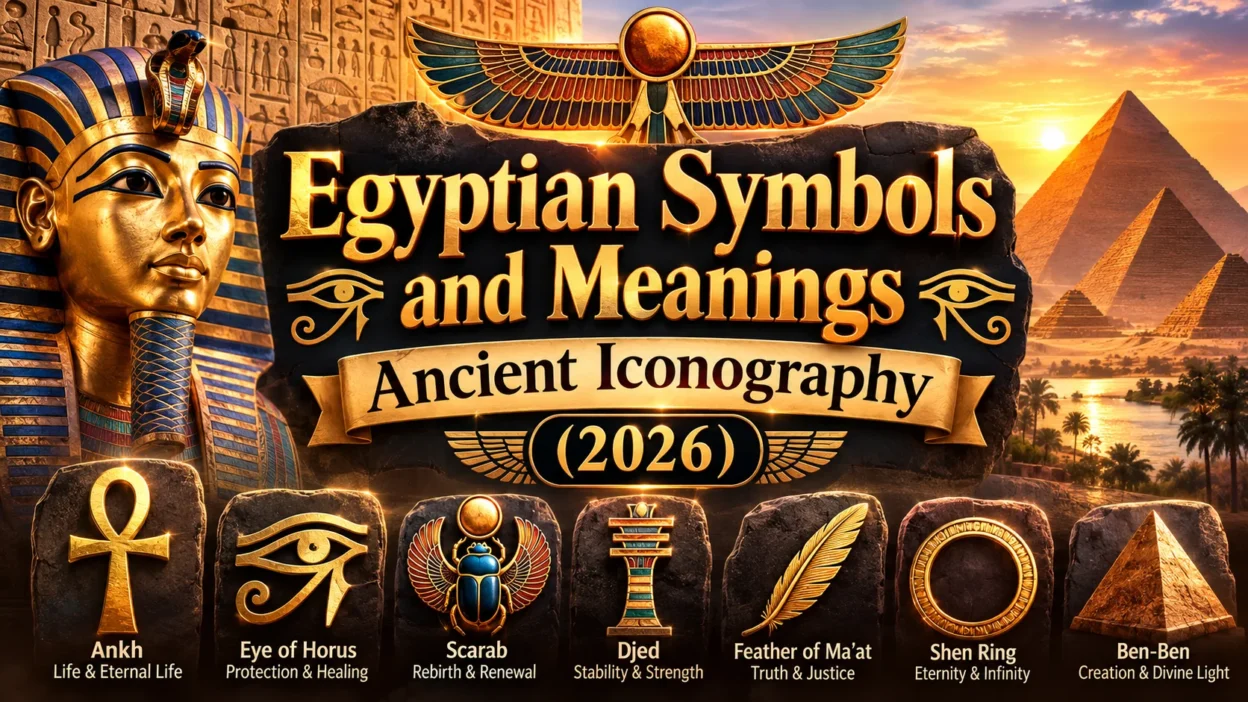
Imagine a world where every image told a story, every shape carried meaning, and every symbol held the power of life, death, and eternity.
For the ancient Egyptians, this was reality.
Over 5,000 years ago, they developed a sophisticated system of symbols—hieroglyphs and sacred icons—that communicated the deepest truths of their civilization. These symbols appeared everywhere: on temple walls, inside royal tombs, on jewelry, and even on everyday objects. They were not just decoration. They were the language of the gods.
Today, these symbols continue to fascinate us. From the mysterious Ankh to the powerful Eye of Horus, each emblem offers a window into a civilization that believed in eternal life, cosmic balance, and the divine power of the pharaoh.
This complete guide explores the most important Egyptian symbols and meanings—their origins, their significance, and why they still resonate with us thousands of years later.
Understanding Egyptian Symbolism
Before diving into specific Egyptian symbols and meanings, it’s essential to understand how the ancient Egyptians viewed symbols.
| Aspect | Explanation |
|---|---|
| Purpose | Symbols communicated religious beliefs, cosmic concepts, royal authority, and the promise of eternal life |
| Medium | Temple walls, tomb paintings, papyrus scrolls, jewelry, amulets, statues, architecture |
| Key principle | Form equals function—the shape of a symbol embodied its meaning and power |
| Influence | Symbols were believed to hold actual power, not just represent it |
The ancient Egyptian word for “writing” was medu-netjer, meaning “words of the gods.” Hieroglyphs were considered sacred—a gift from the god Thoth. Every symbol was chosen carefully, not just for what it meant, but for what it could do. In a culture where the afterlife was as real as the present, symbols provided protection, guidance, and power.
The Ankh: Key of Life
The Ankh (pronounced “ankh”) is one of the most recognizable Egyptian symbols—a cross with a loop at the top.
| Aspect | Meaning |
|---|---|
| Symbol | ☥ |
| Meaning | Life, eternal life, the morning sun, male and female principles, heavens and earth |
| Origin | Early Dynastic Period (c. 3150-2613 BCE) |
| Known as | The Key of Life, the Key of the Nile |
| Associated with | Isis, Osiris, Ra, and many other gods |
What the Ankh Represents
The Ankh embodies the concept of life itself—both earthly and eternal. Its key-like shape symbolized holding “the key to the secrets of existence.”
The union of opposites—male and female, heaven and earth, time and eternity—is represented in its form. The loop at the top represented the sun rising over the horizon, while the cross below symbolized the earth and the path of the sun.
How It Was Used
- Held by gods: Most deities are depicted holding the Ankh by its loop, offering life to pharaohs or the deceased
- As amulets: The Ankh was one of the most popular protective charms, worn by both the living and placed on mummies
- In art: It appears in virtually every kind of Egyptian artwork—from sarcophagi to tomb paintings, palace adornments to statuary
Why It Matters Today
Early Christians in Egypt (Copts) later adopted the Ankh as a symbol of their faith because of its enduring meaning. Today, people continue to recognize the Ankh as a powerful symbol of ancient Egyptian culture, spirituality, and eternal life.
The Djed: Pillar of Stability
The Djed looks like a column with a broad base, narrow top, and four horizontal lines crossing near the top.
| Aspect | Meaning |
|---|---|
| Symbol | (Column with four crossbars) |
| Meaning | Stability, endurance, resurrection, the backbone of Osiris |
| Origin | Predynastic Period (c. 6000-3150 BCE) through the Ptolemaic Period (323-30 BCE) |
| Associated with | Osiris, the god of the afterlife |
What the Djed Represents
The Djed symbolized stability and endurance—the strength that holds the universe together. It was thought to represent the backbone of Osiris, the god of the afterlife.
The symbol also carried a promise: just as Osiris was resurrected after death, those who honored the Djed could hope for their own resurrection in the afterlife.
How It Was Used
- On sarcophagi: Placed on the bottom to help the newly arrived soul “stand up and walk into the afterlife”
- During festivals: A Djed pillar was raised during ceremonies celebrating Osiris
- In amulets: Worn for protection and stability
- Often paired with the Ankh and Was: Together, these three symbols represented life, stability, and power
The Was Scepter: Symbol of Power
The Was scepter is a staff with a forked bottom and a top shaped like the head of a canine or other animal.
| Aspect | Meaning |
|---|---|
| Symbol | (Scepter with animal head) |
| Meaning | Power, dominion, authority, control over chaos |
| Origin | First Dynasty (c. 3000-2990 BCE) |
| Associated with | Gods, pharaohs, Anubis, Ra |
What the Was Scepter Represents
The Was scepter symbolized the power and dominion of the gods and the pharaoh. It represented the ability to control chaos and maintain cosmic order (Ma’at).
The scepter evolved from the earliest symbol of royal power—the hekat—seen in representations of the first pharaoh, Narmer (c. 3150 BCE).
Variations
- Blue staff: Associated with Ra-Horakhty, god of the rising and setting sun, symbolizing the sky
- Snake-topped: Associated with Ra, symbolizing rebirth (as the sun rises each morning)
- Forked bottom: Represented duality—the balance of opposing forces
The Eye of Horus (Udjat): Protection and Healing
The Eye of Horus, also known as the Udjat or Wadjet eye, is one of the most powerful protective symbols in ancient Egypt.
| Aspect | Meaning |
|---|---|
| Symbol | (Eye with markings) |
| Meaning | Protection, healing, royal power, good health, the moon |
| Origin | Old Kingdom (c. 2400 BCE) |
| Associated with | Horus, the falcon god; Ra, the sun god |
The Myth Behind the Eye
The Eye of Horus comes from a powerful myth. Horus, the falcon god, was the son of Osiris and Isis. In his battle with Set, the god of chaos, Horus lost his eye. It was later healed by the god Thoth.
The Eye thus became a symbol of healing, restoration, and protection. It is said to have been used as a powerful amulet to ward off evil and bring good health.
What the Eye Represents
| Element | Meaning |
|---|---|
| The Eye itself | Protection, healing, royal power |
| Its association with the moon | One of Horus’s eyes was the sun, the other was the moon |
| As a solar eye | Represents the power of Ra, the sun god |
How It Was Used
- As an amulet: One of the most popular protective charms, worn by the living and placed on mummies
- In architecture: Often carved above entrances to protect buildings from evil
- On medical instruments: Because of its healing associations
The Scarab: Rebirth and Transformation
The Scarab beetle is one of ancient Egypt’s most important and enduring symbols.
| Aspect | Meaning |
|---|---|
| Symbol | (Dung beetle) |
| Meaning | Rebirth, transformation, creation, the rising sun, protection |
| Associated with | Khepri, the creator god and god of the morning sun |
| Origin | Old Kingdom onward |
Why the Scarab Was Important
The scarab beetle (a type of dung beetle) rolls balls of dung across the ground—a behavior that the Egyptians associated with the sun god rolling the sun across the sky. Just as the beetle’s eggs hatch from the dung ball, the sun is “reborn” each morning.
The scarab was associated with Khepri, the god of the morning sun, who was depicted as a scarab beetle or as a man with a scarab for a head.
How It Was Used
- As amulets: The most popular protective charm in Egypt—worn by the living and placed on mummies, often over the heart
- As seals: Scarabs were often carved with a flat bottom and used as personal seals or stamps
- In heart scarabs: Large scarabs placed on the chest of the deceased to prevent the heart from testifying against them in the afterlife
The Tjet (Knot of Isis): Protection
The Tjet (also called the Knot of Isis) is a symbol similar to the Ankh but with “arms” at its sides, resembling a knot.
| Aspect | Meaning |
|---|---|
| Symbol | (Loop with downward arms) |
| Meaning | Protection, fertility, the blood of Isis |
| Associated with | Isis, the goddess of magic and motherhood |
What the Tjet Represents
The Tjet is often called the “Blood of Isis.” It represented the power of the great goddess Isis, the mother of Horus and the most powerful goddess in the Egyptian pantheon. The symbol may have originally represented the genitals of Isis, later becoming a more generalized symbol of protection.
Some scholars believe the Ankh may have evolved from the Tjet—a sign of how important female deities were in early Egyptian history.
The Crook and Flail: Kingship and Authority
The Crook (staff with a hooked top) and the Flail (staff with three attached beads or strips) are symbols of royal authority.
| Aspect | Meaning |
|---|---|
| Symbols | (Hooked staff and striped staff) |
| Meaning | Kingship, authority, guidance, protection |
| Associated with | Osiris, the pharaoh |
What They Represent
- The Crook (heka): Represented the king’s role as a shepherd—guiding and protecting his people. It was a symbol of royal authority.
- The Flail (nekhakha): Represented the king’s power to punish and maintain order. Together, the crook and flail symbolized the pharaoh’s dual role as both a kind ruler and a just enforcer.
- Osiris often held these symbols, highlighting their importance in ancient Egyptian beliefs. Artists also portrayed kings holding them to emphasize their connection to the god and their divine authority.
The Shen: Eternity and Protection
The Shen is a circular ring, often with a line extending from it, forming a cartouche (see below).
| Aspect | Meaning |
|---|---|
| Symbol | (Circle with tangent line) |
| Meaning | Eternity, infinity, protection |
| Associated with | The sun, the universe |
What the Shen Represents
The Shen symbolized the sun’s eternal journey around the earth and represented eternity. When ancient Egyptians enclosed a pharaoh’s name within a Shen ring to create a cartouche, they formed a protective boundary that guarded the royal name from harm.
The Sesen: Lotus Flower of Rebirth
The Sesen is the lotus flower, a symbol of rebirth and creation.
| Aspect | Meaning |
|---|---|
| Symbol | (Lotus flower) |
| Meaning | Rebirth, creation, the sun, purity |
| Associated with | The sun god Ra, creation myths |
What the Sesen Represents
The lotus flower closes at night and opens again in the morning. This behavior made it a powerful symbol of the sun’s daily rebirth and the cycle of life, death, and resurrection.
In the Egyptian creation myth, the first god emerged from a lotus flower that rose from the primordial waters of Nun. The lotus thus symbolized the moment of creation itself.
The Ben-Ben: Primeval Mound
The Ben-Ben is a pyramidal stone, associated with the sun god Ra and the creation of the world.
| Aspect | Meaning |
|---|---|
| Symbol | (Pyramidal stone) |
| Meaning | Creation, the primordial mound, the sun’s first light |
| Associated with | Ra, the sun god |
What the Ben-Ben Represents
According to Egyptian mythology, the first mound of earth, known as the Ben-Ben, rose from the watery chaos of Nun and created the world. The sun god Ra appeared on this sacred mound first, bringing light and life to the world.
The priests kept the Ben-Ben stone in Ra’s temple at Heliopolis, and Egyptian builders later used it as the model for the pyramids.
The Ka and Ba: Soul and Spirit
The ancient Egyptians believed humans had multiple spiritual components, including the Ka and the Ba.
| Aspect | Meaning |
|---|---|
| Symbols | Ka (two upraised arms), Ba (bird with human head) |
| Meaning | Life-force, soul, spiritual essence |
| Associated with | The afterlife, the individual’s spirit |
What They Represent
- The Ka (two upraised arms): This symbol represented the life-force of a person. It was the vital essence that continued to exist after death, requiring food and drink offerings to sustain it.
- The Ba (bird with human head): This symbol represented the soul’s ability to travel to the afterlife using wings. It was depicted as a bird with a human head—the head of the deceased.
The Feather of Ma’at: Truth and Justice
The Feather of Ma’at represents the goddess of truth, justice, and cosmic order.
| Aspect | Meaning |
|---|---|
| Symbol | (Ostrich feather) |
| Meaning | Truth, justice, balance, divine order |
| Associated with | Ma’at, the goddess of truth |
What the Feather Represents
Ma’at was the goddess of truth, justice, and cosmic balance. Her symbol—an ostrich feather—represented the ideal order of the universe. The pharaohs were expected to rule according to Ma’at.
During the Weighing of the Heart ceremony, the gods weighed the deceased person’s heart against the Feather of Ma’at. If the heart weighed less than or the same as the feather, they judged the person worthy of entering the afterlife.
The Cartouche: Royal Protection
A Cartouche is an oval or elongated ring enclosing a royal name, created by extending a Shen ring.
| Aspect | Meaning |
|---|---|
| Symbol | (Oval ring with royal name) |
| Meaning | Protection, the eternal name of the pharaoh |
| Associated with | Pharaohs, the sun’s circuit |
What the Cartouche Represents
The cartouche was a protective enclosure for the royal name. By enclosing the king’s name within the Shen (eternity) symbol, the Egyptians believed they were ensuring the pharaoh’s name—and his soul—would last forever.
The term “cartouche” comes from the French word for “cartridge,” as the shape reminded French soldiers of a gunpowder cartridge.
Crowns of Egypt
The pharaohs of Egypt wore different crowns to symbolize their power over different regions.
| Crown | Meaning |
|---|---|
| Deshret (Red Crown) | Lower Egypt (the Nile Delta) |
| Hedjet (White Crown) | Upper Egypt (the Nile Valley) |
| Pschent (Double Crown) | Unified Egypt—both Upper and Lower Egypt |
The Pschent, the double crown, was the most powerful symbol of the pharaoh’s rule over the entire country.
Sacred Animals
The Egyptians believed gods could manifest in animal forms, making certain animals sacred symbols.
| Animal | Symbolism |
|---|---|
| Falcon (Horus) | Kingship, the sky, protection, power |
| Ibis (Thoth) | Wisdom, writing, magic |
| Crocodile (Sobek) | Power, fertility, military prowess |
| Scarab (Khepri) | Rebirth, the morning sun, creation |
| Lion | Strength, power, majesty |
| Cow (Hathor) | Motherhood, love, music, the sky |
Common Hieroglyphs and Their Meanings
These are some of the most frequently encountered logograms in Egyptian writing.
| Hieroglyph | Meaning | Notes |
|---|---|---|
| ☥ | Ankh | Life, eternal life |
| (Column with crossbars) | Djed | Stability, endurance |
| (Eye) | Udjat/Wedjat | Protection, healing |
| (Beetle) | Scarab | Rebirth, transformation |
| (Ostrich feather) | Ma’at | Truth, justice |
| (Oval ring) | Cartouche | Royal protection |
| (Bird with human head) | Ba | Soul, spirit |
| (Two upraised arms) | Ka | Life-force |
| (Lotus flower) | Sesen | Rebirth, creation |
| (Sun) | Ra | Sun, solar god |
Egyptian Symbols in Modern Culture
The symbols of ancient Egypt continue to appear in modern culture.
| Modern Usage | Example |
|---|---|
| Jewelry | Ankh necklaces, Eye of Horus pendants |
| Tattoos | Scarabs, Ankhs, Eye of Horus |
| Architecture | Obelisks, pyramid motifs |
| Literature/Film | The Mummy, Stargate, Cleopatra |
| Corporate logos | The Eye of Horus appears in some logos |
| Spirituality | Modern pagan and New Age movements use Egyptian symbols |
Frequently Asked Questions
Q. What is the most important Egyptian symbol?
The Ankh is arguably the most important. It symbolizes life and eternal life, and appears in virtually all Egyptian artwork. The Djed and Was scepter are also highly significant.
Q. What does the Eye of Horus mean?
The Eye of Horus represents protection, healing, and royal power. It was one of the most popular amulets in ancient Egypt.
Q. What does the Ankh mean?
The Ankh represents life and eternal life. It symbolizes the union of male and female, heaven and earth, and time and eternity, earning it the title “Key of Life.”
Q. What does the Scarab mean?
The Scarab represents rebirth, transformation, creation, and the sun. It was the most popular amulet in ancient Egypt.
Q. What is the Djed symbol?
The Djed is a column symbolizing stability and endurance. It represented the backbone of Osiris and was a powerful symbol of the afterlife.
Q. What is the Was scepter?
The Was scepter symbolizes power, dominion, and authority. It was held by gods and pharaohs.
Q. What does the Feather of Ma’at mean?
The Feather of Ma’at represents truth, justice, and cosmic order. It was used in the Weighing of the Heart ceremony to judge the deceased.
Q. What is a cartouche?
A cartouche is an oval ring enclosing a royal name. It provided protection for the pharaoh’s name and soul.
Q. What is the Tjet symbol?
The Tjet, or Knot of Isis, represents protection and fertility. It is associated with the goddess Isis.
Q. What is the Sesen?
The Sesen is the lotus flower, symbolizing rebirth and creation. It was associated with the sun and the creation of the world.
Final Takeaway
Egyptian symbols and meanings offer a window into one of the oldest and most fascinating civilizations in human history. Each symbol tells a story of life, death, the cosmos, and the eternal quest for immortality.
Three Things to Remember
- Ancient Egyptians believed that symbols held real power. Rather than serving as simple representations, symbols embodied the very power and qualities they depicted.
- Life, death, and eternity are central themes — Most Egyptian symbols deal with the afterlife, resurrection, and the eternal journey of the soul.
- The Ankh, Djed, and Was are the three most important — Together, they represent life, stability, and power—the core values of Egyptian civilization.
Quick Reference Card
| Symbol | Meaning | Associated With |
|---|---|---|
| ☥ Ankh | Life, eternal life | Isis, Osiris, Ra |
| Djed | Stability, endurance | Osiris |
| Was Scepter | Power, dominion | Gods, pharaohs |
| Eye of Horus | Protection, healing | Horus, Ra |
| Scarab | Rebirth, transformation | Khepri, the sun |
| Feather of Ma’at | Truth, justice | Ma’at |
| Cartouche | Protection of royal name | Pharaohs |
Lillian Hayes is a content writer focused on explaining meanings and language in a simple and clear way. She creates easy-to-understand content that helps readers learn and communicate better.