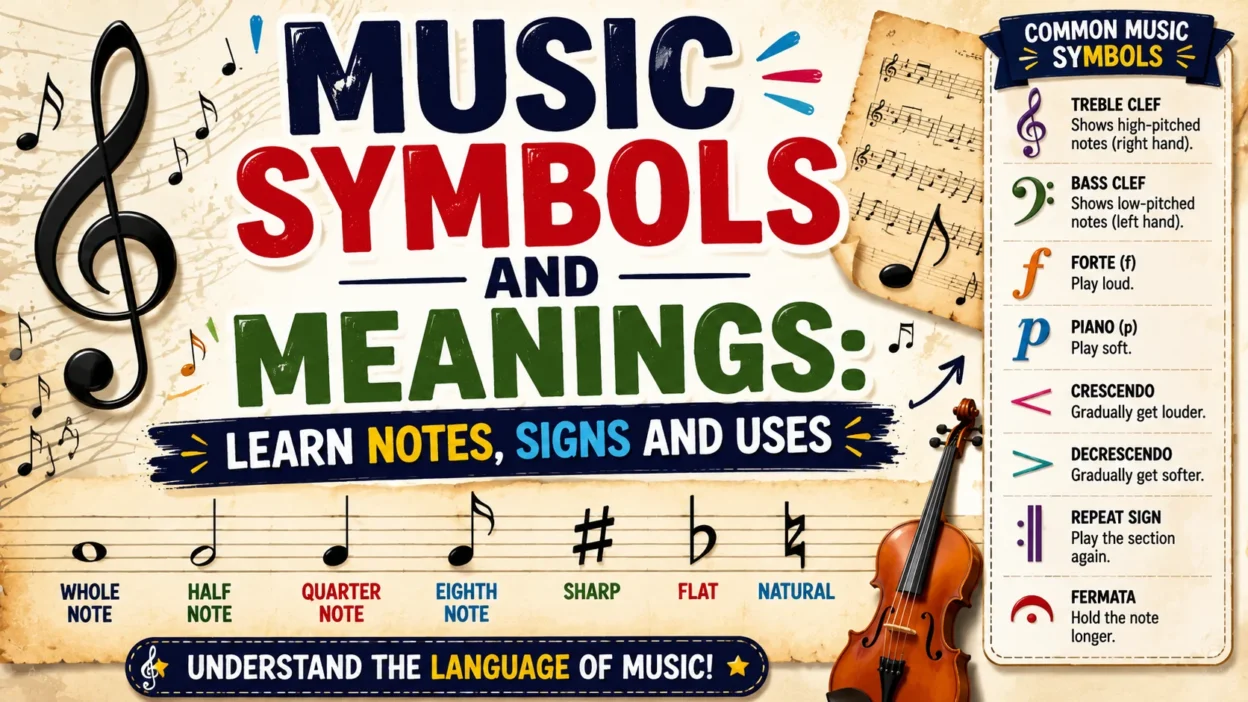
Music is often called the universal language, and like any language, it has its own system of symbols. These symbols allow composers, musicians, conductors, and students to communicate rhythm, pitch, dynamics, tempo, articulation, and expression without using words. Whether you’re reading sheet music for the first time or expanding your musical knowledge, understanding music symbols and meanings is essential.
Musical notation has evolved over centuries, creating a standardized system used worldwide. From the treble clef and bass clef to sharp signs, rests, dynamics, and time signatures, every symbol serves a specific purpose. Together, these symbols tell performers exactly how a piece should sound.
Many beginners find music notation intimidating because of the number of symbols involved. However, once you understand the meaning behind each one, reading sheet music becomes much easier. Learning music symbols can improve your performance skills, help you understand compositions, and deepen your appreciation of music theory.
This comprehensive guide explains the most important music symbols and meanings, how they are used, and why they matter in musical notation.
Quick Answer
Music symbols are markings used in sheet music to indicate pitch, rhythm, tempo, dynamics, articulation, and expression. Common symbols include the treble clef, bass clef, sharp sign (#), flat sign (♭), natural sign (♮), notes, rests, and dynamic markings such as piano (soft) and forte (loud).
Meaning Overview Table
| Aspect | Meaning |
|---|---|
| Definition | Symbols used to represent musical instructions |
| Pronunciation | Music Symbols and Meanings |
| Part of Speech | Noun Phrase |
| Usage | Sheet music and musical notation |
| Context | Music theory, performance, composition |
What Are Music Symbols?
Music symbols are visual signs used in written music to communicate information to performers. These symbols tell musicians:
- Which notes to play
- How long to play them
- How loudly or softly to perform
- The speed of the music
- Special techniques and expressions
Without music symbols, accurately sharing musical compositions would be extremely difficult.
History of Musical Notation
Musical notation dates back more than a thousand years. Early systems used simple markings above text to indicate melodies.
Over time, musicians developed more advanced notation systems that included:
- Staff lines
- Clefs
- Rhythmic symbols
- Dynamic markings
- Tempo instructions
Modern musical notation is now used throughout the world and remains the standard method of recording music.
Staff Symbol Meaning
What Is a Staff?
The staff consists of five horizontal lines and four spaces.
Every note is placed on a line or space to indicate pitch.
Purpose
The staff acts as the foundation of written music.
Without the staff, musical symbols would have no fixed position.
Clef Symbols and Meanings
Clefs identify the pitch range of notes on the staff.
Treble Clef (𝄞)
Meaning
The treble clef is used for higher-pitched instruments and voices.
Common Instruments
- Violin
- Flute
- Trumpet
- Clarinet
- Guitar
Symbolism
Represents the note G.
Bass Clef (𝄢)
Meaning
Used for lower-pitched instruments.
Common Instruments
- Bass guitar
- Tuba
- Cello
- Trombone
Symbolism
Represents the note F.
Alto Clef (𝄡)
Meaning
Used primarily by violas.
Tenor Clef (𝄡)
Meaning
Used for certain higher ranges of bass instruments.
Note Symbols and Meanings
Whole Note (𝅝)
Meaning
Lasts for four beats in common time.
Half Note (𝅗𝅥)
Meaning
Lasts for two beats.
Quarter Note (♩)
Meaning
Lasts for one beat.
Eighth Note (♪)
Meaning
Lasts for half a beat.
Sixteenth Note (♬)
Meaning
Lasts for one-quarter of a beat.
Rest Symbols and Meanings
Rests indicate periods of silence.
Whole Rest
Represents four beats of silence.
Half Rest
Represents two beats of silence.
Quarter Rest
Represents one beat of silence.
Eighth Rest
Represents half a beat of silence.
Sixteenth Rest
Represents one-quarter beat of silence.
Silence is just as important as sound in music.
Accidental Symbols and Meanings
Accidentals alter the pitch of notes.
Sharp (♯)
Meaning
Raises a note by one semitone.
Example:
F becomes F♯.
Flat (♭)
Meaning
Lowers a note by one semitone.
Example:
B becomes B♭.
Natural (♮)
Meaning
Returns a note to its original pitch.
Double Sharp (𝄪)
Meaning
Raises a note by two semitones.
Double Flat (𝄫)
Meaning
Lowers a note by two semitones.
Time Signature Symbols
Time signatures indicate the rhythmic structure of music.
4/4 Time
Meaning
Four beats per measure.
Most common time signature.
3/4 Time
Meaning
Three beats per measure.
Often used in waltzes.
2/4 Time
Meaning
Two beats per measure.
Common in marches.
6/8 Time
Meaning
Six eighth-note beats per measure.
Frequently used in folk and traditional music.
Dynamic Symbols and Meanings
Dynamics indicate volume.
Pianissimo (pp)
Meaning
Very soft.
Piano (p)
Meaning
Soft.
Mezzo Piano (mp)
Meaning
Moderately soft.
Mezzo Forte (mf)
Meaning
Moderately loud.
Forte (f)
Meaning
Loud.
Fortissimo (ff)
Meaning
Very loud.
Dynamics help musicians add emotional expression.
Tempo Symbols and Meanings
Tempo tells musicians how fast to play.
Largo
Meaning
Very slow.
Adagio
Meaning
Slow and expressive.
Andante
Meaning
Walking pace.
Moderato
Meaning
Moderate speed.
Allegro
Meaning
Fast and lively.
Vivace
Meaning
Very lively.
Presto
Meaning
Extremely fast.
Articulation Symbols and Meanings
Articulation affects how notes are played.
Staccato (•)
Meaning
Short and detached.
Legato (Slur)
Meaning
Smooth and connected.
Accent (>)
Meaning
Play with emphasis.
Tenuto (—)
Meaning
Hold the note for its full value.
Marcato (^)
Meaning
Strong emphasis.
Expression Symbols and Meanings
Crescendo (<)
Meaning
Gradually get louder.
Decrescendo (>)
Meaning
Gradually get softer.
Fermata (𝄐)
Meaning
Hold a note longer than usual.
Repeat Sign (:||)
Meaning
Repeat a section of music.
Tie
Meaning
Connects two notes of the same pitch.
Key Signature Symbols
Key signatures appear after the clef.
They indicate which notes are consistently sharp or flat throughout a piece.
Examples:
- G Major = 1 sharp
- D Major = 2 sharps
- F Major = 1 flat
- B♭ Major = 2 flats
Common Music Symbols Chart
| Symbol | Meaning |
|---|---|
| 𝄞 | Treble Clef |
| 𝄢 | Bass Clef |
| ♯ | Sharp |
| ♭ | Flat |
| ♮ | Natural |
| ♩ | Quarter Note |
| ♪ | Eighth Note |
| ♬ | Sixteenth Note |
| pp | Very Soft |
| ff | Very Loud |
| < | Crescendo |
| > | Decrescendo |
| : | |
| 𝄐 | Fermata |
| • | Staccato |
Music Symbols Used in Different Genres
Classical Music
Uses the widest range of notation symbols.
Jazz
Includes chord symbols and improvisation markings.
Pop Music
Often combines standard notation with chord charts.
Rock Music
Uses notation, tablature, and chord symbols.
Film Music
Relies heavily on dynamics and expression symbols.
Why Music Symbols Matter
Music symbols help musicians:
- Read compositions accurately
- Maintain rhythm
- Understand expression
- Communicate musical ideas
- Perform consistently
Without notation symbols, complex music would be difficult to preserve and share.
Examples Table
| Symbol Example | Meaning |
|---|---|
| 𝄞 | Treble clef |
| 𝄢 | Bass clef |
| ♯ | Sharp |
| ♭ | Flat |
| ♮ | Natural |
| ♩ | Quarter note |
| ♪ | Eighth note |
| pp | Very soft |
| ff | Very loud |
| 𝄐 | Fermata |
Related Terms Table
| Related Term | Meaning |
|---|---|
| Staff | Musical lines |
| Clef | Pitch indicator |
| Note | Musical sound |
| Rest | Silence |
| Tempo | Speed |
| Dynamics | Volume |
| Rhythm | Beat pattern |
| Measure | Musical section |
| Key Signature | Scale indicator |
| Time Signature | Beat structure |
| Harmony | Multiple notes |
| Melody | Main tune |
| Chord | Group of notes |
| Articulation | Note style |
| Expression | Musical feeling |
Common Mistakes
| Mistake | Correct Understanding |
|---|---|
| Treble and bass clefs mean the same thing | They indicate different pitch ranges |
| Sharps always make notes louder | They change pitch, not volume |
| Rests are unimportant | Silence is essential |
| Tempo and dynamics are identical | Tempo affects speed; dynamics affect volume |
| All notes last the same length | Different notes have different durations |
| Crescendo means instant loudness | It means gradual increase |
| Fermata has a fixed duration | Performer decides the length |
| Time signatures indicate key | They indicate rhythm |
| Articulation changes pitch | It changes note style |
| Music symbols are universal across all systems | Some genres use additional notation |
Related Questions
What is the most important music symbol?
The clef is one of the most important symbols because it determines how notes are read on the staff.
What does the sharp symbol mean?
A sharp raises a note by one semitone.
What does a fermata do?
A fermata tells the performer to hold a note longer than its written value.
Why are rests important?
Rests create silence, which contributes to rhythm, balance, and musical expression.
FAQs
What are music symbols called?
They are collectively known as musical notation symbols.
How many music symbols are there?
There are dozens of symbols used for rhythm, pitch, dynamics, articulation, and expression.
What does a treble clef mean?
It indicates higher-pitched notes and is used by many instruments and vocal parts.
What does a bass clef mean?
It indicates lower-pitched notes.
What is a sharp symbol?
A sharp raises a note by one semitone.
What does forte mean in music?
Forte means loud.
What does piano mean in music?
Piano means soft.
Why is musical notation important?
It allows music to be accurately recorded, shared, and performed.
Conclusion
Music symbols and meanings form the foundation of written musical communication. From clefs and notes to dynamics, tempo markings, articulations, and expression symbols, every marking on a sheet of music serves a purpose. These symbols enable musicians around the world to interpret compositions consistently and accurately.
Whether you’re a beginner learning to read music or an experienced performer refining your skills, understanding musical notation opens the door to deeper musical knowledge and appreciation. By mastering these symbols, you’ll be better equipped to read sheet music, perform confidently, and understand the language that connects musicians across cultures and generations.

Lillian Hayes is a content writer focused on explaining meanings and language in a simple and clear way. She creates easy-to-understand content that helps readers learn and communicate better.