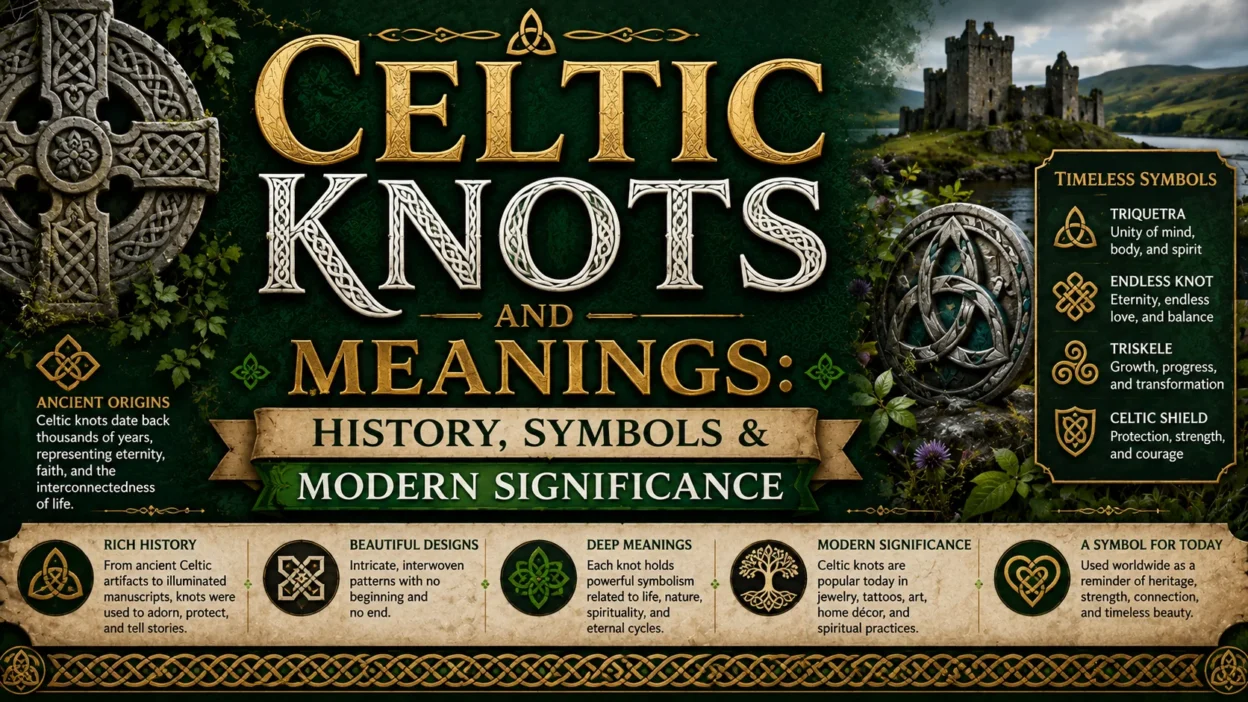
Celtic knots and meanings continue to fascinate people because these intricate designs combine beautiful artwork with ideas of connection, continuity, faith, love, strength, and heritage. Their interwoven lines often loop over and under one another, creating patterns that appear to have no obvious beginning or end. You can find Celtic knotwork in medieval manuscripts, carved crosses, stone monuments, jewelry, artwork, and modern tattoos.
Celtic knotwork became especially prominent in the Insular art tradition of Ireland and Britain during the early medieval period. Famous examples appear in works such as the Book of Kells and the Lindisfarne Gospels. However, the history is more complex than the popular idea that every Celtic knot had one fixed ancient meaning. Interlace existed in several artistic traditions before and alongside Celtic use, and many specific meanings associated with individual knots today developed through later Christian, Celtic Revival, and modern interpretations.
This guide explains the most popular Celtic knot types and meanings, their history, symbolism, relationship meanings, spiritual associations, tattoo interpretations, and modern uses. It also separates historical evidence from popular interpretations so you can understand these symbols without oversimplifying their cultural background.
What Do Celtic Knots Mean?
| Celtic Knot or Symbol | Common Meaning | Modern Interpretation |
|---|---|---|
| Trinity Knot | Unity and threefold connection | Faith, balance, relationships |
| Celtic Love Knot | Lasting love | Romance and commitment |
| Dara Knot | Strength and roots | Resilience and family heritage |
| Shield Knot | Protection | Safety and strength |
| Sailor’s Knot | Loyalty and connection | Friendship and relationships |
| Solomon’s Knot | Unity and interconnection | Enduring bonds |
| Celtic Spiral | Cycles and movement | Growth and transformation |
| Celtic Cross | Faith and heritage | Christianity and Irish identity |
| Celtic Tree of Life | Growth and connection | Family and personal development |
| Eternity Knot | Continuity | Lasting relationships and remembrance |
The Main Idea Behind Celtic Knotwork
The most common modern interpretation of Celtic knotwork comes from its interwoven and continuous structure. When lines remain connected throughout a design, they naturally suggest continuity, unity, and an enduring relationship. This is why modern Celtic-inspired designs frequently represent ideas such as eternity, family, love, loyalty, and spiritual connection.
It is important, however, to distinguish between documented historical use and modern symbolism. Historians can confidently identify extensive interlace in Celtic and Insular art, but there is no surviving medieval dictionary assigning one universal meaning to every knot design.
What Is a Celtic Knot?
A Celtic knot is an ornamental design created from interwoven lines. Many examples form closed patterns in which the strands repeatedly pass over and under one another. Some designs appear endless, while others combine knotwork with spirals, animals, crosses, or other decorative elements.
Celtic knotwork is strongly associated with Insular art, a style that developed in Ireland and Britain during the early medieval period. Artists incorporated intricate interlace into illuminated manuscripts, metalwork, carved stones, and Christian monuments.
The Book of Kells provides one of the most famous examples of this artistic tradition. The manuscript contains elaborate decorative initials, interlacing patterns, figures, and other ornamentation. Trinity College Dublin describes the manuscript as a richly decorated Gospel book that has remained one of the most important examples of medieval Insular art.
Although people commonly call these designs “Celtic knots,” interlace itself did not belong exclusively to Celtic cultures. Similar patterns appeared in Roman, Byzantine, Germanic, Islamic, and other artistic traditions. Celtic and Insular artists developed distinctive forms and used interlace extensively in their own visual tradition.
History of Celtic Knots
Interlace patterns have a long history. Knot-like designs appeared in Roman art centuries before the medieval Celtic tradition, including Roman mosaics from the third and fourth centuries AD. Artists in several regions later adapted interwoven patterns for architecture, manuscripts, sculpture, and decorative objects.
Celtic and Insular artists made interlace especially prominent from the early medieval period onward. The patterns became important elements of manuscripts and religious artwork, where artists combined geometric decoration with Christian imagery.
The Book of Kells, created around the late eighth or early ninth century, remains one of the most recognizable examples. Its elaborate ornament includes complex interlace woven into initials and decorative pages.
This history also explains why modern interpretations can become confusing. People sometimes describe every Celtic knot as an ancient symbol with a specific meaning, but historical evidence does not support that broad claim. Some modern names and meanings represent later interpretations rather than documented medieval definitions.
1. Trinity Knot Meaning
The Trinity Knot, also known as the Triquetra, is one of the most recognizable Celtic-inspired symbols. Its three interconnected loops create a distinctive three-sided form.
The word triquetra comes from Latin and means “three-cornered.” The number three plays an important role in many interpretations of the design. In Christian contexts, the symbol became associated with the Holy Trinity: the Father, Son, and Holy Spirit.
Modern interpretations also connect the three parts with concepts such as:
- Past, present, and future
- Birth, life, and death
- Life, death, and rebirth
- Mind, body, and spirit
- Earth, sea, and sky
- Three interconnected aspects of existence
The central theme is three elements forming one connected whole.
Trinity Knot Meaning in Love
In modern jewelry and tattoo culture, people often use the Trinity Knot to represent an enduring relationship. Its continuous lines can symbolize a bond that remains connected through time.
Couples may interpret it as:
- Eternal love
- Loyalty
- Commitment
- Partnership
- Emotional connection
- Shared life
These relationship meanings are best understood as modern interpretations rather than a single documented ancient definition.
2. Celtic Love Knot Meaning
The Celtic Love Knot is a modern term for interwoven designs that people associate with romance and lasting relationships.
Because the lines appear continuously connected, the design naturally lends itself to ideas such as:
- Eternal love
- Commitment
- Loyalty
- Partnership
- Devotion
- Marriage
- Unbreakable bonds
Celtic-inspired love knots are particularly popular in rings, necklaces, wedding gifts, bracelets, and matching tattoos.
However, claims that one specific “Celtic Love Knot” served as an ancient Celtic wedding symbol require caution. Modern romantic interpretations developed over time, and historical sources do not provide a universal ancient classification for every design marketed under this name.
3. Dara Knot Meaning
The Dara Knot is commonly associated with the roots of the oak tree. Its name is connected with the Irish word doire, meaning an oak grove.
Modern symbolism connects the Dara Knot with:
- Strength
- Resilience
- Wisdom
- Stability
- Family roots
- Inner strength
- Endurance
- Connection to nature
The oak provides a powerful visual metaphor. Its roots anchor the tree while its branches continue to grow, making the design a natural symbol for staying grounded while developing and adapting.
Modern Celtic guides commonly interpret the Dara Knot as a strength symbol, although its specific name and symbolism should not automatically be presented as a universally documented medieval meaning.
4. Celtic Shield Knot Meaning
The Celtic Shield Knot is generally represented by an enclosed, symmetrical interlacing pattern. Modern sources commonly associate it with protection and defense.
Its popular meanings include:
- Protection
- Safety
- Strength
- Defense
- Security
- Resilience
- Warding off misfortune
The enclosed shape makes the protective interpretation visually intuitive. However, shield-like interlace patterns appeared across multiple cultures, so it is more accurate to describe the Shield Knot as a Celtic-associated protective symbol rather than claim that one exact pattern had a universal Celtic meaning.
5. Celtic Sailor’s Knot Meaning
The Celtic Sailor’s Knot is a modern knot design associated with sailors, travel, friendship, and relationships that endure distance.
People commonly interpret it as a symbol of:
- Loyalty
- Friendship
- Love
- Family
- Safe journeys
- Long-distance relationships
- Enduring connection
The symbolism works particularly well for people who spend time apart. A sailor’s knot can represent the idea that distance does not have to break an emotional bond.
Although the design is popular in modern Celtic jewelry, its current relationship symbolism should not automatically be confused with a specific ancient Celtic tradition.
6. Solomon’s Knot Meaning
Solomon’s Knot is an interlaced motif that appears in several cultures and artistic traditions. It is therefore not exclusively Celtic.
The pattern usually consists of interconnected loops that appear tightly woven together. Modern interpretations often associate it with:
- Unity
- Interconnection
- Eternity
- Friendship
- Wisdom
- Enduring relationships
Its widespread cultural history makes it an excellent example of why people should avoid assigning every interlaced pattern exclusively to Celtic culture.
7. Celtic Spiral Meaning
Spiral designs have an especially long history in Ireland and other parts of Europe. Spiral motifs existed long before medieval Celtic knotwork and appear in prehistoric monuments such as Newgrange.
Modern Celtic-inspired interpretations connect spirals with:
- Growth
- Transformation
- Renewal
- Movement
- Life cycles
- Energy
- Personal development
The spiral naturally draws the eye inward or outward, which helps explain its association with movement and transformation.
A spiral should not automatically be classified as a Celtic knot, but it remains an important part of the broader history of Celtic-inspired symbolism.
8. Celtic Cross Meaning
The Celtic Cross is different from a traditional knot because the cross forms the primary structure, while interlace may appear as decoration.
Its strongest historical association is with Christianity and medieval Insular art. Stone crosses and manuscripts provide substantial evidence for the combination of Christian imagery with local decorative traditions.
Modern meanings include:
- Faith
- Christianity
- Irish heritage
- Celtic identity
- Spirituality
- Cultural heritage
- Eternity
Because of its documented Christian context, the Celtic Cross has a clearer historical religious association than many modern knot categories.
9. Celtic Tree of Life Meaning
The Celtic Tree of Life is one of the most popular Celtic-inspired designs in modern jewelry, tattoos, artwork, and home decoration.
People commonly associate it with:
- Growth
- Family
- Strength
- Balance
- Heritage
- Connection
- Renewal
- The relationship between earth and sky
Roots represent family and foundations, while branches represent growth and future possibilities.
The familiar circular Tree of Life design is best understood as a modern Celtic-inspired symbol rather than a single ancient Celtic emblem with one universally documented meaning.
10. Eternity Knot Meaning
An Eternity Knot generally refers to an endless or continuous interlaced design.
Its modern symbolism includes:
- Eternity
- Continuity
- Lasting love
- Infinite connection
- Commitment
- Remembrance
- Unbroken relationships
The symbolism comes primarily from the structure itself. If a line appears to have no beginning or ending, it naturally represents something continuous.
Celtic Knots and Their Meanings at a Glance
| Knot or Symbol | Common Meaning | Popular Modern Use |
|---|---|---|
| Trinity Knot | Unity and threefold connection | Faith and relationships |
| Celtic Love Knot | Eternal love | Weddings and romance |
| Dara Knot | Strength and roots | Resilience and family |
| Shield Knot | Protection | Security and strength |
| Sailor’s Knot | Loyalty and connection | Friendship and long-distance love |
| Solomon’s Knot | Unity | Relationships and heritage |
| Celtic Spiral | Growth and cycles | Transformation |
| Celtic Cross | Faith and heritage | Religion and identity |
| Tree of Life | Growth and family | Family symbolism |
| Eternity Knot | Continuity | Commitment and remembrance |
What Do Celtic Knots Symbolize in General?
Although each design has its own modern interpretation, several themes appear repeatedly.
Eternity
Continuous lines create the impression of something without a beginning or end. This makes eternity one of the most common modern interpretations of Celtic knotwork.
Connection
Interwoven strands remain physically connected throughout the design. This makes connection one of the most intuitive meanings.
Unity
Multiple strands come together to form one complete pattern. People often use this visual idea to symbolize unity between people, families, communities, or spiritual concepts.
Life Cycles
Repeating loops can represent cycles, renewal, change, and the continuing movement of life.
Love and Loyalty
Modern Celtic-inspired designs frequently use interlacing to represent enduring relationships and emotional commitment.
Heritage
For many people, Celtic knotwork serves as a visual connection to Irish, Scottish, Welsh, or broader Celtic cultural heritage.
Celtic Knots and Love
Celtic knotwork has become especially popular as a relationship symbol because its structure provides a strong visual metaphor for connection.
People choose Celtic-inspired designs for:
- Wedding rings
- Engagement jewelry
- Anniversary gifts
- Matching tattoos
- Friendship bracelets
- Family necklaces
- Wedding decorations
A continuous knot can represent a relationship that remains connected through different stages of life.
However, the meaning does not have to come from historical tradition. A person can assign a personal meaning to a Celtic-inspired knot based on their own relationship, family history, or life experience.
Celtic Knot Meanings in Tattoos
Celtic knot tattoos remain popular because they combine intricate artwork with flexible symbolism.
| Tattoo Design | Common Meaning |
|---|---|
| Trinity Knot | Unity, faith, balance |
| Dara Knot | Strength and family roots |
| Shield Knot | Protection |
| Love Knot | Romance and commitment |
| Tree of Life | Family and growth |
| Celtic Cross | Faith and heritage |
| Spiral | Transformation and renewal |
| Interwoven Knot | Connection and continuity |
Before choosing a tattoo, research the specific design carefully. Some symbols sold online as “ancient Celtic knots” are modern creations or later interpretations. Understanding that distinction can help you choose a design that reflects your intended meaning without making unsupported historical claims.
Celtic Knots in Jewelry
Celtic knotwork translates especially well into jewelry because the patterns can work at both small and large sizes.
Popular choices include:
- Rings
- Necklaces
- Pendants
- Bracelets
- Earrings
- Brooches
- Wedding bands
People often choose Trinity Knot jewelry for faith or unity, Love Knot jewelry for romantic commitment, Shield Knot designs for protection, and Tree of Life designs for family and growth.
For a meaningful gift, choose the design according to the message you want to communicate rather than simply selecting the most recognizable pattern.
Celtic Knots and Christianity
Celtic and Insular knotwork became closely associated with Christian art during the early medieval period. Artists incorporated interlace into manuscripts, crosses, decorated initials, and religious objects.
The Book of Kells remains one of the strongest examples of this combination of elaborate ornament and Christian text. Its decoration includes complex interlacing and other intricate motifs.
The Trinity Knot later became especially popular in Christian symbolism because its three-part design provides a natural visual association with the Holy Trinity.
Still, not every Celtic knot is inherently Christian. Interlace functioned as a decorative artistic technique in different contexts.
Are Celtic Knots Actually Ancient?
Yes, but the answer requires some nuance.
Interlace is genuinely ancient, and Celtic and Insular artists used it extensively during the early medieval period. However, similar patterns existed in other cultures, and many specific names and meanings used today come from modern interpretations.
For example, modern sources frequently describe the Dara Knot as an oak-root symbol or the Celtic Love Knot as a symbol of eternal romance. These interpretations can be meaningful, but historians cannot always demonstrate that medieval Celtic artists used those exact names or meanings.
A more accurate statement is:
Celtic knotwork has a genuine ancient and medieval artistic history, while many individual symbolic meanings have evolved over time.
This distinction makes the subject more interesting because it shows how symbols continue to develop as cultures reinterpret them.
Common Misconceptions About Celtic Knots
| Common Claim | More Accurate Explanation |
|---|---|
| Every Celtic knot has one ancient meaning. | Historical evidence does not support one fixed meaning for every design. |
| Celtic knots originated only with the Celts. | Interlace appeared in several cultures and artistic traditions. |
| Every knot represents eternity. | Endless patterns naturally suggest continuity, but designs vary. |
| The Dara Knot definitely had its modern name in ancient Ireland. | The modern classification and symbolism are difficult to document precisely. |
| Celtic Love Knots were ancient wedding symbols. | Their romantic symbolism is largely modern. |
| Every Celtic knot is religious. | Knotwork appeared in both religious and decorative settings. |
| Celtic Crosses are simply knots. | The Celtic Cross is primarily a Christian cross with Celtic and Insular artistic associations. |
How to Choose a Celtic Knot
Choosing a design becomes easier when you start with the meaning you want to express.
For Love
Choose a Celtic Love Knot or another interwoven design associated with lasting connection.
For Faith
The Trinity Knot or Celtic Cross may be appropriate for a religious or spiritual purpose.
For Strength
The Dara Knot is commonly associated with roots, resilience, and inner strength.
For Protection
The Shield Knot is the most common modern choice.
For Family
The Tree of Life or a family-inspired interwoven knot can represent heritage and connection.
For Personal Growth
A Celtic Spiral can symbolize transformation, renewal, and the cycles of life.
Frequently Asked Questions
What is the most famous Celtic knot?
The Trinity Knot, or Triquetra, is one of the most recognizable Celtic-inspired symbols. Its three interconnected loops have appeared in medieval art and are now widely used in jewelry, tattoos, and spiritual symbolism.
What does a Celtic knot symbolize?
Celtic knots commonly symbolize connection, continuity, unity, eternity, and enduring relationships. The meaning can change depending on the design and the cultural or personal context.
What does the Celtic Love Knot mean?
The Celtic Love Knot commonly represents eternal love, loyalty, commitment, and an enduring relationship. Its romantic symbolism is primarily a modern interpretation of interwoven knotwork.
What does the Dara Knot symbolize?
The Dara Knot is commonly associated with strength, resilience, wisdom, roots, and family heritage, inspired by the symbolism of the oak tree.
What does the Celtic Shield Knot mean?
The Shield Knot commonly represents protection, safety, strength, and defense. Similar protective interlace motifs also existed outside Celtic cultures.
What does the Trinity Knot mean spiritually?
The Trinity Knot can symbolize unity, balance, interconnectedness, and three aspects forming one whole. Christian interpretations commonly connect it with the Holy Trinity.
Are Celtic knots Irish or Scottish?
Celtic knotwork is strongly associated with Ireland and Britain, especially the Insular art tradition. Similar interlace patterns also appeared in other European and cultural traditions.
Can Celtic knots represent family?
Yes. Modern interpretations frequently use Celtic knotwork to symbolize family bonds, shared heritage, loyalty, and lasting connection.
What Celtic knot means protection?
The Celtic Shield Knot is the design most commonly associated with protection. Modern interpretations connect its enclosed structure with safety, defense, and resilience.
What Celtic knot represents strength?
The Dara Knot is commonly associated with strength because its design evokes the roots of an oak tree. Modern interpretations connect it with resilience, stability, wisdom, and deep foundations.
Conclusion
Celtic knots and meanings bring together centuries of artistic development, religious history, cultural heritage, and modern symbolism. Their interwoven lines naturally suggest ideas of connection, unity, continuity, and eternity, while individual designs have developed their own popular associations. The Trinity Knot is commonly connected with threefold unity and Christian faith, the Dara Knot with strength and roots, the Shield Knot with protection, and modern Love Knots with lasting relationships.
At the same time, understanding the history behind these symbols requires some caution. Medieval Celtic and Insular artists clearly used elaborate interlace in manuscripts, stonework, metalwork, and Christian art, but they did not leave behind a complete guide assigning one fixed meaning to every knot. Many interpretations that appear in modern jewelry, tattoo culture, and popular articles developed much later.
That distinction does not make Celtic knots less meaningful. Instead, it allows you to appreciate both their documented artistic history and the personal meanings people give them today. Whether you are choosing a tattoo, buying jewelry, researching Celtic heritage, or simply exploring ancient symbols, a Celtic knot can represent a powerful idea of connection that continues to resonate across generations.
Lillian Hayes is a content writer focused on explaining meanings and language in a simple and clear way. She creates easy-to-understand content that helps readers learn and communicate better.