
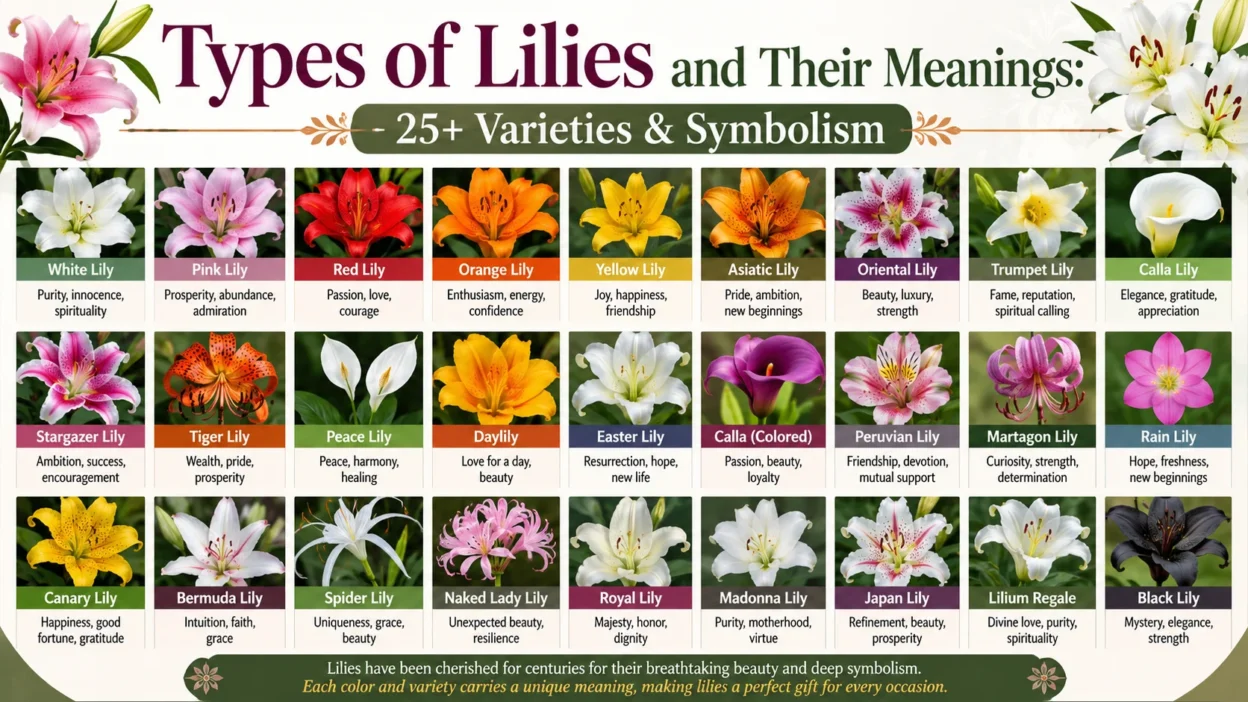
Lilies are among the most recognizable flowers in gardens, bouquets, religious artwork, and special occasions. Their large blooms, elegant shapes, vivid colors, and sometimes powerful fragrance have made them symbols of beauty and emotion across many cultures. But when you explore the types of lilies and their meanings, you quickly discover that “lily” can refer to many different varieties, hybrids, colors, and even plants that are not true lilies at all.
True lilies belong to the Lilium genus, and horticulturists commonly divide them into nine major divisions based on their parentage and characteristics. These include Asiatic, Martagon, Candidum, American, Longiflorum, Trumpet and Aurelian, Interdivisional, and Wild Lilies.
The symbolic meaning also changes with the lily’s type, color, and cultural context. White lilies commonly represent purity and innocence, pink lilies can symbolize admiration and prosperity, orange lilies often suggest confidence and pride, and red lilies are associated with passion.
This guide explores popular lily varieties, their meanings, colors, cultural symbolism, and the best occasions for giving or growing them.
Quick Answer: Types of Lilies and Their Meanings
| Lily Type | Appearance | Common Meaning |
|---|---|---|
| Asiatic Lily | Bright, upward-facing blooms | Energy, enthusiasm, vitality |
| Oriental Lily | Large, fragrant flowers | Beauty, refinement, admiration |
| Tiger Lily | Orange petals with dark spots | Confidence, wealth, pride |
| Stargazer Lily | Pink and white spotted blooms | Ambition, admiration, prosperity |
| Easter Lily | White trumpet-shaped flowers | Purity, hope, renewal |
| Madonna Lily | Pure white flowers | Purity, innocence, devotion |
| Trumpet Lily | Long trumpet-shaped blooms | Grace, elegance, celebration |
| Martagon Lily | Downward-facing, recurved petals | Resilience, woodland beauty |
| Candidum Lily | White, fragrant blooms | Purity and devotion |
| Longiflorum Lily | Long white trumpets | Purity and renewal |
| Oriental-Trumpet (Orienpet) | Large, fragrant hybrid blooms | Strength and elegance |
| Calla Lily* | Smooth, funnel-shaped flower | Elegance and beauty |
*Calla lilies are not true lilies. They belong to the Araceae family rather than the Lilium genus.
What Do Lilies Symbolize?
The general symbolism of lilies includes purity, beauty, devotion, rebirth, grace, love, and renewal. White lilies have particularly strong associations with purity and innocence in Western Christian traditions, while different colors and varieties have developed their own meanings.
The meaning of a lily can depend on three major factors:
- Type or variety
- Flower color
- Cultural or religious context
For example, a white lily may communicate purity or sympathy, while a bright orange tiger lily can convey confidence, pride, or wealth. A pink Stargazer lily may communicate admiration or prosperity.
Because flower symbolism varies between traditions, these meanings should be treated as common cultural associations rather than universal rules.
1. Asiatic Lilies
Asiatic lilies belong to the first horticultural division of true lilies. They are among the earliest lilies to bloom and are known for their bright colors and relatively easy cultivation. Their flowers can face upward, outward, or downward, and they generally have little or no fragrance.
Asiatic Lily Meaning
Asiatic lilies commonly symbolize:
- Energy
- Enthusiasm
- Vitality
- Happiness
- Confidence
- Positive emotions
Their wide range of colors makes them versatile flowers for gardens and bouquets.
Because Asiatic lilies usually lack the strong fragrance associated with Oriental lilies, they can also work well for people who prefer visually dramatic flowers without an intense scent.
2. Oriental Lilies
Oriental lilies are famous for their large flowers, strong fragrance, and elegant appearance. They often grow tall and produce outward-facing blooms in colors such as white, pink, and red.
Oriental Lily Meaning
Oriental lilies commonly symbolize:
- Beauty
- Refinement
- Elegance
- Admiration
- Love
- Prosperity
- Sophistication
Their dramatic appearance makes them popular in formal floral arrangements, weddings, celebrations, and romantic bouquets.
3. Tiger Lilies
The Tiger Lily, scientifically known as Lilium lancifolium, is one of the easiest lilies to recognize. Its orange flowers feature dark spots and strongly recurved petals, creating a pattern that resembles a tiger’s markings. It belongs to the Asiatic group.
Tiger Lily Meaning
Tiger lilies commonly represent:
- Confidence
- Pride
- Wealth
- Courage
- Positive energy
- Boldness
Traditional flower-language sources sometimes gave the tiger lily a more cautionary meaning related to pride, while modern interpretations often emphasize confidence and prosperity.
This makes tiger lilies a popular choice for congratulations, encouragement, and celebrations.
4. Stargazer Lilies
Stargazer lilies are a famous Oriental hybrid recognized by their pink, white, and spotted petals and upward-facing flowers. They are highly fragrant and remain among the most recognizable lilies used by florists.
Stargazer Lily Meaning
Stargazer lilies commonly symbolize:
- Ambition
- Aspiration
- Admiration
- Prosperity
- Success
- Encouragement
Their upward-facing blooms help explain the association with reaching toward goals and looking toward the future. Pink Stargazers are especially popular for birthdays, congratulations, anniversaries, and celebratory bouquets.
5. Easter Lilies
The Easter Lily, Lilium longiflorum, produces elegant white trumpet-shaped flowers. It has become strongly associated with Easter and Christian celebrations. Horticultural sources classify Longiflorum lilies separately from Asiatic, Oriental, and other groups.
Easter Lily Meaning
Easter lilies commonly symbolize:
- Purity
- Hope
- Renewal
- Resurrection
- New beginnings
- Faith
Their white color and association with Easter give them a particularly strong religious meaning in Christian traditions.
They are also suitable for expressing hope and renewal outside religious settings.
6. Madonna Lilies
The Madonna Lily, Lilium candidum, is known for its pure white, fragrant flowers. It has a long history of religious and cultural symbolism.
Madonna Lily Meaning
Madonna lilies commonly symbolize:
- Purity
- Innocence
- Virtue
- Grace
- Devotion
- Spiritual beauty
In Christian art, the white lily became closely associated with the Virgin Mary and purity. The Madonna Lily has therefore played an important symbolic role in religious artwork and traditions.
7. Trumpet Lilies
Trumpet lilies produce long, trumpet-shaped flowers that often face outward or downward. They belong to the Trumpet and Aurelian division of horticultural lilies.
Trumpet Lily Meaning
Their elegant shape commonly inspires associations with:
- Grace
- Celebration
- Beauty
- Elegance
- Confidence
- Communication
Trumpet lilies can create a dramatic garden display and also work well in large floral arrangements.
8. Martagon Lilies
Martagon lilies, sometimes called Turk’s cap lilies, have distinctive downward-facing flowers with strongly recurved petals. Their leaves often grow in whorls around the stem.
Martagon Lily Meaning
Because of their unusual shape and woodland character, people often associate them with:
- Resilience
- Natural beauty
- Mystery
- Grace
- Endurance
- Woodland charm
Martagon lilies are particularly attractive in naturalistic or woodland-style gardens.
9. Longiflorum Lilies
Longiflorum lilies include the classic Easter Lily and related species. They produce long, white, trumpet-shaped flowers and are commonly grown as potted plants.
Longiflorum Lily Meaning
Their symbolism generally includes:
- Purity
- Hope
- Renewal
- Faith
- Innocence
- New beginnings
Because of these meanings, Longiflorum lilies are particularly popular for Easter and other spiritual occasions.
10. Orienpet Lilies
Orienpet lilies, also called OT hybrids, result from crosses between Oriental and Trumpet lilies. They combine characteristics from both groups and can produce very large, fragrant flowers on tall plants.
Orienpet Lily Meaning
These impressive hybrids can symbolize:
- Strength
- Grandeur
- Elegance
- Confidence
- Beauty
- Abundance
Their large flowers make them especially suitable for gardens where you want a dramatic focal point.
11. American Hybrid Lilies
American lilies come from North American species and are included in the horticultural classification of true lilies. They often have pendulous flowers and grow well in cool, moist conditions.
American Lily Meaning
Modern symbolic interpretations can include:
- Natural beauty
- Freedom
- Resilience
- Connection to nature
- Wildness
These lilies are especially appealing for naturalistic gardens.
12. Candidum Hybrids
Candidum hybrids are part of the horticultural group associated with Lilium candidum and related lilies. They are known for their elegant flowers and historical connection to the Madonna Lily.
Candidum Lily Meaning
They commonly evoke:
- Purity
- Grace
- Devotion
- Innocence
- Spirituality
Their white flowers make them especially suitable for traditional and formal settings.
Lily Colors and Their Meanings
Color can significantly change the message a lily communicates.
| Lily Color | Common Meaning |
|---|---|
| White | Purity, innocence, virtue, sympathy |
| Pink | Admiration, prosperity, femininity |
| Orange | Confidence, pride, wealth, encouragement |
| Red | Passion, love, desire |
| Yellow | Joy, gratitude, happiness |
| Purple | Wealth, spirituality, elegance |
These meanings come from different flower-language and floristry traditions, so they can vary by source and culture.
White Lily Meaning
White lilies have perhaps the strongest traditional symbolism.
They commonly represent:
- Purity
- Innocence
- Virtue
- Grace
- Peace
- Sympathy
- Renewal
Christian art has long associated white lilies with the Virgin Mary and purity, while modern floristry frequently uses them for weddings and sympathy arrangements.
Because white lilies appear in both joyful and solemn settings, the occasion strongly influences their message.
Pink Lily Meaning
Pink lilies commonly symbolize:
- Admiration
- Prosperity
- Abundance
- Appreciation
- Femininity
- Good wishes
These Pink Stargazer lilies are especially popular when someone wants to express admiration or celebrate an achievement.
Orange Lily Meaning
Orange lilies often communicate:
- Confidence
- Pride
- Wealth
- Encouragement
- Energy
- Enthusiasm
Tiger lilies are the best-known orange lilies and often appear in celebratory arrangements.
Red Lily Meaning
Red lilies generally symbolize:
- Passion
- Love
- Desire
- Romance
- Strong emotion
Their dramatic color makes them particularly appropriate for romantic occasions.
Yellow Lily Meaning
Yellow lilies commonly represent:
- Joy
- Gratitude
- Happiness
- Cheerfulness
- Friendship
- Good health
They can be a thoughtful choice when you want to say thank you or celebrate someone’s recovery or success.
Purple Lily Meaning
Purple lilies can symbolize:
- Wealth
- Spirituality
- Elegance
- Royalty
- Admiration
Their unusual color gives them a sophisticated appearance and makes them useful for formal floral arrangements.
Lily Meanings by Occasion
| Occasion | Best Lily Choice | Common Message |
|---|---|---|
| Wedding | White lily | Purity and devotion |
| Anniversary | Pink or white lily | Love and admiration |
| Birthday | Pink or colorful lily | Happiness and good wishes |
| Graduation | Stargazer or orange lily | Ambition and success |
| Congratulations | Orange or pink lily | Confidence and prosperity |
| Sympathy | White lily | Peace and remembrance |
| Easter | Easter lily | Faith and renewal |
| Thank You | Yellow lily | Gratitude and joy |
| Romantic Gift | Red or pink lily | Passion and admiration |
| New Beginning | White or Easter lily | Hope and renewal |
Lily vs. Calla Lily: Are They the Same?
Despite its name, the calla lily is not a true lily.
True lilies belong to the Lilium genus, while calla lilies belong to the Zantedeschia genus in the Araceae family.
Calla lilies have smooth, funnel-shaped flowers and are widely associated with:
- Elegance
- Beauty
- Sophistication
- Grace
- Celebration
They are especially popular in weddings and formal floral arrangements.
Lily of the Valley vs. True Lilies
Lily of the valley is also not a true lily. It belongs to a different plant family and has small, bell-shaped flowers rather than the large blooms associated with Lilium.
Despite the name, it has its own distinct symbolism, including:
- Sweetness
- Humility
- Return to happiness
- Devotion
Flower-language traditions have given lily of the valley meanings that differ considerably from those of true lilies.
What Is the Most Popular Type of Lily?
There is no single answer because popularity depends on whether you mean gardens, bouquets, or individual cultivars.
Asiatic lilies are widely grown because they offer many colors, bloom early, and generally grow easily. Oriental lilies are particularly popular as cut flowers because of their large, fragrant blooms. Tiger lilies are also widely recognized because of their distinctive orange-and-black appearance.
Which Lily Has the Strongest Fragrance?
Oriental lilies are among the most strongly scented true lilies. They produce large, fragrant flowers and are especially popular in bouquets and floral arrangements. Asiatic lilies generally have little or no fragrance, making them a better choice for people who prefer scent-free flowers.
Are All Lilies the Same?
No. Lilies vary considerably in:
- Flower shape
- Height
- Color
- Fragrance
- Blooming season
- Growing conditions
- Symbolism
- Parentage
Horticulturists recognize nine major divisions for garden lilies, although many modern garden plants are hybrids.
How to Choose the Right Lily
Choosing a lily becomes easier when you decide whether you care most about meaning, appearance, fragrance, or growing conditions.
Choose White Lilies for Purity and Sympathy
White lilies work well for weddings, religious celebrations, memorials, and situations where you want to communicate peace or purity.
Choose Pink Lilies for Admiration
Pink lilies are ideal for birthdays, congratulations, anniversaries, and thoughtful gifts.
Choose Orange Lilies for Confidence
Orange lilies offer an energetic and bold message, making them appropriate for celebrations and encouragement.
Choose Red Lilies for Romance
Red lilies are a natural choice when you want to communicate passion and strong romantic feelings.
Choose Yellow Lilies for Friendship
Yellow lilies can communicate happiness, gratitude, and appreciation without the romantic message associated with red flowers.
Choose Oriental Lilies for Fragrance
If fragrance matters, Oriental lilies are a strong choice because of their large, scented blooms.
Frequently Asked Questions
What are the main types of lilies?
The main horticultural divisions include Asiatic, Martagon, Candidum, American, Longiflorum, Trumpet and Aurelian, Oriental, Interdivisional, and Wild Lilies.
What is the most popular lily flower?
Asiatic, Oriental, Tiger, Easter, and Stargazer lilies are among the best-known types. Popularity varies depending on whether the flower is grown in gardens or used in floral arrangements.
What does a lily symbolize?
Lilies commonly symbolize purity, beauty, devotion, renewal, grace, and love. The exact meaning changes according to the type, color, and cultural context.
What does a white lily mean?
White lilies commonly symbolize purity, innocence, virtue, grace, peace, and remembrance. They are used for both weddings and sympathy arrangements.
What does a pink lily mean?
Pink lilies commonly represent admiration, prosperity, abundance, and good wishes. Stargazer lilies are particularly associated with these meanings.
What does an orange lily mean?
Orange lilies commonly symbolize confidence, pride, wealth, encouragement, and energy. Tiger lilies are the best-known orange variety.
What does a red lily mean?
Red lilies generally symbolize passion, romance, love, and desire, making them appropriate for romantic occasions.
Are calla lilies real lilies?
No. Calla lilies are not members of the Lilium genus. They belong to the Araceae family, although their common name includes the word “lily.”
Which lilies smell the strongest?
Oriental lilies are known for their strong fragrance, while Asiatic lilies generally have little or no scent.
What is the difference between Oriental and Asiatic lilies?
Oriental lilies generally produce larger, fragrant flowers and prefer different growing conditions, while Asiatic lilies tend to bloom earlier, offer a broad range of colors, and usually lack fragrance.
Conclusion
The world of lilies includes far more variety than a single classic flower. From vibrant Asiatic lilies and fragrant Oriental lilies to distinctive Tiger lilies, elegant Easter lilies, and dramatic Trumpet lilies, each type offers a different combination of appearance, growing characteristics, and symbolism. Horticultural classifications recognize nine major divisions of true lilies, while popular florist varieties add even more choices for gardens and bouquets.
The meaning of a lily also depends heavily on its color and context. White lilies often represent purity and remembrance, pink lilies suggest admiration and prosperity, orange lilies convey confidence and energy, red lilies express passion, and yellow lilies communicate joy and gratitude.
Whether you’re selecting flowers for a wedding, sympathy arrangement, birthday, anniversary, or garden, understanding the types of lilies and their meanings can help you choose a bloom that looks beautiful and communicates the right message.

Lillian Hayes is a content writer focused on explaining meanings and language in a simple and clear way. She creates easy-to-understand content that helps readers learn and communicate better.