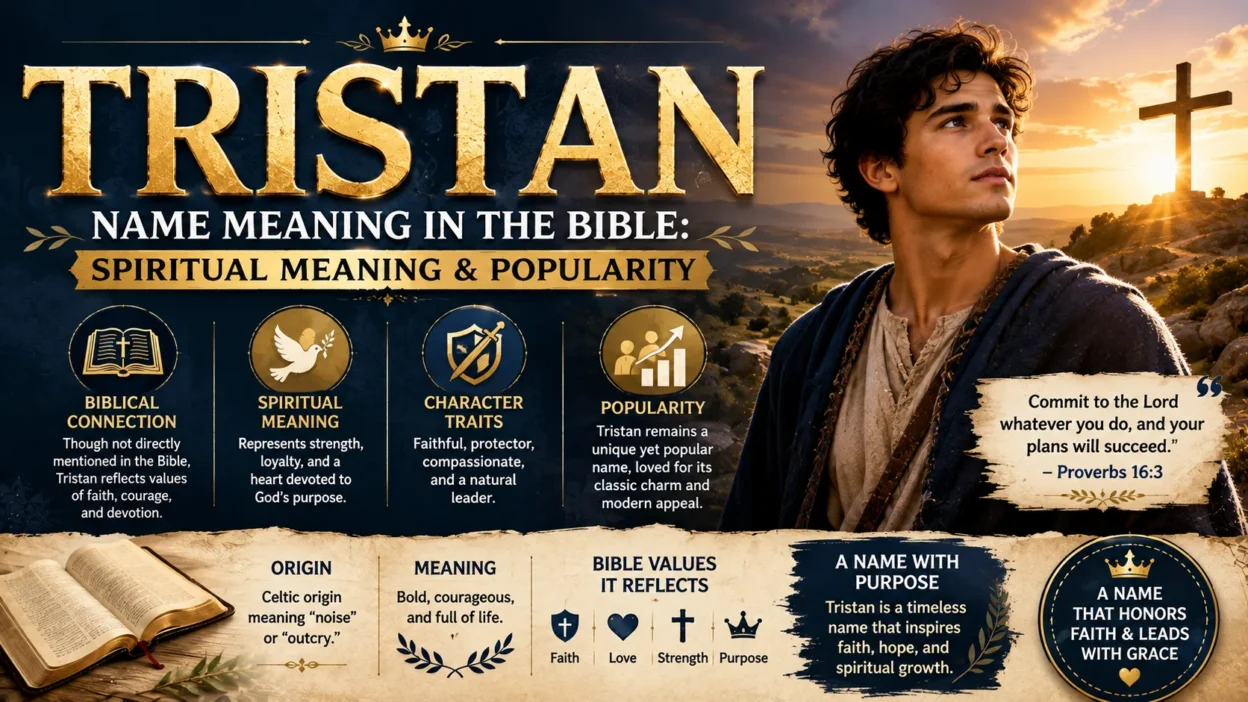
If you are searching for the Tristan name meaning Bible, the most important fact to know is that Tristan is not a biblical name. The name does not appear in either the Old Testament or the New Testament, so the Bible does not give Tristan a direct Hebrew or biblical meaning. Instead, Tristan comes from older European naming traditions and became famous through medieval literature, particularly the legendary story of Tristan and Iseult.
The name has a complicated etymology. Many sources connect Tristan with the old Pictish name Drustan or Drust, while its medieval French form became associated with triste, meaning “sad” or “sorrowful.” The original Celtic root may instead have been connected with ideas such as noise, tumult, or outcry.
Although Tristan has no literal biblical meaning, Christian parents can still choose it. Its associations with sorrow, courage, loyalty, perseverance, and hope can provide meaningful spiritual symbolism when viewed alongside biblical teachings.
Quick Answer: Tristan Name Meaning in the Bible
| Attribute | Details |
|---|---|
| Name | Tristan |
| Biblical Name? | No |
| Meaning | Commonly associated with sorrowful or sad |
| Possible Original Root | Drust / Drustan |
| Origin | Celtic, Pictish, Welsh, and medieval European traditions |
| Gender | Primarily masculine |
| Pronunciation | TRIS-tən |
| Biblical Meaning | None directly |
| Spiritual Associations | Hope, endurance, courage, compassion |
| Famous Association | Tristan and Iseult |
| Common Variants | Tristen, Tristin, Triston, Tristram |
| 2025 U.S. Boy Rank | #309 |
Current name references identify Tristan as a masculine name with English, French, and Arthurian usage. Behind the Name traces it probably to the old Pictish name Drustan, while medieval French stories likely influenced its association with the word triste, meaning “sad.”
Is Tristan a Biblical Name?
No, Tristan is not a biblical name.
You will not find a person named Tristan in the Old Testament or New Testament. The name developed outside the biblical naming traditions of Hebrew, Aramaic, and ancient Greek. Modern sources that specifically examine the question agree that Scripture does not mention Tristan.
This distinction matters because people sometimes label any name with a spiritual interpretation as a “biblical name.” Those terms do not mean the same thing.
- Biblical name: A name that appears in Scripture.
- Biblical meaning: A meaning directly established by biblical language or tradition.
- Christian name: A name that Christians may use because of its history, symbolism, or cultural significance.
- Spiritually meaningful name: A name whose meaning can remind someone of particular faith values.
Tristan belongs to the last two categories rather than the first.
What Does Tristan Mean in the Bible?
Because Tristan does not appear in Scripture, the Bible does not assign it a specific meaning.
The name is commonly associated with “sad,” “sorrowful,” or “melancholy,” largely because medieval French writers connected Tristan with triste. However, this may be a later association rather than the original etymology of the name.
Some linguistic sources instead trace Tristan to the Pictish or Celtic Drust/Drustan, with possible meanings related to noise or tumult.
Therefore, the safest explanation is:
Tristan has no direct biblical meaning. Its most common traditional interpretation is “sorrowful” or “sad,” while its older Celtic/Pictish roots may relate to noise or tumult.
Tristan Name Origin
Tristan has a Celtic and medieval European history.
Behind the Name explains that the name probably developed from the old Pictish name Drustan, a diminutive form of Drust. The medieval form Tristan appeared in French stories during the 12th century. Writers likely connected the name with Old French triste, meaning “sad.”
The name also appears in Welsh forms such as Trystan and Drystan.
Its historical development can be summarized as:
Drust → Drustan → Tristan / Trystan / Drystan
The name became much more recognizable because of medieval Arthurian literature.
Tristan Name Etymology
The exact etymology of Tristan remains debated.
Celtic/Pictish Theory
One theory connects Tristan with the old Pictish name Drustan, derived from Drust. Some sources associate this older root with meanings such as “noise,” “tumult,” or “outcry.”
French Literary Association
When medieval French writers used the form Tristan, they appear to have associated it with triste, meaning “sad.” This connection became especially strong because the Tristan character had a tragic love story.
Because these explanations differ, it is better to say that Tristan is commonly associated with sorrow or sadness rather than claiming that “sorrowful” is unquestionably its original Celtic meaning.
What Does Tristan Mean Spiritually?
Tristan does not have an official biblical spiritual meaning. However, its association with sorrow can inspire several Christian themes.
The Bible frequently discusses:
- Sorrow
- Comfort
- Hope
- Perseverance
- Faith
- Compassion
- Restoration
- Strength during hardship
For this reason, some Christian interpretations connect Tristan symbolically with the idea that sorrow does not have to define a person’s future.
A spiritual interpretation might therefore view Tristan as representing:
Sorrow → Endurance → Faith → Hope
This is a symbolic interpretation, not a biblical definition of the name.
Tristan and Biblical Themes of Sorrow
The Bible acknowledges sorrow as a real part of human life. Rather than presenting sadness as permanent, Scripture repeatedly connects hardship with God’s comfort and the hope of restoration.
For example, Psalm 34:18 describes God as being near to those who have broken hearts. James 1:2–4 discusses how trials can develop perseverance and maturity.
These themes can give the name Tristan a positive Christian interpretation:
- Sorrow can produce compassion.
- Hardship can develop endurance.
- Trials can strengthen faith.
- Pain does not eliminate hope.
Again, these ideas do not mean that the Bible defines Tristan as “faith” or “hope.” They simply provide a meaningful way for Christian parents to interpret a non-biblical name.
Is Tristan a Christian Name?
Tristan is not a biblical name, but Christians can certainly use it.
Christian naming traditions have never been limited exclusively to names found in Scripture. Many Christian families choose names from later European history, saints, literature, and other cultures.
If you want a name that appears directly in the Bible, Tristan would not meet that requirement. But if you want a name that can carry Christian symbolism, Tristan can still work.
Its association with sorrow can remind a family of biblical ideas such as:
- God’s comfort
- Perseverance through difficulty
- Compassion for others
- Hope after suffering
- Strength during trials
Is Tristan in the Old Testament?
No.
The name Tristan does not appear in the Old Testament. Its European origins developed outside the ancient Hebrew naming tradition represented in the Old Testament.
Is Tristan in the New Testament?
No.
Tristan does not appear among the apostles, disciples, early Christians, or other named figures in the New Testament.
The name developed much later in European history, particularly through Celtic traditions and medieval literature.
Does Tristan Have a Hebrew Meaning?
No established Hebrew meaning exists for Tristan.
Tristan is not derived from a Hebrew biblical name. Sources that describe its history generally connect it with Celtic, Pictish, Welsh, and medieval French traditions rather than Hebrew.
Therefore, claims that Tristan directly means a particular Hebrew religious concept should be treated cautiously.
Does Tristan Have a Greek Meaning?
Tristan is not originally a Greek name.
Its historical roots are associated with Celtic and Pictish traditions, while the French literary form influenced its association with triste.
The name may sometimes appear on websites discussing Greek names, but that does not establish a Greek etymology.
Tristan in Medieval Literature
The name became famous through the medieval story of Tristan and Iseult.
Tristan was a legendary hero associated with the Arthurian cycle. According to the traditional story, his uncle, King Mark of Cornwall, sent him to Ireland to bring Iseult back as Mark’s bride. During the journey, Tristan and Iseult accidentally drank a love potion and fell deeply in love.
Their love story became one of medieval Europe’s most famous tragic romances.
This literary history strongly influenced the meaning people associate with Tristan. Because the story contains separation, conflict, forbidden love, and tragedy, the name became connected with sadness and sorrow.
Tristan Name Personality
A name does not scientifically determine someone’s personality. However, names develop cultural associations from their meanings, history, sound, and famous namesakes.
Tristan is often associated with qualities such as:
- Courage
- Loyalty
- Sensitivity
- Romanticism
- Determination
- Emotional depth
- Strength
- Compassion
- Independence
- Resilience
The legendary Tristan was a courageous warrior and deeply loyal character, so the name can carry a combination of strength and emotional sensitivity.
Personality Traits Associated With Tristan
| Trait | Common Association |
|---|---|
| Courage | Legendary heroic character |
| Loyalty | Tristan’s devotion in medieval stories |
| Sensitivity | Connection with sorrow |
| Romantic | Tristan and Iseult |
| Strong | Arthurian heroic tradition |
| Compassionate | Emotional interpretation |
| Resilient | Association with overcoming hardship |
| Independent | Distinctive Celtic character |
| Passionate | Legendary love story |
| Determined | Heroic literary associations |
These qualities are symbolic rather than scientific predictions.
Tristan Name Popularity
Tristan remains a recognizable and moderately popular boy’s name in the United States.
According to current U.S. data presented by Nameberry, Tristan ranked #309 for boys in 2025, with 1,103 recorded births. The name ranked #267 in 2024, showing a recent decline in ranking while remaining comfortably within the U.S. top 1,000.
Its recent popularity history shows a gradual decline from its stronger position during the 2010s:
| Year | U.S. Boy Rank | Births |
|---|---|---|
| 2014 | #98 | 3,927 |
| 2015 | #101 | 3,926 |
| 2016 | #108 | 3,636 |
| 2017 | #121 | 3,308 |
| 2018 | #123 | 3,229 |
| 2019 | #151 | 2,569 |
| 2020 | #182 | 2,124 |
| 2021 | #208 | 1,822 |
| 2022 | #225 | 1,600 |
| 2023 | #253 | 1,379 |
| 2024 | #267 | 1,296 |
| 2025 | #309 | 1,103 |
This makes Tristan familiar without being among the most common choices for boys today.
Is Tristan a Boy or Girl Name?
Tristan is primarily a boy’s name, although modern naming trends allow it to be used for girls as well.
In 2025, Tristan ranked #309 for boys compared with #5,706 for girls, according to current U.S. data presented by The Bump.
This makes Tristan overwhelmingly masculine in current American usage.
How Do You Pronounce Tristan?
The standard English pronunciation is:
TRIS-tən
You can divide the name into two syllables:
Tris-tan
The French pronunciation differs and sounds closer to trees-TAHN.
The English pronunciation is represented as /ˈtrɪstən/.
Nicknames for Tristan
Tristan is already relatively short, but several nicknames can work.
| Nickname | Style |
|---|---|
| Tris | Short and modern |
| Tristy | Cute and playful |
| Trist | Simple |
| Tan | Very short |
| T | Minimal |
| Tristie | Friendly |
| T-Man | Casual |
Tris is probably the easiest everyday nickname.
Tristan Name Variations
Tristan appears in several forms across different languages and naming traditions.
| Variation | Language/Tradition |
|---|---|
| Tristan | English/French |
| Tristen | English |
| Tristin | English |
| Triston | English |
| Tristram | English |
| Trystan | Welsh |
| Drystan | Welsh |
| Drustan | Pictish |
| Tristán | Spanish |
| Tristão | Portuguese |
Behind the Name specifically lists Tristen, Tristin, Triston, and Tristram as English variants and Drystan, Trystan, Tristán, and Tristão among related forms in other languages.
Names Similar to Tristan
If you like Tristan but want something with a similar style, consider:
Celtic-Inspired Names
- Declan
- Ronan
- Kieran
- Callum
- Rowan
- Dylan
- Aidan
- Gavin
- Cian
- Rhys
Romantic and Literary Names
- Adrian
- Julian
- Sebastian
- Dorian
- Damian
- Lucian
- Roman
- Cassian
- Orion
- Evander
Names Similar in Sound
- Christian
- Cristian
- Tristen
- Tristin
- Triston
- Tristan
- Austin
- Dustin
Middle Names for Tristan
Tristan’s two-syllable structure works well with both short and long middle names.
Classic Combinations
- Tristan James
- Tristan William
- Tristan Alexander
- Tristan Benjamin
- Tristan Edward
- Tristan Samuel
- Tristan Joseph
- Tristan Daniel
- Tristan Thomas
- Tristan Michael
Modern Combinations
- Tristan Blake
- Tristan Cole
- Tristan Miles
- Tristan Jude
- Tristan Hayes
- Tristan Grey
- Tristan Luke
- Tristan Reid
- Tristan Kai
- Tristan Leo
Famous People Named Tristan
Several notable people have carried the name Tristan.
- Tristan Thompson — Canadian-American professional basketball player
- Tristan Rogers — Australian actor
- Tristan Wilds — American actor and musician
- Tristan Harris — American technology ethicist
- Tristan Tzara — Romanian-French avant-garde poet and artist
The name’s presence in sports, entertainment, art, and literature has helped maintain its modern recognition.
Is Tristan a Good Name for a Christian Baby?
That depends on what you want from a name.
If you specifically want a name found in the Bible, Tristan is not the right choice.
If you want a name with:
- European history
- Celtic roots
- Literary depth
- A strong sound
- Romantic associations
- Symbolic connections with perseverance and hope
then Tristan can be an excellent choice.
Christian parents can also give a non-biblical name a meaningful family interpretation. The important distinction is simply to avoid claiming that Tristan itself appears in Scripture.
Common Questions About Tristan
Is Tristan mentioned in the Bible?
No. Tristan does not appear in either the Old Testament or New Testament. Its origins come from European naming traditions rather than biblical languages.
What does Tristan mean?
Tristan is commonly associated with “sad” or “sorrowful,” although its older Pictish/Celtic roots may connect with Drust or Drustan and meanings related to noise or tumult.
Is Tristan a Christian name?
Tristan is not a biblical name, but Christians can use it. Its Christian significance comes from symbolic interpretation rather than Scripture.
Does Tristan mean sorrow?
It is commonly associated with sorrow or sadness, largely because medieval French writers connected Tristan with triste, meaning “sad.”
What is the spiritual meaning of Tristan?
Tristan has no official biblical spiritual meaning. Symbolically, people may connect it with endurance, compassion, courage, faith, and hope during difficult experiences.
Is Tristan a boy name?
Yes. Tristan is primarily masculine. In 2025, it ranked #309 for boys in U.S. birth data, compared with #5,706 for girls.
What is the origin of Tristan?
Tristan probably developed from the old Pictish name Drustan, with Welsh forms such as Trystan and Drystan. Its medieval French form became closely associated with the Tristan and Iseult legend.
What names are similar to Tristan?
Names with a similar Celtic or romantic style include Kieran, Declan, Ronan, Rowan, Adrian, Julian, Sebastian, Damian, and Christian.
Frequently Asked Questions
1. What is the Tristan name meaning in the Bible?
The Bible gives no meaning for Tristan because the name does not appear in Scripture. Its traditional European associations include “sorrowful” or “sad,” while its older roots may relate to Drust or Drustan.
2. Is Tristan a biblical or Hebrew name?
No. Tristan is neither a biblical nor Hebrew name. Its history is connected primarily with Celtic, Pictish, Welsh, and medieval European traditions.
3. What does Tristan mean spiritually?
Although Tristan has no established biblical spiritual meaning, its association with sorrow can symbolically represent endurance, compassion, faith, and hope through hardship.
4. Does the name Tristan mean “sad”?
“Sad” or “sorrowful” is the most common traditional interpretation, influenced by the medieval French word triste. However, this may be a later association rather than the original meaning of the older Celtic/Pictish name.
5. Is Tristan a good Christian baby name?
Yes, if you are comfortable choosing a name that does not appear in the Bible. Tristan has a long history and can symbolically represent qualities such as courage, loyalty, perseverance, and hope.
6. What Bible verses relate to the meaning of Tristan?
Because Tristan has no biblical meaning, no verse specifically defines the name. However, themes of sorrow, comfort, perseverance, and hope appear throughout Scripture. Psalm 34:18, James 1:2–4, Romans 5:3–5, and Matthew 5:4 are examples of passages that can provide meaningful spiritual connections.
7. Is Tristan a rare name?
Tristan is not extremely rare in the United States. It ranked #309 for boys in 2025, although its popularity has declined from its top-100 position in the mid-2010s.
8. What is the biblical alternative to Tristan?
If you like Tristan’s strong, traditional sound but specifically want a biblical name, consider Christian, Thomas, Samuel, Daniel, Nathaniel, Benjamin, or Jonathan.
Conclusion
The Tristan name meaning Bible question has a straightforward answer: Tristan is not found in the Bible and has no direct biblical meaning. Its history instead reaches back to European naming traditions, with scholars connecting it to the old Pictish name Drustan and related Celtic forms. Medieval French literature later associated the name with triste, meaning “sad” or “sorrowful,” an interpretation strengthened by the tragic story of Tristan and Iseult.
Although the name does not come from Scripture, parents can still give Tristan a meaningful Christian interpretation. Its associations with sorrow can serve as a reminder of biblical themes such as compassion, perseverance, comfort, faith, and hope. The name also carries strong literary and heroic associations, making it a distinctive choice for families who appreciate Celtic history and medieval tradition.
Today, Tristan remains a recognizable boys’ name in the United States, ranking #309 in 2025. If you want a name with European heritage, emotional depth, and a strong literary history, Tristan offers a compelling choice—even though it is not a biblical name.

Lillian Hayes is a content writer focused on explaining meanings and language in a simple and clear way. She creates easy-to-understand content that helps readers learn and communicate better.