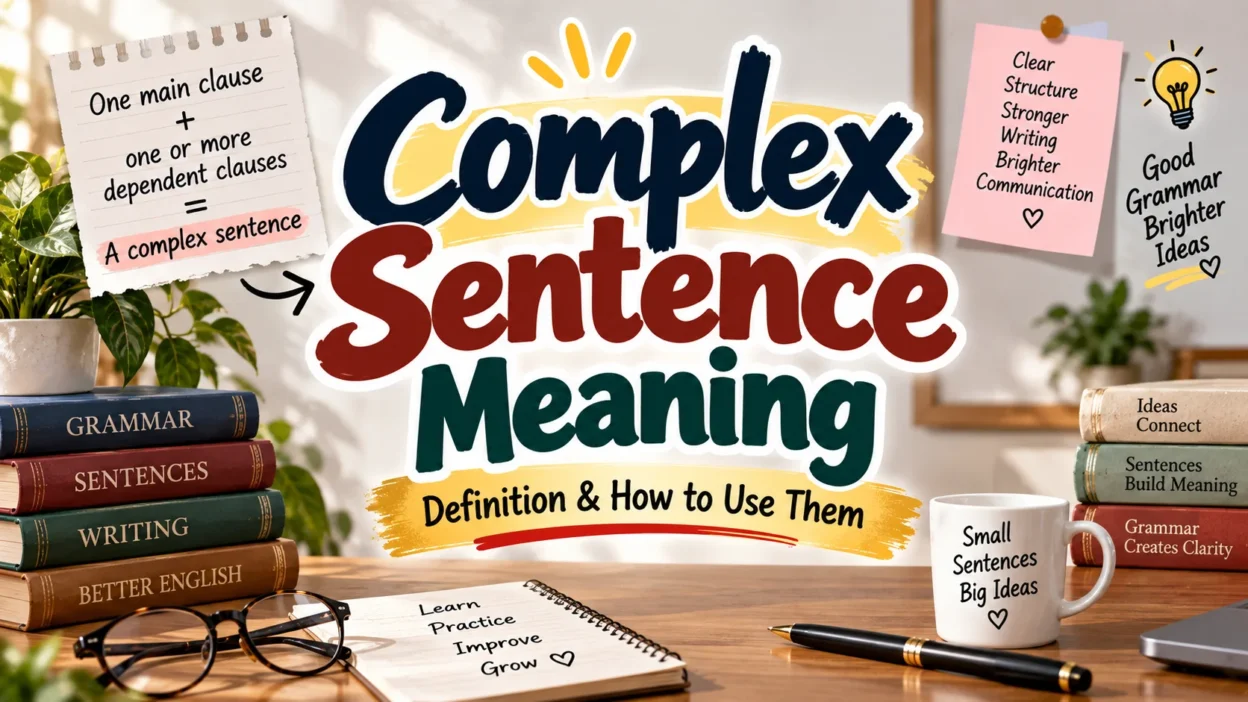
Understanding complex sentence meaning becomes much easier when you know how different parts of a sentence work together. A complex sentence contains one independent clause that can stand on its own and at least one dependent clause that needs the main clause to complete its meaning. These sentences help writers connect ideas, show relationships, and explain why, when, where, or under what condition something happens.
For example, consider the sentence: Because it was raining, we stayed inside. The main idea is we stayed inside, while because it was raining explains the reason. The second part cannot normally stand alone as a complete sentence, so it depends on the independent clause. This relationship is what gives a complex sentence its structure and meaning.
Complex sentences appear frequently in everyday conversations, academic writing, essays, professional communication, books, articles, and formal English. Learning how to identify them can improve both reading comprehension and writing skills. In this guide, you will learn the complex sentence meaning, definition, structure, types of dependent clauses, punctuation rules, examples, common mistakes, and differences between simple, compound, and complex sentences.
📖 What Is the Meaning of a Complex Sentence?
A complex sentence is a sentence that contains one independent clause and at least one dependent clause. The independent clause expresses a complete thought, while the dependent clause adds information but cannot normally express a complete thought by itself.
Dependent clauses often begin with subordinating conjunctions such as because, although, since, when, while, if, unless, after, before, and whenever. Relative pronouns such as who, which, and that can also introduce dependent clauses.
For example:
Although she was tired, Maria finished her homework.
Here, Maria finished her homework is the independent clause. Although she was tired is the dependent clause because it does not express a complete thought on its own.
The dependent clause gives additional information about the main action. It explains the condition or contrast surrounding the action.
🧩 Complex Sentence Structure Explained
The basic structure of a complex sentence is:
Independent Clause + Dependent Clause
or
Dependent Clause + Independent Clause
For example:
- I went home because I felt sick.
- Because I felt sick, I went home.
- She smiled when she saw her friend.
- When she saw her friend, she smiled.
The meaning remains closely connected, but the position of the dependent clause changes.
| Structure | Example |
|---|---|
| Independent + dependent | I stayed home because I was sick. |
| Dependent + independent | Because I was sick, I stayed home. |
| Independent + relative clause | The girl who won the race is my sister. |
| Independent + conditional clause | We will go outside if the rain stops. |
🔍 How to Identify a Complex Sentence
Identifying a complex sentence becomes easier when you look for clauses. First, find the part that can stand alone as a complete sentence. That is usually the independent clause. Then look for another clause that depends on it for its complete meaning.
Watch for subordinating conjunctions such as:
- because
- although
- since
- when
- while
- after
- before
- if
- unless
- whenever
- wherever
- even though
- as
- until
For example:
We canceled the picnic because it started raining.
The independent clause is We canceled the picnic. The dependent clause is because it started raining.
Because introduces the reason, making the second clause dependent on the first.
✏️ Complex Sentence Examples With Meaning
Examples make the complex sentence meaning much easier to understand. Each sentence below connects a main idea with additional information.
- I stayed home because I was feeling sick.
- When the bell rang, the students left the classroom.
- She smiled because she received good news.
- Although he was nervous, he gave a great speech.
- We went outside after the rain stopped.
- If you study regularly, you can improve your grades.
- While I was cooking, my brother cleaned the kitchen.
- Since the store was closed, we went somewhere else.
- Before you leave, please turn off the lights.
- Unless you hurry, you will miss the bus.
- I will call you when I arrive.
- Even though it was cold, they went swimming.
- The teacher praised the student who answered correctly.
- I remember the day when we first met.
- She bought the dress that she had seen online.
Each sentence contains a complete main idea and another clause that provides additional information.
🕒 Complex Sentences Showing Time
Complex sentences are often used to explain when an action happens. Words such as when, while, before, after, and until help connect actions occurring at different times.
For example:
- When the movie ended, we went home.
- I called her after I finished work.
- Before you go to bed, brush your teeth.
- While she was studying, her phone rang.
- We waited until the teacher arrived.
- After the sun came up, the hikers continued walking.
- When I finish my assignment, I will watch television.
- Before the guests arrived, we cleaned the house.
- While the children played, their parents talked.
- After he completed the project, he submitted it.
These sentences make the timing between two events clear.
💡 Complex Sentences Showing Reasons
A complex sentence can explain why something happens. Because, since, and as are commonly used to introduce reason clauses.
Examples include:
- We stayed inside because it was raining.
- Since she was tired, she went to bed early.
- I brought an umbrella because the weather looked cloudy.
- As he was late, he took a taxi.
- She missed the meeting because her car broke down.
- Since the road was blocked, we took another route.
- We canceled the trip because the weather was dangerous.
- As I had finished my work, I decided to relax.
- He apologized because he realized his mistake.
- Since the restaurant was full, we ate somewhere else.
The dependent clause answers the question of why the main action happened.
🔄 Complex Sentences Showing Contrast
Complex sentences can also connect two ideas that seem surprising or different. Although, though, even though, and whereas are useful for showing contrast.
Examples:
- Although it was raining, we played football.
- Even though she was tired, she continued working.
- Although he studied hard, he did not pass the exam.
- Though the task was difficult, they completed it.
- Even though the restaurant was expensive, we enjoyed the meal.
- Although I disagreed, I respected his opinion.
- Though she was nervous, she performed confidently.
- Even though the road was long, the journey was enjoyable.
The dependent clause creates a contrast with the main clause.
🌧️ Complex Sentences Showing Conditions
Conditional complex sentences describe something that depends on another situation. If and unless are especially common in these sentences.
Examples:
- If you work hard, you can achieve your goals.
- If it rains, we will stay inside.
- Unless you hurry, you will miss the train.
- If she calls, please tell me.
- We will go to the beach if the weather improves.
- Unless you practice, your skills may not improve.
- If you save money, you can buy a new laptop.
- You will succeed if you remain consistent.
- Unless the store opens, we cannot buy the supplies.
- If he arrives early, we will start the meeting.
These sentences clearly show a condition and its possible result.
👤 Complex Sentences With Relative Clauses
Relative clauses provide additional information about a person, place, thing, or idea. They often begin with who, which, that, whose, or whom.
Examples:
- The woman who lives next door is a doctor.
- I bought the phone that you recommended.
- This is the book that changed my opinion.
- The student who won the competition received a prize.
- We visited the house where my grandmother grew up.
- I remember the day when we met.
- The dog that was barking belongs to our neighbor.
- She thanked the teacher who helped her.
- This is the restaurant where we had dinner.
- He is the person whom I contacted yesterday.
Relative clauses make sentences more descriptive and informative.
🆚 Simple vs Compound vs Complex Sentences
Understanding the difference between sentence types is important for grammar and writing.
| Sentence Type | Main Structure | Example |
|---|---|---|
| Simple | One independent clause | She studies every day. |
| Compound | Two independent clauses | She studies every day, and she works at night. |
| Complex | One independent + dependent clause | She studies every day because she wants good grades. |
| Compound-complex | Two+ independent + dependent clause | She studies every day because she wants good grades, and her brother helps her. |
A simple sentence contains one main clause. A compound sentence joins independent clauses, usually with coordinating conjunctions such as and, but, or, and so. A complex sentence adds a dependent clause to an independent clause.
📝 Complex Sentence vs Compound Sentence
The main difference is the type of clauses being connected.
A compound sentence connects two independent clauses:
I was tired, but I finished my work.
Both parts can stand alone:
I was tired.
I finished my work.
A complex sentence connects an independent clause with a dependent clause:
I finished my work although I was tired.
Although I was tired cannot normally stand alone as a complete sentence.
This difference is one of the easiest ways to identify complex sentences.
🔤 Common Words Used in Complex Sentences
Subordinating conjunctions are some of the most important words in complex sentence construction. They show relationships between the main idea and the supporting idea.
| Word | Relationship | Example |
|---|---|---|
| Because | Reason | I stayed home because I was sick. |
| Although | Contrast | Although it was late, we continued. |
| If | Condition | If you call, I will answer. |
| When | Time | When she arrived, we started. |
| While | Time | While he studied, I cooked. |
| Before | Time | Before you leave, call me. |
| After | Time | After we ate, we walked. |
| Unless | Condition | Unless you hurry, you will be late. |
| Since | Reason/Time | Since it was raining, we stayed inside. |
| Wherever | Place | Wherever she goes, her dog follows. |
📌 Comma Rules for Complex Sentences
Punctuation depends on the position and type of dependent clause.
When the dependent clause comes before the independent clause, a comma is usually used.
Because it was raining, we stayed home.
When the independent clause comes first, a comma is often unnecessary when the dependent clause is essential to the meaning.
We stayed home because it was raining.
Compare these examples:
- When the class ended, the students left.
- The students left when the class ended.
- Although he was tired, he continued working.
- He continued working although he was tired.
Learning this pattern can help you avoid unnecessary commas.
🚫 Common Complex Sentence Mistakes
One common mistake is writing a dependent clause as if it were a complete sentence.
Incorrect:
Because I was tired.
This is a sentence fragment because because I was tired does not express a complete thought.
Correct:
Because I was tired, I went to bed.
Another common problem is forgetting the comma when a long introductory dependent clause comes before the main clause.
Correct:
Although the weather was extremely cold, the players continued the game.
Writers should also avoid connecting clauses incorrectly. Make sure every dependent clause has an independent clause that completes its meaning.
🎓 Why Complex Sentences Are Important
Complex sentences help writers express relationships between ideas more precisely. Instead of writing several short sentences, you can show whether one event caused another, happened before it, depended on it, or contrasted with it.
For example, instead of writing:
The weather was bad. We stayed home.
You can write:
Because the weather was bad, we stayed home.
The complex sentence tells the reader exactly how the two ideas are connected.
They are especially useful in essays, academic writing, storytelling, explanations, reports, professional communication, and everyday conversation.
✍️ How to Write a Complex Sentence
Creating a complex sentence is simple when you follow a few steps.
First, write a complete independent clause.
I stayed home.
Next, decide what additional relationship you want to express. You might want to show a reason, condition, time, contrast, or place.
Then add a suitable dependent clause.
because I was sick
Combine them:
I stayed home because I was sick.
You can also reverse the order:
Because I was sick, I stayed home.
Practice creating sentences with different subordinating conjunctions to become comfortable with complex sentence structure.
🌟 Complex Sentence Examples for Students
Students often need complex sentences for essays, assignments, grammar exercises, and academic writing. These examples demonstrate different relationships between ideas.
- Because I studied hard, I passed the exam.
- Although the assignment was difficult, I completed it.
- When the teacher entered, everyone became quiet.
- If you practice every day, your writing will improve.
- Since I had enough time, I reviewed my answers.
- Before the test began, I checked my supplies.
- After I finished my homework, I watched a movie.
- While my friends played outside, I studied.
- Unless you follow the instructions, the answer may be incorrect.
- Even though the question looked difficult, I solved it.
💬 Complex Sentences in Everyday English
Complex sentences are not limited to textbooks. People use them naturally when speaking and writing every day.
You might say:
- I will call you when I get home.
- We can go out if the weather improves.
- I stayed late because I had more work.
- Although I was busy, I answered your message.
- Tell me when you are ready.
- I will help you if you need me.
- We waited until the store opened.
- She left because she was feeling tired.
- I smiled when I saw the surprise.
- Unless you need anything else, I will leave now.
These examples show how naturally complex sentence structures appear in everyday communication.
❓ Complex Sentence Meaning FAQs
What is the simple meaning of a complex sentence?
A complex sentence contains one complete main clause and at least one dependent clause. The dependent clause adds information about the reason, time, condition, contrast, place, or another relationship connected to the main idea.
What is an example of a complex sentence?
Because it was raining, we stayed inside is a complex sentence. We stayed inside is the independent clause, while because it was raining is the dependent clause.
How do you identify a complex sentence?
Look for one independent clause and at least one dependent clause. Subordinating conjunctions such as because, although, when, if, while, before, after, and unless often signal the dependent clause.
What is the difference between a simple and complex sentence?
A simple sentence contains one independent clause. A complex sentence contains one independent clause plus at least one dependent clause. For example, She studied is simple, while She studied because she had an exam is complex.
What is the difference between a compound and complex sentence?
A compound sentence contains two or more independent clauses, while a complex sentence contains an independent clause and at least one dependent clause. Compound sentences often use and, but, or, or so, while complex sentences commonly use subordinating conjunctions.
Do complex sentences always need a comma?
No. A comma is commonly used when the dependent clause comes before the independent clause, such as Because it was raining, we stayed home. When the independent clause comes first, a comma is often unnecessary.
Why are complex sentences important in writing?
Complex sentences help writers connect ideas clearly and show relationships such as cause, time, condition, contrast, and place. They can make writing more precise and informative.
Can a complex sentence have more than one dependent clause?
Yes. A sentence can contain one independent clause and multiple dependent clauses. It can also become a compound-complex sentence when it contains multiple independent clauses along with one or more dependent clauses.
🏁 Final Thoughts
The complex sentence meaning becomes clear once you understand the relationship between independent and dependent clauses. A complex sentence has one main clause that can stand alone and at least one dependent clause that adds supporting information.
Learning complex sentence structure can make your English more flexible and precise. Whether you are writing an essay, completing a grammar exercise, creating professional content, or simply improving everyday communication, these sentences help you connect ideas naturally. Start with simple structures using because, although, when, if, and while, then gradually experiment with more detailed sentence patterns.

Lillian Hayes is a content writer focused on explaining meanings and language in a simple and clear way. She creates easy-to-understand content that helps readers learn and communicate better.