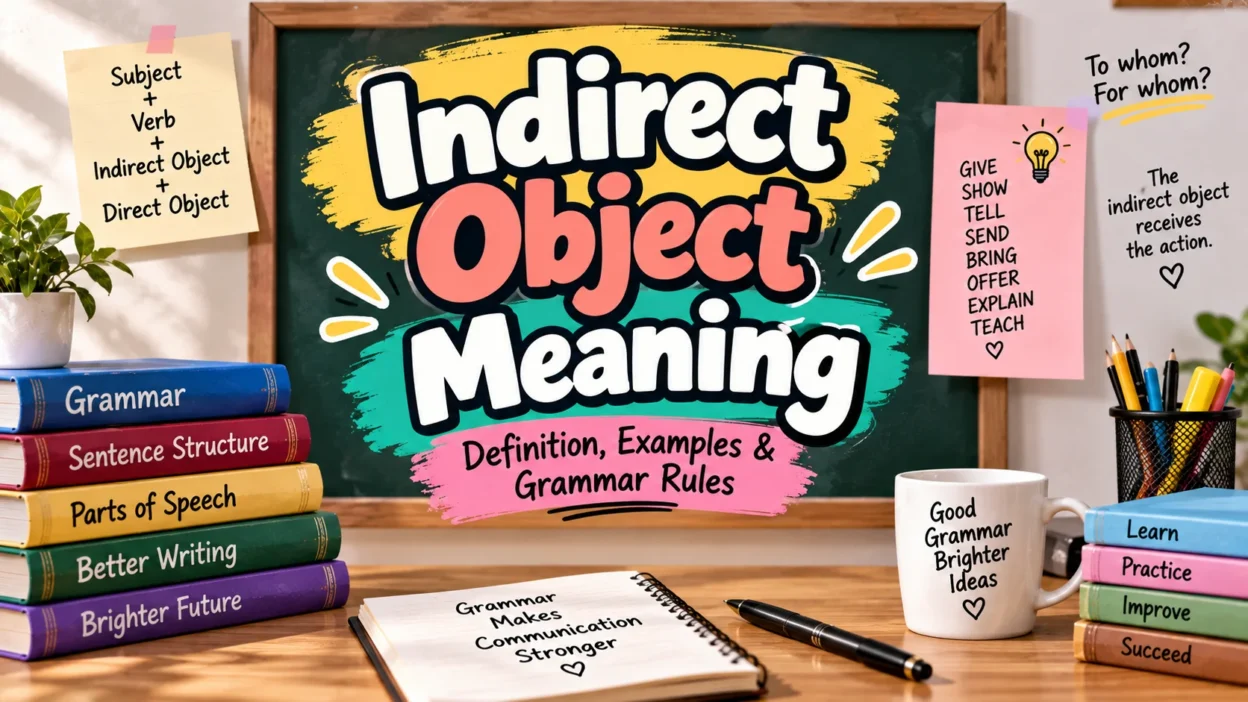
Understanding indirect object meaning is important if you want to learn English sentence structure clearly. An indirect object is a word or phrase that tells us who receives something or who benefits from an action. It usually appears with a direct object because the direct object identifies what is being given, sent, bought, shown, or offered.
For example, look at this sentence: Sarah gave her brother a gift. The word gift is the direct object because it is the thing Sarah gave. Her brother is the indirect object because he received the gift. In other words, the indirect object often answers the questions to whom?, for whom?, to what?, or for what?
Indirect objects are common in everyday English and appear in sentences involving verbs such as give, send, buy, tell, show, offer, lend, teach, bring, and make. Once you understand the difference between direct and indirect objects, sentence analysis becomes much easier. In this guide, you will learn the indirect object meaning, definition, sentence structure, examples, identification rules, direct vs. indirect objects, prepositional phrases, common mistakes, and practical examples for students.
📖 What Is the Meaning of an Indirect Object?
An indirect object is a noun or pronoun that receives the direct object or benefits from the action of the verb.
Consider this example:
Maria gave her friend a present.
- Maria = subject
- gave = verb
- her friend = indirect object
- a present = direct object
The present is the thing being given, while her friend is the person receiving it.
A useful pattern is:
Subject + Verb + Indirect Object + Direct Object
For example:
John sent his mother a letter.
John performs the action, a letter is the thing being sent, and his mother receives it.
🧩 How to Identify an Indirect Object
Finding an indirect object becomes easier when you follow a simple process.
First, find the verb. Then ask what? or whom? to identify the direct object. After that, ask to whom? or for whom? the action was performed.
Example:
The teacher gave the students homework.
Ask:
What did the teacher give?
Homework = direct object.
To whom did the teacher give homework?
The students = indirect object.
This method works with many sentences involving giving, sending, showing, telling, buying, lending, and offering.
✏️ Indirect Object Examples
Here are some straightforward examples to make the concept easier to understand:
- She gave me a book.
- Tom sent his sister a message.
- We bought our mother flowers.
- The teacher taught the students grammar.
- Dad made me breakfast.
- Sarah showed her friend the picture.
- I told my brother the news.
- They offered us some help.
- He lent his friend some money.
- Grandma baked the children cookies.
- The company sent its customers an email.
- She brought her parents a gift.
- I wrote my teacher a letter.
- The coach taught the players a new strategy.
- He promised his wife a surprise.
In each sentence, the indirect object identifies the person who receives or benefits from the direct object.
🎯 Direct Object vs. Indirect Object
The easiest way to understand an indirect object is to compare it with a direct object.
The direct object receives the action directly. The indirect object usually identifies the person or thing that receives the direct object.
| Sentence | Direct Object | Indirect Object |
|---|---|---|
| She gave me a book. | a book | me |
| He sent Sara a letter. | a letter | Sara |
| We bought Mom flowers. | flowers | Mom |
| I told him the story. | the story | him |
| They offered us help. | help | us |
| She taught the children English. | English | the children |
| Dad made me breakfast. | breakfast | me |
| He showed his friend the photo. | the photo | his friend |
A useful shortcut is that the direct object usually answers what? or whom?, while the indirect object often answers to whom? or for whom?
🔄 Indirect Objects With To
Many sentences can express the indirect object using the preposition to.
Compare:
She gave me a present.
and:
She gave a present to me.
The meaning is nearly the same. In the first sentence, me functions as the indirect object. In the second sentence, to me is a prepositional phrase.
More examples:
- He sent me a message.
- He sent a message to me.
- She gave her brother the keys.
- She gave the keys to her brother.
- I showed my friend the picture.
- I showed the picture to my friend.
- They offered us a seat.
- They offered a seat to us.
This structure is useful because English can express the recipient in two different ways.
🎁 Indirect Objects With For
Some verbs use for when someone benefits from an action.
Examples:
- Mom bought me a jacket.
- Mom bought a jacket for me.
- She made her children dinner.
- She made dinner for her children.
- I baked my friend a cake.
- I baked a cake for my friend.
- He ordered his wife coffee.
- He ordered coffee for his wife.
In these examples, the indirect object identifies the person who benefits from the action.
👤 Indirect Object Pronouns
Indirect objects are often pronouns, especially in everyday English. Common indirect object pronouns include me, you, him, her, it, us, and them.
Examples:
- She gave me a gift.
- I sent him an email.
- We bought her flowers.
- They offered us a ride.
- He told them the truth.
- The teacher showed you the answer.
The pronoun represents the person receiving or benefiting from the direct object.
🏫 Indirect Object Examples for Students
Students often encounter indirect objects in grammar exercises. These examples can help with classroom practice.
- The teacher gave the class an assignment.
- The coach taught the players a new technique.
- Sarah showed her classmates her project.
- The principal sent the parents a letter.
- The librarian recommended me a book.
- The teacher explained the lesson to us.
- My friend lent me a pencil.
- The professor gave the students extra time.
- The school offered the children free meals.
- The tutor taught him English grammar.
When analyzing these sentences, look for the recipient of the direct object.
🧠 What Questions Does an Indirect Object Answer?
An indirect object commonly answers questions such as:
To whom?
For whom?
In some sentence structures, it can also be understood as identifying the recipient or beneficiary of the action.
Example:
Lisa gave her brother a sandwich.
What did Lisa give?
A sandwich.
To whom did she give it?
Her brother.
Therefore, her brother is the indirect object.
Another example:
Dad bought me a new phone.
What did Dad buy?
A new phone.
For whom did Dad buy it?
Me.
Therefore, me is the indirect object.
🔍 How to Find the Indirect Object in a Sentence
Use these four steps:
1. Find the subject.
Identify who performs the action.
2. Find the verb.
Determine what action occurs.
3. Find the direct object.
Ask what? or whom?
4. Find the recipient or beneficiary.
Ask to whom? or for whom?
For example:
Emma gave her sister a necklace.
Subject: Emma
Verb: gave
Direct object: a necklace
Indirect object: her sister
This simple process works for many common English sentences.
⚠️ Common Mistakes With Indirect Objects
One common mistake is confusing the indirect object with the direct object.
In the sentence:
I gave my friend a book.
Some learners incorrectly identify my friend as the direct object. However, the book is the thing being given, so it is the direct object. My friend receives the book, making it the indirect object.
Another mistake occurs when learners assume every sentence must contain an indirect object. That is not true. Many sentences have only a subject, verb, and direct object.
For example:
She opened the door.
The door is the direct object, but there is no indirect object.
🚫 Not Every Sentence Has an Indirect Object
An indirect object is not required in every sentence.
Compare these examples:
She opened the door.
This sentence has a direct object but no indirect object.
She gave me the key.
This sentence has both:
- me = indirect object
- the key = direct object
The presence of a direct object does not automatically mean that an indirect object exists.
🆚 Indirect Object vs. Object of a Preposition
An indirect object and the object of a preposition can sometimes refer to the same person, but their grammatical roles differ.
Compare:
She gave me a book.
Here, me is the indirect object.
She gave a book to me.
Here, me is the object of the preposition to, not an indirect object in the same grammatical structure.
This distinction can be useful when studying formal English grammar and sentence analysis.
📚 Verbs Commonly Used With Indirect Objects
Many verbs can appear in sentences containing indirect objects. Common examples include:
| Verb | Example |
|---|---|
| Give | She gave me a gift. |
| Send | He sent me a message. |
| Buy | They bought her flowers. |
| Tell | I told him the truth. |
| Show | She showed us the photo. |
| Teach | He taught them English. |
| Offer | They offered me help. |
| Lend | She lent him money. |
| Bring | He brought us food. |
| Make | Mom made me breakfast. |
| Sell | He sold me his old bike. |
| Promise | She promised him a reward. |
| Hand | He handed me the keys. |
| Pass | Please pass me the salt. |
| Read | She read the children a story. |
Learning these common verbs can make indirect objects easier to recognize.
🗣️ Indirect Objects in Everyday English
You probably use indirect objects regularly without thinking about grammar.
For example:
- Give me a minute.
- Send me the details.
- Tell her the news.
- Show me the picture.
- Bring us some water.
- Buy him a gift.
- Lend me your pen.
- Pass me the salt.
- Make them some tea.
- Offer her a seat.
These structures are extremely common in conversations, messages, emails, and everyday communication.
📝 Practice: Find the Indirect Object
Try identifying the indirect object in each sentence.
1. Sarah gave John a present.
Indirect object: John
2. Mom bought me a new shirt.
Indirect object: me
3. The teacher showed the students a video.
Indirect object: the students
4. He sent his friend a message.
Indirect object: his friend
5. Grandma baked us a cake.
Indirect object: us
6. The coach taught the players a new skill.
Indirect object: the players
7. I told my sister a secret.
Indirect object: my sister
8. They offered the guests some food.
Indirect object: the guests
🌟 Why Is the Indirect Object Important?
Understanding indirect objects helps you understand how English sentences organize information. It allows you to identify who receives something and distinguish that person from the thing being given, sent, shown, or offered.
This knowledge is particularly useful for students learning English grammar because direct and indirect objects frequently appear together. Once you understand their roles, sentence parsing, grammar exercises, and writing become much easier.
Indirect objects also help you build more natural sentences because they show relationships between actions, things, and people.
❓ Indirect Object Meaning FAQs
What is the simple meaning of an indirect object?
An indirect object is the person or thing that receives the direct object or benefits from an action. In the sentence She gave me a book, me is the indirect object because I receive the book.
How do you find an indirect object?
First find the verb and direct object. Then ask to whom? or for whom? the action happens. The answer is often the indirect object.
What is an example of an indirect object?
In the sentence Tom gave Sarah a flower, Sarah is the indirect object and a flower is the direct object. Sarah receives the flower.
What is the difference between a direct and indirect object?
A direct object receives the action directly and usually answers what? or whom? An indirect object identifies the recipient or beneficiary and often answers to whom? or for whom?
Can an indirect object come before a direct object?
Yes. In English, an indirect object often comes before the direct object. For example, She gave me a book places me before a book.
Can a sentence have a direct object but no indirect object?
Yes. For example, He opened the door contains a direct object, the door, but no indirect object.
Is an object after to always an indirect object?
Not necessarily. In She gave a book to John, John is the object of the preposition to. The sentence expresses the recipient using a prepositional phrase rather than placing John directly before the direct object.
What are common verbs that use indirect objects?
Common verbs include give, send, buy, tell, show, teach, offer, lend, bring, make, pass, hand, sell, and promise. These verbs frequently describe actions involving a recipient or beneficiary.
🏁 Final Thoughts
The indirect object meaning is simple once you focus on the relationship between the action, the direct object, and the recipient. An indirect object usually tells us who receives something or who benefits from an action.
Remember the basic pattern:
Subject + Verb + Indirect Object + Direct Object
For example:
She gave me a gift.
Here, me is the indirect object and a gift is the direct object.
Once you can identify the direct object and then ask to whom? or for whom?, finding an indirect object becomes much easier. Practice with common verbs such as give, send, tell, show, buy, teach, lend, and offer, and you will quickly become more confident with English sentence structure.

Lillian Hayes is a content writer focused on explaining meanings and language in a simple and clear way. She creates easy-to-understand content that helps readers learn and communicate better.