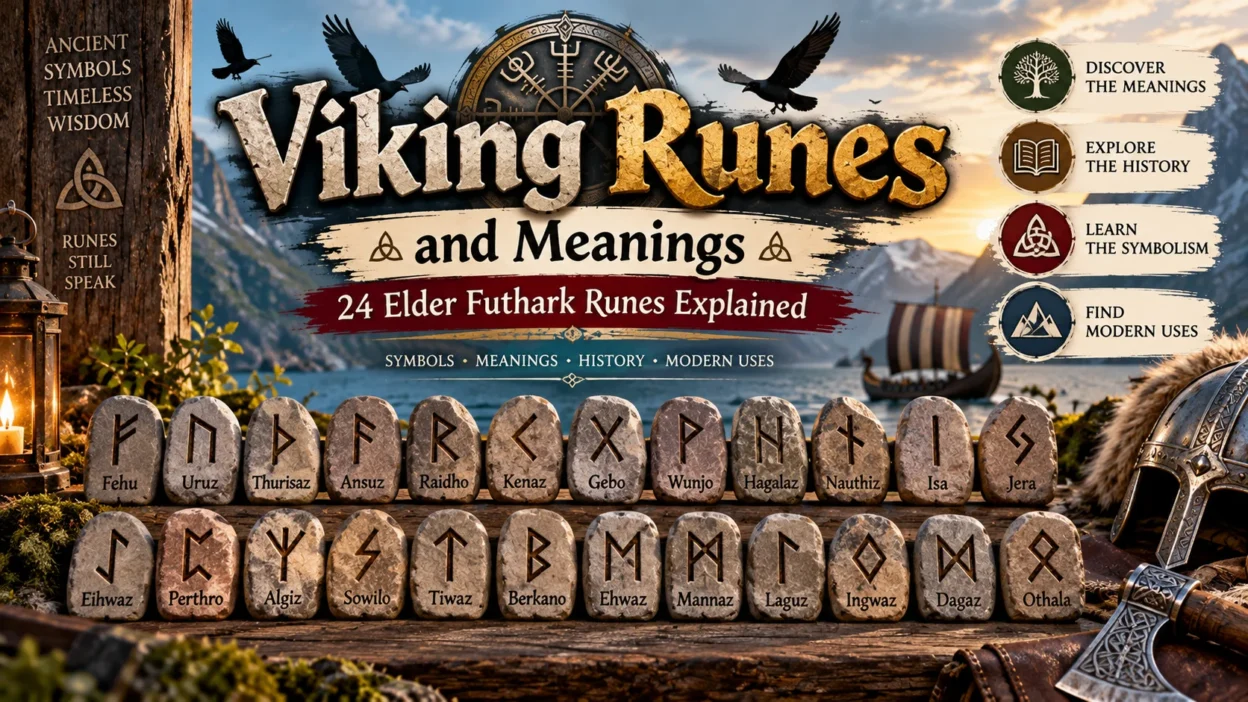
Viking runes and meanings offer a fascinating look into Scandinavian history, language, culture, and symbolism. People in Scandinavia carved runes into stones, wood, metal, bone, and other materials to record names, messages, memorials, and other information.
When people search for Viking runes, they often mean the runic alphabets that people used in Scandinavia before and during the Viking Age. The Elder Futhark contains 24 runes, while the Younger Futhark contains 16 main characters and became especially important during the Viking Age.
Modern rune guides also give individual runes symbolic meanings such as strength, protection, wealth, travel, wisdom, and transformation. However, these modern meanings do not always match the original historical evidence. This guide separates the historical background from modern symbolic interpretations.
Historical note: Scholars reconstruct many rune names and meanings from inscriptions, linguistic evidence, rune poems, and related sources. Some popular modern meanings come from later traditions rather than direct Viking-Age evidence.
⚔️ What Are Viking Runes?
Viking runes formed part of the writing traditions that Scandinavian people used during the Viking Age. The angular shapes made runes practical for carving into hard or narrow surfaces.
The word Futhark comes from the first six rune sounds:
F – U – Þ – A – R – K
People used several runic systems across different periods and regions. The main systems include:
- Elder Futhark — 24 runes
- Younger Futhark — 16 runes
- Anglo-Saxon Futhorc — an expanded English runic system
- Medieval runes — later Scandinavian developments
The Elder Futhark came before the Viking Age, while Younger Futhark became the main Scandinavian runic system during much of the Viking Age.
ᚠ Elder Futhark Runes and Meanings
The Elder Futhark contains 24 characters. Scholars divide these runes into three groups of eight, commonly called ættir.
Each rune represented a sound, and many rune names referred to objects, natural phenomena, animals, concepts, or figures from Germanic culture.
Modern rune enthusiasts often give each character a broader symbolic meaning.
| Rune | Name | Sound | Name Meaning |
|---|---|---|---|
| ᚠ | Fehu | F | Wealth / cattle |
| ᚢ | Uruz | U | Aurochs |
| ᚦ | Thurisaz | Th | Giant / thorn |
| ᚨ | Ansuz | A | God / deity |
| ᚱ | Raidho | R | Riding / journey |
| ᚲ | Kenaz | K | Torch / related term |
| ᚷ | Gebo | G | Gift |
| ᚹ | Wunjo | W | Joy |
| ᚺ | Hagalaz | H | Hail |
| ᚾ | Nauthiz | N | Need |
| ᛁ | Isa | I | Ice |
| ᛃ | Jera | J/Y | Year / harvest |
| ᛇ | Eihwaz | EI | Yew |
| ᛈ | Perthro | P | Uncertain |
| ᛉ | Algiz | Z/R | Uncertain |
| ᛊ | Sowilo | S | Sun |
| ᛏ | Tiwaz | T | Týr |
| ᛒ | Berkano | B | Birch |
| ᛖ | Ehwaz | E | Horse |
| ᛗ | Mannaz | M | Human / person |
| ᛚ | Laguz | L | Water / lake |
| ᛜ | Ingwaz | NG | Ing |
| ᛞ | Dagaz | D | Day |
| ᛟ | Othala | O | Inherited property |
💰 ᚠ Fehu Meaning: Wealth and Cattle
Fehu (ᚠ) begins the Elder Futhark. Scholars connect its reconstructed name with cattle and movable wealth.
Ancient Germanic societies valued cattle as an important form of wealth. For that reason, Fehu provides a useful example of how rune names can reflect the economic world of the people who used them.
Modern rune traditions often connect Fehu with:
- Wealth
- Prosperity
- Abundance
- Resources
- Success
- Possessions
- Material goals
Modern interpretations often expand the historical idea of movable wealth into a broader symbol of prosperity.
🦬 ᚢ Uruz Meaning: Strength and the Aurochs
Uruz (ᚢ) refers to the aurochs, a large wild bovine that once lived across parts of Europe and Asia.
The aurochs represented a powerful animal, so modern traditions often connect Uruz with physical strength and endurance.
Common modern associations include:
- Strength
- Courage
- Endurance
- Vitality
- Resilience
- Determination
- Personal power
Uruz can therefore work well as a modern symbol for overcoming challenges and developing inner strength.
🌩️ ᚦ Thurisaz Meaning: Giants and Force
Thurisaz (ᚦ) connects with the Old Norse concept of a þurs, commonly translated as a giant or supernatural being. Later Germanic traditions also connected the character with the thorn sound.
Modern interpretations often give Thurisaz themes such as:
- Power
- Defense
- Conflict
- Protection
- Force
- Boundaries
- Challenge
The rune’s traditional name gives it a strong connection with supernatural beings and powerful forces.
🧠 ᚨ Ansuz Meaning: Gods and Communication
Ansuz (ᚨ) connects with an ancient Germanic word for god or deity. Linguistic evidence also connects related terms with the Æsir, the major group of Norse gods.
Modern rune traditions often associate Ansuz with:
- Communication
- Speech
- Wisdom
- Knowledge
- Inspiration
- Learning
- Divine themes
Ansuz can represent communication in a broad symbolic sense, although its historical name primarily points toward divine or god-related terminology.
🛤️ ᚱ Raidho Meaning: Journey and Riding
Raidho (ᚱ) connects with words associated with riding or traveling.
Modern interpretations naturally extend this idea into themes of movement and personal journeys.
People commonly associate Raidho with:
- Travel
- Journeys
- Movement
- Progress
- Direction
- Adventure
- Personal paths
Someone creating Viking-inspired artwork about travel may choose Raidho because of its connection with journeys.
🔥 ᚲ Kenaz Meaning: Torch and Light
Kenaz (ᚲ) has a debated historical interpretation, although scholars often connect the name with a torch or a related concept.
Modern traditions commonly interpret the rune through the imagery of light and illumination.
These interpretations include:
- Knowledge
- Creativity
- Learning
- Inspiration
- Discovery
- Skill
- Illumination
The torch image provides a natural metaphor for discovering knowledge or bringing light into darkness.
🎁 ᚷ Gebo Meaning: Gift and Generosity
Gebo (ᚷ) has one of the clearest rune names. The word means gift.
Gift exchange played an important role in Germanic social relationships. People could use generosity to strengthen bonds and establish reciprocal relationships.
Modern symbolic interpretations include:
- Generosity
- Friendship
- Partnership
- Giving
- Reciprocity
- Balance
- Relationships
Gebo therefore works well as a symbolic choice for friendship, partnership, and meaningful exchanges.
😊 ᚹ Wunjo Meaning: Joy and Happiness
Wunjo (ᚹ) connects with joy and happiness.
Modern rune traditions often give Wunjo positive associations such as:
- Happiness
- Joy
- Harmony
- Friendship
- Celebration
- Success
- Contentment
The rune often appears in modern designs that emphasize happiness, community, and positive experiences.
🌨️ ᚺ Hagalaz Meaning: Hail and Disruption
Hagalaz (ᚺ) means hail. A hailstorm could damage crops and disrupt daily life, so the natural phenomenon provides a useful historical context for modern interpretations of change and disruption.
Modern symbolic meanings include:
- Change
- Disruption
- Challenge
- Transformation
- Unexpected events
- Natural forces
- Adaptation
Hagalaz does not simply mean “bad luck.” Instead, modern interpretations often use it to represent sudden change or circumstances outside a person’s control.
⛓️ ᚾ Nauthiz Meaning: Need and Necessity
Nauthiz (ᚾ) connects with need or necessity.
The concept suggests circumstances that create limitations or require people to respond with patience and determination.
Modern interpretations include:
- Need
- Discipline
- Hardship
- Patience
- Restriction
- Survival
- Determination
Nauthiz can symbolize the ability to continue working through difficult circumstances.
🧊 ᛁ Isa Meaning: Ice and Stillness
Isa (ᛁ) means ice.
Ice provides a natural image of stillness, coldness, rigidity, and temporary suspension. Modern rune traditions build on these qualities when interpreting Isa.
Common associations include:
- Stillness
- Patience
- Focus
- Waiting
- Reflection
- Stability
- Pause
Isa can symbolically represent a time when circumstances slow down and require patience.
🌾 ᛃ Jera Meaning: Year and Harvest
Jera (ᛃ) connects with year and the cycle of time. The rune also carries strong associations with the agricultural cycle and harvest.
Modern interpretations often connect Jera with:
- Harvest
- Growth
- Results
- Cycles
- Reward
- Patience
- Completion
Jera represents the idea that results can follow a natural cycle rather than appearing immediately.
🌲 ᛇ Eihwaz Meaning: Yew and Endurance
Eihwaz (ᛇ) connects with the yew tree.
Yew trees can live for a very long time, and their wood has historically had practical importance. Modern rune traditions therefore often connect Eihwaz with endurance and resilience.
Common interpretations include:
- Endurance
- Resilience
- Protection
- Persistence
- Transformation
- Continuity
- Strength
The historical name gives this rune a strong connection with nature.
❓ ᛈ Perthro Meaning: Mystery and the Unknown
Perthro (ᛈ) has one of the least certain rune names in the Elder Futhark. Scholars continue to debate its original meaning.
Modern rune traditions often associate Perthro with ideas such as:
- Mystery
- Fate
- Chance
- Hidden knowledge
- Possibility
- The unknown
- Discovery
These symbolic meanings do not represent a universally documented Viking-Age definition.
🛡️ ᛉ Algiz Meaning: Protection and Uncertainty
Algiz (ᛉ) serves as the conventional modern name for this rune, but scholars cannot confidently establish its original Elder Futhark name.
Modern traditions often associate Algiz with:
- Protection
- Defense
- Guardianship
- Alertness
- Instinct
- Awareness
- Safety
Because the original name remains uncertain, readers should distinguish the modern protective interpretation from established historical evidence.
☀️ ᛊ Sowilo Meaning: Sun and Light
Sowilo (ᛊ) connects with the sun.
The sun naturally symbolizes light, energy, warmth, and visibility. Modern rune traditions use these ideas to interpret Sowilo.
Common symbolic associations include:
- Light
- Success
- Victory
- Energy
- Confidence
- Wholeness
- Direction
Sowilo remains one of the most recognizable Elder Futhark symbols in modern Viking-inspired artwork.
⚔️ ᛏ Tiwaz Meaning: Týr, Courage, and Duty
Tiwaz (ᛏ) connects with Týr, a Norse god whose name appears in the linguistic history of the rune.
Modern traditions often associate Tiwaz with:
- Courage
- Honor
- Duty
- Justice
- Leadership
- Determination
- Sacrifice
The rune frequently appears in modern Viking-inspired designs that emphasize courage and responsibility.
🌳 ᛒ Berkano Meaning: Birch and Renewal
Berkano (ᛒ) connects with the birch tree.
The birch provides a natural symbol of growth and renewal, which explains many of the modern associations surrounding this rune.
Modern interpretations include:
- Growth
- Renewal
- Birth
- Fertility
- Protection
- Nurturing
- New beginnings
Berkano works especially well in nature-inspired Viking artwork.
🐎 ᛖ Ehwaz Meaning: Horse and Movement
Ehwaz (ᛖ) means horse.
Horses played important roles in transportation, agriculture, warfare, and culture across ancient Scandinavia and other Germanic societies.
Modern interpretations often connect Ehwaz with:
- Movement
- Progress
- Trust
- Partnership
- Cooperation
- Travel
- Change
The horse gives Ehwaz a strong connection with movement and cooperation.
👤 ᛗ Mannaz Meaning: Humanity and Community
Mannaz (ᛗ) connects with human beings or people.
Modern interpretations extend this basic human connection into themes involving identity and community.
Common associations include:
- Humanity
- Identity
- Community
- Society
- Self-awareness
- Cooperation
- Personal development
Mannaz provides a useful symbol for human connection and social relationships.
🌊 ᛚ Laguz Meaning: Water and Flow
Laguz (ᛚ) connects with water or a lake.
Water constantly changes shape and moves around obstacles, which explains why modern traditions often use Laguz as a symbol of flow and adaptability.
Modern associations include:
- Water
- Flow
- Adaptability
- Emotion
- Intuition
- Movement
- Reflection
Laguz suits designs that focus on oceans, rivers, travel, and natural movement.
🌱 ᛜ Ingwaz Meaning: Ing and Fertility
Ingwaz (ᛜ) connects with Ing, a Germanic deity or ancestral figure mentioned in early Germanic tradition.
Modern interpretations commonly connect the rune with:
- Fertility
- Potential
- Growth
- Family
- Completion
- New beginnings
- Stored energy
The rune also has a distinctive geometric shape that works well in modern Norse-inspired artwork.
🌅 ᛞ Dagaz Meaning: Day and Transformation
Dagaz (ᛞ) means day.
The transition from darkness to daylight creates a natural metaphor for change, awakening, and a new perspective.
Modern interpretations include:
- Awakening
- Transformation
- Breakthrough
- Hope
- Illumination
- New perspective
- Change
Dagaz can therefore represent a transition from one stage of life to another.
🏡 ᛟ Othala Meaning: Heritage and Inheritance
Othala (ᛟ) connects with concepts involving inherited property, possessions, or ancestral inheritance.
Modern interpretations often expand this idea into:
- Heritage
- Ancestry
- Family
- Home
- Tradition
- Inheritance
- Belonging
The symbol also deserves careful contextual consideration because some modern extremist movements have appropriated it and other runic symbols. That modern use does not define the ancient rune or every contemporary use of it.
🛡️ Viking Runes Associated With Protection
Modern rune traditions frequently connect several runes with protection. Historical evidence, however, does not establish one universal Viking system that assigned every rune a fixed magical purpose.
Modern symbolic traditions commonly connect:
- Algiz — protection and guardianship
- Thurisaz — defense and force
- Eihwaz — resilience and protection
- Tiwaz — courage and determination
- Sowilo — strength and confidence
Use these descriptions as symbolic interpretations rather than proven supernatural properties.
💪 Viking Runes Associated With Strength
Several runes can represent strength in modern Viking-inspired symbolism. Their associations often draw from animals, gods, natural forces, or concepts represented by their names.
Common choices include:
- Uruz — strength and endurance
- Tiwaz — courage and duty
- Thurisaz — force and defense
- Eihwaz — resilience
- Sowilo — confidence and success
Uruz provides the clearest example because its name connects with the powerful aurochs.
🧭 Viking Runes Associated With Travel
People who want a Viking-inspired symbol for travel often look toward runes whose names connect with movement.
These include:
- Raidho — riding and journeys
- Ehwaz — horse and movement
- Laguz — water and flow
- Jera — cycles and progress
- Dagaz — transition
Raidho stands out because its reconstructed name directly connects with riding or a journey.
🧠 Viking Runes Associated With Wisdom
Modern rune traditions connect several characters with knowledge, communication, reflection, or illumination.
Popular symbolic choices include:
- Ansuz — speech and divine wisdom
- Kenaz — illumination and knowledge
- Mannaz — self-awareness and humanity
- Sowilo — light and understanding
- Isa — reflection and focus
These associations can help people choose a rune for artwork, educational projects, or personal symbolism.
🪓 Elder Futhark vs. Younger Futhark
People often use the terms Elder Futhark and Younger Futhark interchangeably, but the two systems represent different stages in runic history.
| Feature | Elder Futhark | Younger Futhark |
|---|---|---|
| Main characters | 24 | 16 |
| Approximate period | 2nd–8th centuries | 8th–12th centuries |
| Viking Age connection | Predates most of the Viking Age | Strongly connected to Viking Age Scandinavia |
| Main region | Wider Germanic world | Scandinavia |
| Character count | Larger | Smaller |
The reduction from 24 characters to 16 created an interesting writing system because Scandinavian languages contained more sounds than the smaller alphabet directly represented.
🪵 What Did Vikings Use Runes For?
Scandinavian people used runes for many practical and commemorative purposes.
Historical inscriptions show uses such as:
- Memorial messages
- Personal names
- Ownership marks
- Short communications
- Memorial stones
- Objects and tools
- Religious contexts
- Commemorative inscriptions
- Everyday writing
Runes did not serve only one purpose. People used them according to the needs of their community and the materials available to them.
🗿 Viking Runestones and Their Importance
Runestones provide some of the clearest physical evidence for Scandinavian runic writing. Sweden contains thousands of known runic inscriptions and many famous runestones.
Many inscriptions mention:
- Names
- Family relationships
- Memorials
- Journeys
- Land
- Religious beliefs
- Social status
- Important events
These stones help historians understand how Scandinavian communities used writing in real life.
🔤 How Do Viking Runes Work?
Each rune represented a sound or sound value within its particular writing system. The exact value could change between different periods and languages.
For example:
- ᚠ — f
- ᚢ — u
- ᚦ — th
- ᚨ — a
- ᚱ — r
- ᚲ — k
- ᚷ — g
- ᚹ — w
The rune alphabet therefore worked as a writing system rather than a simple collection of mysterious symbols.
🔮 Did Vikings Use Runes for Magic?
Historical sources show that people connected runes with magical or supernatural practices in some contexts. However, modern websites sometimes present a detailed magical meaning for every rune as if Vikings universally followed one standardized system.
Historical evidence does not support that simplified picture.
People used runes primarily as writing characters, while some inscriptions and literary sources indicate additional magical or ritual uses. Scholars continue to debate the details of those practices.
🧩 Are Viking Runes a Secret Code?
Runes can look like a secret code because their angular shapes differ from modern Latin letters. However, people designed them as writing systems rather than secret codes.
Their straight lines worked especially well when people carved messages into:
- Wood
- Stone
- Bone
- Metal
- Tools
- Weapons
- Jewelry
Their unusual appearance today largely reflects the difference between ancient runic writing and modern alphabets.
🧿 Viking Runes in Modern Culture
Modern artists, jewelry makers, tattoo designers, writers, and game creators frequently use Viking runes as visual symbols.
You may see runes in:
- Jewelry
- Tattoos
- Video games
- Fantasy novels
- Movies
- Historical artwork
- Norse-inspired décor
- Graphic design
- Educational materials
- Character names
- Fictional worlds
Modern creators should research individual symbols before using them, especially when a symbol has acquired additional meanings in modern political contexts.
⚠️ Viking Runes and Modern Context
Ancient runic symbols have sometimes attracted modern political and extremist groups. However, that modern appropriation does not make every use of a rune political or extremist.
People continue to use runes for legitimate historical research, education, art, literature, archaeology, and cultural study. Context matters when someone interprets a modern use of a runic symbol.
Anyone researching Viking symbols should therefore distinguish ancient historical meanings, later interpretations, and modern appropriations.
📚 How to Study Viking Runes Historically
If you want to learn about runes beyond modern symbolism, start with historical and linguistic sources.
Useful subjects include:
- Runology
- Old Norse
- Elder Futhark inscriptions
- Younger Futhark inscriptions
- Scandinavian archaeology
- Rune poems
- Germanic linguistics
- Norse history
- Runestone studies
- Medieval Scandinavian writing
This approach helps you separate well-supported historical information from modern spiritual interpretations.
❓ Frequently Asked Questions About Viking Runes and Meanings
What are Viking runes?
Viking runes are characters from Scandinavian runic writing systems, especially Younger Futhark, which people widely used during the Viking Age. People also use the term more broadly for Norse and Germanic runes.
How many Viking runes are there?
The number depends on the runic system. Elder Futhark contains 24 runes, while Younger Futhark contains 16 main characters.
What does Futhark mean?
Futhark comes from the first six characters of the rune sequence: F, U, Þ, A, R, K.
What is the difference between Elder Futhark and Younger Futhark?
Elder Futhark contains 24 characters and predates the Viking Age. Younger Futhark contains 16 main characters and became the main Scandinavian runic system during the Viking Age.
Which Viking rune means wealth?
Fehu connects with cattle and movable wealth. Modern rune traditions also associate it with prosperity and abundance.
Which rune represents strength?
Modern traditions commonly connect Uruz with strength because its name refers to the powerful aurochs.
Which Viking rune means protection?
Modern rune traditions often connect Algiz with protection. Thurisaz and Eihwaz also receive protective interpretations.
Which rune represents travel?
Raidho commonly represents travel or a journey in modern interpretations because its name connects with riding or journeys.
Which rune means love?
No Elder Futhark rune has a securely documented historical meaning that simply translates as “love.” Modern interpretations often connect Gebo with relationships because its name means gift and gift exchange carried social significance.
Which rune represents the sun?
Sowilo connects with the sun and often represents light, energy, and success in modern interpretations.
Which rune represents courage?
Modern traditions commonly connect Tiwaz with courage, duty, honor, and determination.
Is Elder Futhark a Viking alphabet?
Elder Futhark predates the Viking Age, so calling it specifically a “Viking alphabet” can create historical confusion. Younger Futhark has a much stronger direct connection with Viking-Age Scandinavia.
Did Vikings tattoo runes?
Researchers do not have strong evidence that widespread rune tattooing formed a standard Viking practice. Modern Viking-style rune tattoos represent a contemporary use of the symbols.
Can I translate my name into Viking runes?
You can transliterate a modern name into a historical runic system, but you should first choose the appropriate runic alphabet and account for differences between modern English sounds and historical Scandinavian languages.
Did every Viking rune have a magical meaning?
No. People primarily used runes as writing characters. Some historical sources connect runes with magic or ritual practices, but modern lists often assign simplified spiritual meanings that do not directly represent a universal Viking-Age system.
⚔️ Final Thoughts on Viking Runes and Meanings
Viking runes and meanings offer a fascinating connection to Scandinavian writing, language, archaeology, and cultural history. The Elder Futhark gives us 24 characters, while Younger Futhark provides the 16-rune system that connects more directly with the Viking Age.
The historical record shows that people used runes for names, messages, memorials, objects, stones, and other forms of writing. Modern traditions have added broader symbolic meanings involving strength, protection, travel, wisdom, love, wealth, and transformation.
When studying these symbols, keep the distinction between historical evidence and modern interpretation in mind. That distinction makes your understanding of Viking runes more accurate and gives each symbol a richer historical context.
Lillian Hayes is a content writer focused on explaining meanings and language in a simple and clear way. She creates easy-to-understand content that helps readers learn and communicate better.