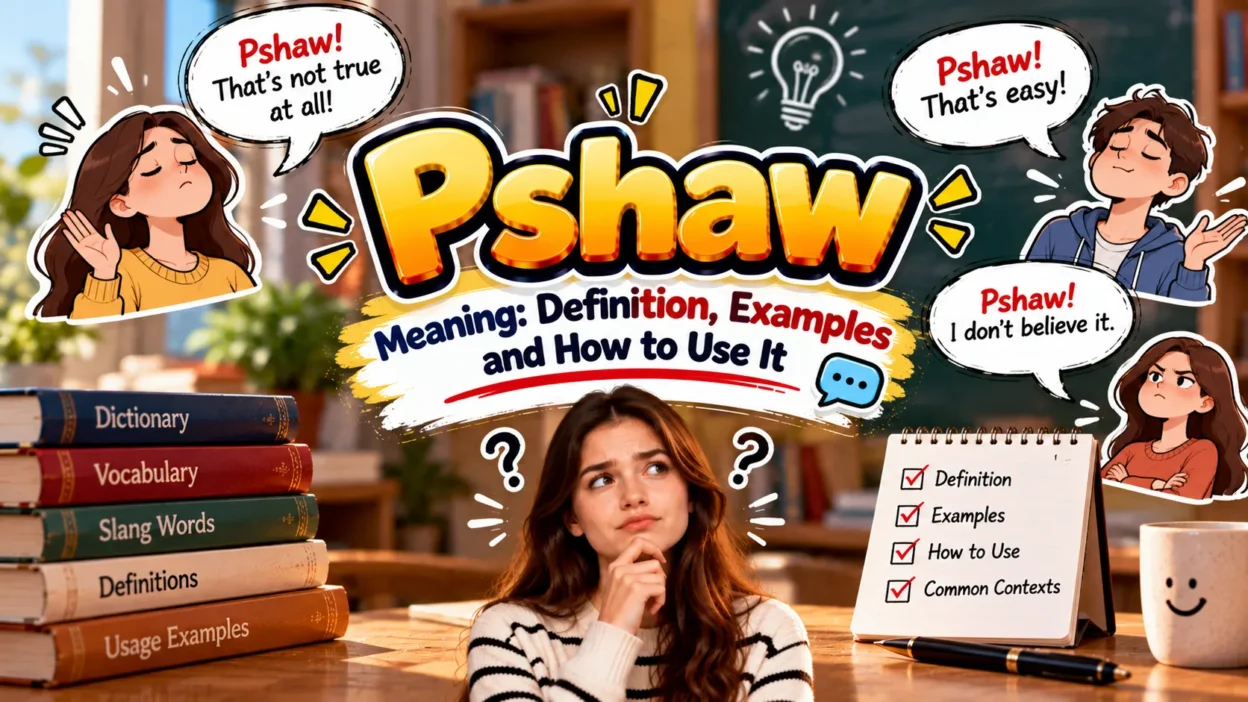
Have you ever seen the word pshaw in a book, online conversation, or social media post and wondered what it means? Pshaw is an English interjection used to express disbelief, impatience, dismissal, or mild contempt. It is similar to saying “Oh, nonsense!” or “As if!”
Although pshaw is not common in everyday texting today, you may encounter it in older books, humorous conversations, and writing that uses a dramatic or old-fashioned tone. Understanding the meaning of pshaw can help you recognize its tone and use it correctly in a sentence.
In this guide, you’ll discover what pshaw means, where it comes from, how people use it, and how it compares with similar expressions.
💬 What Does Pshaw Mean?
Pshaw is an interjection that expresses disbelief, scorn, impatience, or the feeling that something is ridiculous or unimportant.
People use it to dismiss an idea, reject a claim, or show that they do not take something seriously. Depending on the context, it can sound playful, sarcastic, dramatic, or slightly insulting.
Here are the most common meanings of pshaw:
- Disbelief: Showing that you do not believe something.
- Dismissal: Treating an idea or statement as unimportant.
- Impatience: Expressing annoyance with what someone has said.
- Contempt: Suggesting that something is foolish or ridiculous.
- Playful disagreement: Rejecting a claim in a humorous or exaggerated way.
For example, if someone says, “You will never finish that project,” you might respond, “Pshaw! I’ll have it done by tomorrow.”
In this example, pshaw dismisses the person’s doubt and expresses confidence.
📖 What Part of Speech Is Pshaw?
Pshaw is an interjection. An interjection is a word or short expression used to communicate a feeling or reaction.
Other common interjections include “wow,” “oops,” “oh,” “ugh,” and “alas.” Like these words, pshaw can stand alone or appear at the beginning of a sentence.
Examples:
- “Pshaw! That is nothing to worry about.”
- “Oh, pshaw, you are making too much of it.”
- “Pshaw! I never believed that story.”
- “Pshaw, there must be a better solution.”
When used at the beginning of a sentence, pshaw is often followed by a comma or an exclamation mark, depending on how strongly the writer wants to express the emotion.
🗣️ How Is Pshaw Used in a Sentence?
Pshaw is usually used to dismiss a statement, express disbelief, or respond to something considered silly. The exact meaning depends on the situation and the speaker’s tone.
Here are some examples:
- “Pshaw! I can easily finish this assignment.”
- “Pshaw, that rumor is completely ridiculous.”
- “Oh, pshaw! You know I was only joking.”
- “Pshaw! We do not need to worry about such a small problem.”
- “Pshaw, I have heard that excuse a hundred times.”
- “Pshaw! There is no reason to give up now.”
- “She waved her hand and said, ‘Pshaw! That is nonsense.’”
- “Pshaw, you are far too modest about your achievements.”
In each example, the word communicates a dismissive or skeptical reaction. It can make dialogue sound humorous, confident, or old-fashioned.
📱 What Does Pshaw Mean in Texting and Online Chats?
In texting and online conversations, pshaw generally carries the same meaning as it does in traditional writing. It expresses disbelief, dismissal, or mild annoyance.
However, it is not a widely used modern texting abbreviation like LOL or BRB. It is a regular English interjection that may appear when someone wants to sound playful, sarcastic, theatrical, or deliberately old-fashioned.
Here are a few examples of how it might appear in a message:
- Friend: “You are going to lose the game.”You: “Pshaw! I’ve got this.”
- Friend: “That task looks impossible.”You: “Pshaw, nothing is impossible if we work together.”
- Friend: “You probably forgot about our plans.”You: “Pshaw! I would never forget.”
- Friend: “That movie was the best ever.”You: “Pshaw, I’ve seen much better ones.”
In modern online conversations, the word may sound intentionally dramatic or humorous. Some people use it because its old-fashioned tone makes their response more entertaining.
😂 Is Pshaw a Sarcastic Word?
Pshaw can be sarcastic, but it is not always sarcastic. Its primary purpose is to dismiss something or express disbelief, and sarcasm is one possible way to communicate that reaction.
For example:
- Sarcastic: “Pshaw! Because your plan has worked so wonderfully before.”
- Playful: “Pshaw, you know I would never miss your birthday.”
- Dismissive: “Pshaw! That is not a serious problem.”
- Confident: “Pshaw, I can handle the challenge myself.”
The word’s tone depends on the surrounding words, the situation, and the speaker’s intention.
If someone says pshaw with a playful expression, it may sound friendly. If they use it to reject another person’s concerns, it may sound rude or condescending.
📚 Where Did the Word Pshaw Come From?
Pshaw is an old English interjection that imitates an expression of contempt, disbelief, or impatience. It has appeared in English writing for centuries, particularly in dialogue and literary descriptions of a character’s reaction.
The word is sometimes used to represent a dismissive sound, much like an expressive “bah!” or “tch!” in dialogue.
Writers may choose pshaw when they want a character to sound dramatic, old-fashioned, confident, or unimpressed. It is particularly recognizable in older literature and stylized conversations.
Although the word is still understood, it is relatively uncommon in everyday modern speech. Many people today would express the same idea by saying “nonsense,” “whatever,” “as if,” or “don’t be ridiculous.”
🔄 Pshaw vs. Similar Words and Expressions
Several English expressions can communicate the same general feeling as pshaw. However, each has its own tone and level of formality.
| Word or Phrase | Meaning | Example |
|---|---|---|
| Pshaw | Dismissal or disbelief | “Pshaw! That is nonsense.” |
| Bah | Disapproval or contempt | “Bah! What a ridiculous idea.” |
| Nonsense | Something considered foolish or untrue | “That explanation is nonsense.” |
| Whatever | Dismissal or lack of interest | “Whatever, I don’t care.” |
| As if | Disbelief or sarcastic rejection | “As if I would believe that.” |
| Hmph | Displeasure or skepticism | “Hmph! I expected better.” |
| Rubbish | Something considered false or worthless | “That story is rubbish.” |
| Oh, please | Impatience or disbelief | “Oh, please, that excuse is unbelievable.” |
Pshaw is generally more old-fashioned than “whatever” or “oh, please.” If you want to sound natural in a modern conversation, one of these alternatives may be more appropriate.
🎭 Is Pshaw a Positive or Negative Word?
Pshaw is generally dismissive rather than positive or negative on its own. It signals a reaction, and the meaning depends on what the speaker is responding to.
It can be lighthearted when someone rejects a harmless suggestion. And It can also sound negative when used to mock someone’s concerns or opinions.
For example:
- Lighthearted: “Pshaw! You make me sound like a hero.”
- Confident: “Pshaw, that challenge is easy.”
- Dismissive: “Pshaw! Your argument makes no sense.”
- Sarcastic: “Pshaw, because everything always goes according to your plan.”
If you are unsure how the word will sound, consider your audience. In professional communication, a direct and respectful sentence is usually clearer than an old-fashioned dismissive expression.
✍️ Common Mistakes When Using Pshaw
Although pshaw is a short word, it is easy to misunderstand its purpose.
Mistake 1: Treating pshaw as an acronym.
Pshaw is not normally an abbreviation with a separate meaning for each letter. It is an interjection.
Mistake 2: Assuming it always means anger.
Pshaw can express annoyance, but it can also show playful disbelief, confidence, or mild contempt.
Mistake 3: Using it in every casual conversation.
The word is relatively uncommon in modern speech. Using it too frequently may make your writing sound theatrical or old-fashioned.
Mistake 4: Assuming it is a swear word.
Pshaw is not generally considered profanity. It is a mild expression of dismissal or disbelief.
Mistake 5: Ignoring the context.
The same word can sound playful or rude depending on how it is used. Consider the surrounding conversation before interpreting its tone.
❓ Frequently Asked Questions About Pshaw Meaning
What does pshaw mean in simple words?
Pshaw means “nonsense,” “I don’t believe that,” or “that’s ridiculous.” It is an interjection used to express disbelief, impatience, or dismissal.
Is pshaw a real English word?
Yes. Pshaw is an established English interjection that appears in dictionaries and literature, although it is uncommon in everyday modern conversation.
Is pshaw slang?
Pshaw is better described as an interjection than modern slang. It is an expressive word that has an old-fashioned or humorous tone.
How do you pronounce pshaw?
Pshaw is commonly pronounced like “sh-aw,” with the psh sounding similar to the beginning of “shush.” Pronunciation can vary slightly by speaker.
Is pshaw rude?
It is not inherently rude or offensive. However, it can sound dismissive or condescending if you use it to reject someone’s opinion or concerns.
What is another word for pshaw?
Depending on the context, alternatives include “nonsense,” “bah,” “whatever,” “as if,” “rubbish,” and “oh, please.”
Can I use pshaw in a text message?
Yes. You can use pshaw in a text message to express playful disbelief or dismiss an idea. Because it sounds old-fashioned, it may be especially useful for humorous or exaggerated responses.
Does pshaw mean I don’t care?
Not exactly. Pshaw can suggest that you do not take something seriously, but it primarily expresses dismissal, disbelief, or contempt rather than simple indifference.
🏁 Conclusion
The word pshaw means an expression of disbelief, dismissal, impatience, or mild contempt. It is an interjection that people use to reject an idea, show skepticism, or suggest that something is ridiculous.
Although pshaw is less common in modern everyday conversation, it remains useful in literature, humorous dialogue, and playful online messages. Its tone can range from lighthearted to sarcastic, depending on the context.
In simple terms, when someone says “Pshaw!” they are usually expressing something like “Oh, nonsense!” or “I don’t believe that!” Understanding the situation will help you interpret the intended meaning correctly

Lillian Hayes is a content writer focused on explaining meanings and language in a simple and clear way. She creates easy-to-understand content that helps readers learn and communicate better.