
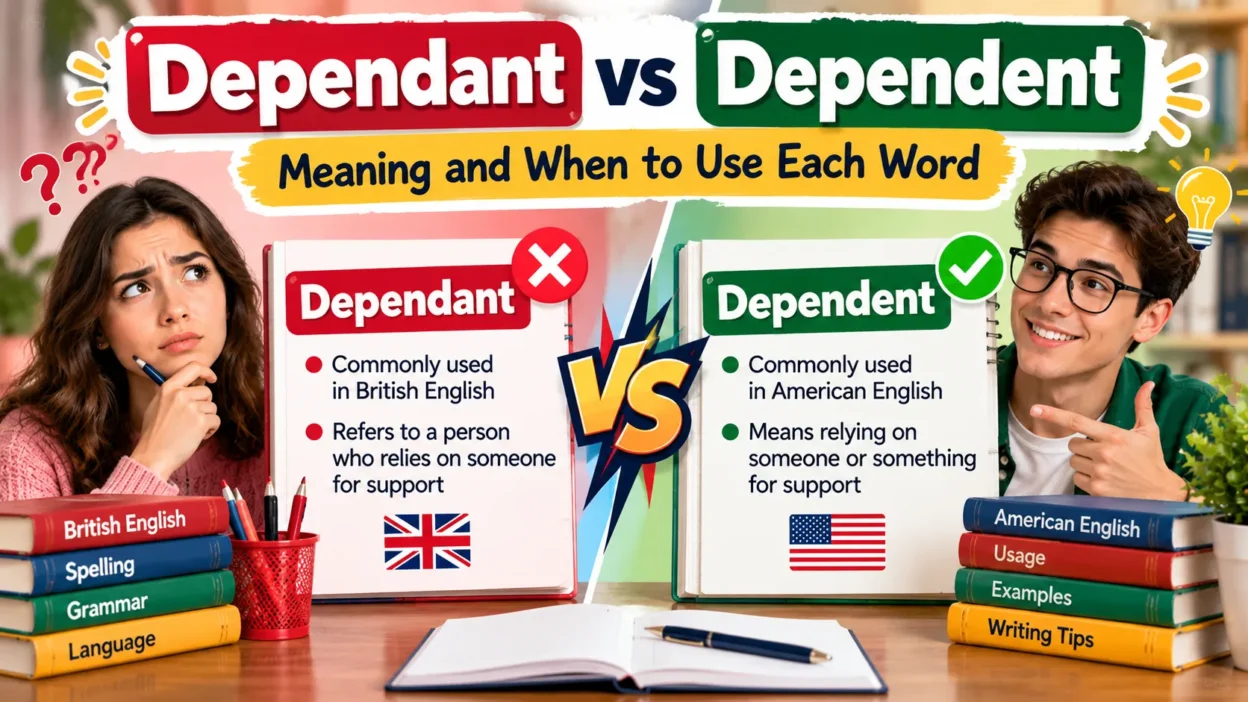
The words dependant and dependent look almost identical and share a closely related meaning, making them easy to confuse. Both refer to someone or something that relies on another person, thing, or condition. However, their usage differs depending on the variety of English and the grammatical role they play in a sentence.
The main difference between dependant vs. dependent is that dependent is the standard adjective in both American and British English, while dependant is commonly used as a noun in British English. In American English, dependent is generally used for both the adjective and the noun. For example, an American writer might say, “The child is dependent on her parents” and “She has two dependents.” Understanding this distinction helps you choose the appropriate spelling for your audience.
What Does Dependent Mean? 📘
Dependent is an adjective that describes someone or something that relies on another person, resource, or condition for support, assistance, or continued existence. It can refer to financial support, emotional reliance, scientific relationships, or situations in which one outcome depends on another.
The word is widely used in everyday communication, academic writing, business documents, and technical discussions. It often appears in phrases such as dependent on, financially dependent, and dependent variable.
Examples of dependent in sentences:
- The young child is dependent on her parents for food and shelter.
- The company is dependent on customer satisfaction for long-term success.
- The final result is dependent on the accuracy of the data.
- Some plants are dependent on specific environmental conditions.
- His income is dependent on the number of projects he completes.
In each example, dependent describes a person, organization, or outcome that relies on something else.
Quick tip: When you describe reliance or a condition that relies on another factor, dependent is the appropriate adjective.
What Does Dependant Mean? 🧾
Dependant is a noun commonly used in British English to describe a person who relies on someone else for financial support or care. It is particularly common in discussions about family responsibilities, employment benefits, taxation, and official paperwork.
In American English, the spelling dependent is generally used for this noun as well. Therefore, the preferred form depends partly on the regional spelling conventions you are following.
Examples of dependant in sentences:
- He listed his wife and children as dependants on the form.
- The employee receives additional benefits for each eligible dependant.
- She provides financial support for her elderly dependant.
- The application asks whether the applicant has any dependants.
- The policy explains the eligibility requirements for a dependant.
These examples use dependant as a noun referring to someone who relies on another person for support.
Quick tip: In British English, dependant often identifies the person receiving support, while dependent describes the condition of relying on someone or something.
Dependant vs. Dependent: Key Differences 📊
Although the words share a meaning, their grammatical roles and regional usage distinguish them. The following table summarizes the main differences.
| Feature | Dependant | Dependent |
|---|---|---|
| Part of speech | Usually a noun in British English | Usually an adjective; also a noun |
| Main meaning | A person who relies on someone else | Relying on someone or something |
| American English usage | Less common | Standard for both noun and adjective |
| British English usage | Common noun spelling | Standard adjective spelling |
| Example | She supports two dependants. | The children are dependent on her. |
Remember: In American English, use dependent for both meanings. In British English, dependant is commonly used for the person receiving support, while dependent describes reliance.
Dependent vs. Dependant Examples in Context ✍️
Seeing the words in complete sentences makes it easier to understand how their spelling changes with grammatical function and regional convention.
Example 1: Family Support
- Adjective: The child is dependent on her parents.
- British English noun: The parents support one dependant.
- American English noun: The parents support one dependent.
Example 2: Employment Benefits
- Adjective: The employee is dependent on the benefits provided by the company.
- British English noun: The employee added two dependants to the application.
- American English noun: The employee added two dependents to the application.
3: Financial Assistance
- Adjective: The elderly man is financially dependent on his family.
- British English noun: His family cares for an elderly dependant.
- American English noun: His family cares for an elderly dependent.
Example 4: Official Documents
- Adjective: Eligibility is dependent on the applicant’s circumstances.
- British English noun: The form requests details about each dependant.
- American English noun: The form requests details about each dependent.
These examples show that the difference is primarily grammatical and regional, not a difference in the underlying idea.
Dependent vs. Dependant in American and British English 🇺🇸🇬🇧
One of the most important considerations is your target audience. American and British English follow different conventions for the noun form.
American English
In American English, dependent is used as both an adjective and a noun.
Examples:
- She is dependent on her family.
- He has three dependents.
- The payment is dependent on approval.
This is the preferred approach for American websites, school assignments, and professional documents.
British English
In British English, dependent is the standard adjective, while dependant is commonly used as a noun.
Examples:
- She is dependent on her family.
- He has three dependants.
- The payment is dependent on approval.
Both varieties are correct within their respective conventions. The important thing is to maintain consistency throughout your writing.
What Does Dependent on Mean? 🔗
The phrase dependent on means that someone or something relies on another person, thing, or condition. It can express financial reliance, practical need, or a relationship between factors.
Examples:
- The project is dependent on receiving funding.
- The child is dependent on adults for care.
- The final schedule is dependent on weather conditions.
- The business is dependent on repeat customers.
- The outcome is dependent on several variables.
In American and British English, the adjective is spelled dependent in this phrase. The spelling does not change to dependant simply because the sentence mentions a person.
For example, “She is dependent on her parents” is correct, not “She is dependant on her parents” under standard modern usage.
Dependant vs. Dependent in Tax and Legal Contexts 💼
These words frequently appear on tax forms, insurance applications, employment documents, and benefit claims. In these settings, a dependent or dependant generally refers to a person who meets specific eligibility requirements for support or benefits.
The spelling varies by regional convention, but the legal definition depends on the relevant rules. For example, tax authorities may define eligible dependents based on relationship, residence, income, or the amount of support provided.
Do not assume that everyone who receives financial help automatically qualifies as a dependent for tax purposes. Eligibility depends on the applicable law, policy, or program.
When completing official documents, follow the terminology used by the relevant agency. If the form uses dependent, copy that spelling; if a British document uses dependant, follow its wording.
Common Mistakes to Avoid ⚠️
The most frequent errors occur when writers use the noun spelling in place of the adjective or switch between American and British conventions without a reason.
- Incorrect in standard modern usage: She is dependant on her parents.
Correct: She is dependent on her parents. - American English: He has two dependants.
Preferred: He has two dependents. - British English: She listed three dependents on the form.
Common British form: She listed three dependants on the form. - Correct in both varieties: The outcome is dependent on the results.
To avoid mistakes, first determine whether you need an adjective or a noun. Then apply the spelling convention used by your intended audience.
Dependent vs. Independent: What Is the Difference? ⚖️
The word independent is the opposite of dependent in many contexts. A dependent person or system relies on support, while an independent person or system can function without that particular support.
| Word | Meaning | Example |
|---|---|---|
| Dependent | Relying on someone or something | The child is dependent on her parents. |
| Independent | Not relying on someone or something | The adult is financially independent. |
These terms are useful when discussing personal responsibility, business operations, education, scientific research, and financial circumstances.
In statistics, the terms dependent variable and independent variable have more specific meanings. A dependent variable is the outcome being measured, while an independent variable is a factor that may help explain changes in that outcome.
Frequently Asked Questions About Dependant vs. Dependent ❓
1. What is the main difference between dependant and dependent?
Dependent is the standard adjective in both American and British English. Dependant is commonly used as a noun in British English, while American English generally uses dependent as both a noun and an adjective.
2. Is dependant spelled correctly?
Yes. Dependant is a correct noun spelling in British English. In American English, dependent is the standard spelling for the noun.
3. Is it dependent on or dependant on?
The standard expression is dependent on. For example, “The outcome is dependent on the evidence.” The adjective is spelled dependent in both American and British English.
4. Should I use dependent or dependant on a US tax form?
Use the spelling and terminology provided by the relevant US tax form. American English generally uses dependent as a noun, but tax eligibility depends on the applicable rules, not just the spelling.
5. Is dependent a noun or an adjective?
It can be both. As an adjective, it describes reliance on another person or thing. As a noun, especially in American English, it refers to someone who relies on another person for support.
6. What is the plural of dependant?
The plural of dependant is dependants. This noun form is commonly used in British English. In American English, the corresponding plural is dependents.
7. What is the opposite of dependent?
The most common opposite is independent. It describes someone or something that does not rely on another person or thing in the relevant context.
8. Which spelling should I use for a US audience?
For a US audience, use dependent for both the adjective and the noun. This is the standard American English convention.
Conclusion 🎯
The difference between dependant vs. dependent mainly involves grammatical function and regional spelling conventions. Dependent is the standard adjective in both American and British English, while dependant is commonly used as a noun in British English. American English generally uses dependent for both purposes.
If you are writing for a US audience, choose dependent in every case. For British English, use dependent as an adjective and dependant as a noun when following that convention. Keeping the distinction in mind will help you write more accurately and professionally.

Lillian Hayes is a content writer focused on explaining meanings and language in a simple and clear way. She creates easy-to-understand content that helps readers learn and communicate better.