
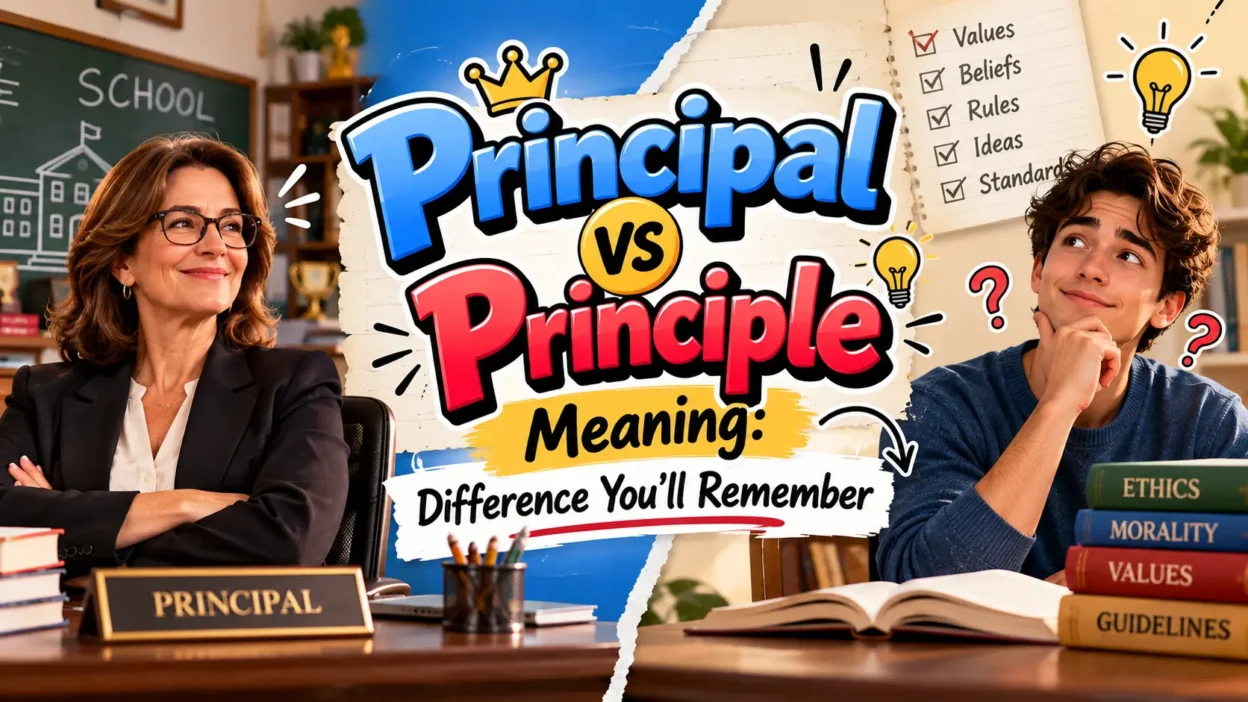
Principal vs principle is one of those English word pairs that can cause confusion because the two words sound almost exactly the same. Their spellings are different, however, and so are their meanings. Knowing the difference can help you avoid common grammar and vocabulary mistakes in emails, essays, school assignments, professional writing, and everyday conversations.
The easiest way to remember them is simple: principal usually refers to a person or something that is most important, while principle refers to a rule, belief, or fundamental idea. For example, a school principal is a person, while an ethical principle is a belief or standard that guides behavior.
This guide explains the principal vs principle meaning, pronunciation, definitions, examples, memory tricks, common mistakes, and practical ways to choose the correct word.
📚 Principal vs Principle at a Glance
The fastest way to understand these commonly confused words is to compare them side by side. Although they sound similar, their grammatical roles and meanings are different.
| Word | Meaning | Common Use | Example |
|---|---|---|---|
| Principal | A person in charge or something most important | Noun / adjective | The school principal spoke to the students. |
| Principle | A rule, belief, or basic idea | Noun | Honesty is an important principle. |
| Principal | Main, primary, or most important | Adjective | Safety is our principal concern. |
| Principle | A moral or guiding standard | Noun | She refused to compromise her principles. |
The quickest rule:
Principal = person or primary
Principle = belief, rule, or standard
That simple distinction will solve most everyday uses.
🏫 What Does Principal Mean?
The word principal has two especially common meanings. As a noun, it can refer to the person who manages a school. As an adjective, it means the main, primary, or most important.
For example, if you say, “The principal called a meeting,” you are talking about a person. If you say, “The principal reason was cost,” you are describing the main reason.
Principal as a noun
- The principal welcomed the new students.
- Our school principal announced the results.
- The principal met with the parents.
- The students thanked their principal.
- The principal addressed the teachers.
Principal as an adjective
- What is the principal reason for the delay?
- Safety is our principal concern.
- The principal objective is to improve quality.
- Her principal responsibility is managing the department.
- The company’s principal goal is customer satisfaction.
So, principal can describe either a person in authority or something that is primary.
⚖️ What Does Principle Mean?
A principle is a fundamental rule, belief, value, or standard that guides how someone thinks or behaves. Unlike principal, it does not normally refer to a person.
Principles can be personal, moral, scientific, professional, or general rules.
For example, honesty can be a personal principle. In science, a principle can refer to a fundamental idea that helps explain how something works.
Examples of principle:
- Honesty is an important principle.
- She refused to compromise her principles.
- The company operates according to ethical principles.
- The basic principle behind the system is simple.
- He believes strongly in the principle of fairness.
The key idea is that principle is a rule, belief, or fundamental idea—not a school administrator.
🧠 Principal vs Principle: The Main Difference
The biggest difference between these words becomes much easier when you focus on what each one represents.
Principal can refer to:
- A school leader
- A person in charge
- The main part
- The primary reason
- The most important factor
- The original amount of money in finance
Principle can refer to:
- A moral belief
- A personal value
- A rule
- A standard
- A fundamental idea
- A scientific concept
| If You Mean… | Use |
|---|---|
| School administrator | Principal |
| Main reason | Principal |
| Most important factor | Principal |
| Primary objective | Principal |
| Moral rule | Principle |
| Personal belief | Principle |
| Ethical standard | Principle |
| Fundamental idea | Principle |
✏️ Principal vs Principle Examples
Seeing the words in complete sentences is one of the easiest ways to understand their difference. Pay attention to what each word is describing.
Examples with principal
- The principal spoke during the school assembly.
- The principal asked everyone to remain calm.
- Education is the principal focus of the program.
- Her principal concern was student safety.
- The principal reason for leaving was the long commute.
- The bank calculated the interest on the principal amount.
- The principal objective is to improve customer service.
- He became the school’s new principal last year.
- The principal issue was a lack of communication.
- Quality remains our principal priority.
Examples with principle
- Honesty is one of her strongest principles.
- He refused to lie because it went against his principles.
- The company follows strict ethical principles.
- The machine works according to a simple scientific principle.
- She believes in the principle of equal treatment.
- They discussed the basic principles of leadership.
- He would not compromise his principles for money.
- The principle behind the idea is easy to understand.
- Fairness is an important principle in the organization.
- The teacher explained the basic principles of mathematics.
💰 Principal in Finance: An Important Meaning
There is another important use of principal, especially in banking, loans, mortgages, and investing. In finance, the principal is the original amount of money borrowed or invested, before interest or other charges are added.
For example, if you borrow $10,000, the principal is $10,000. If you later pay interest, that interest is separate from the principal amount.
| Financial Term | Meaning |
|---|---|
| Principal | Original amount borrowed or invested |
| Interest | Cost or earnings associated with the principal |
| Principal payment | Payment that reduces the amount originally borrowed |
| Principal balance | Remaining amount of the original loan |
Examples:
- I made a payment toward the loan principal.
- The interest is calculated based on the remaining principal.
- She invested $5,000 in principal.
- Paying extra toward the principal can reduce the balance faster.
Remember: this financial meaning uses principal, not principle.
🎯 Principal as “Main” or “Most Important”
One useful way to remember principal is that it can mean main or primary. This meaning appears frequently in formal writing.
For example:
- The principal reason
- The principal objective
- The principal concern
- The principal cause
- The principal goal
- The principal responsibility
- The principal factor
- The principal advantage
- The principal issue
- The principal purpose
If you can replace the word with main or primary, principal is often the correct choice.
Example:
The principal reason was cost.
You can replace principal with main:
The main reason was cost.
That is a useful test.
🧭 Principle as a Moral Rule or Belief
When you’re talking about values or beliefs that guide behavior, use principle.
People can have personal principles about honesty, fairness, responsibility, loyalty, kindness, or integrity.
Examples:
- She lives by strong moral principles.
- Honesty is one of my most important principles.
- He acted according to his principles.
- They refused the offer on principle.
- The decision was based on a basic ethical principle.
A helpful question is:
Is this word describing a belief, rule, or standard?
If yes, principle is likely the correct word.
🧩 Common Phrases With Principal
Certain phrases make the correct spelling easier to recognize.
Common expressions:
- School principal
- Assistant principal
- Principal reason
- Principal concern
- Principal objective
- Principal amount
- Principal balance
- Principal investigator
- Principal office
- Principal component
- Principal source
- Principal feature
Example sentences:
- The school principal announced a new policy.
- The principal objective is to improve safety.
- The principal amount was paid in full.
- She is the principal investigator on the project.
- Cost was the principal concern.
📖 Common Phrases With Principle
Principle is often used when discussing beliefs, standards, rules, or fundamental concepts.
Common expressions:
- Moral principle
- Ethical principle
- Basic principle
- Fundamental principle
- Scientific principle
- Guiding principle
- General principle
- First principle
- Principle of fairness
- Principle of equality
- Principle of honesty
Example sentences:
- Fairness is an important guiding principle.
- The theory is based on a fundamental principle.
- The company has strict ethical principles.
- He believes in the principle of equality.
🧠 The Best Memory Trick for Principal vs Principle
The most popular memory trick is:
The principal is your PAL.
Why?
Because a school principal is a person, and principal contains the letters that can remind you of PAL.
Another useful trick is:
Principal = primary
Both words begin with pri and relate to something main or important.
For principle, think:
Principle = personal rule
A principle is often something you believe or follow.
Easy formula:
Principal → Person + Primary
Principle → Personal rule + belief
If you remember that formula, you will be able to choose correctly in most situations.
❌ Common Principal vs Principle Mistakes
Because these words are homophones, writers often use the wrong spelling even when they understand the meaning. Here are some common mistakes to avoid.
| Incorrect | Correct | Why |
|---|---|---|
| School principle | School principal | A principal is a person |
| Moral principal | Moral principle | A principle is a belief or rule |
| Principal of honesty | Principle of honesty | It refers to a standard |
| Principle reason | Principal reason | It means main reason |
| Principal amount of loan | Principal amount | Financial term |
| Personal principal | Personal principle | Personal belief or rule |
Remember:
School = principal
Main = principal
Money borrowed = principal
Belief = principle
Rule = principle
Moral standard = principle
🔄 Principal vs Principle in Everyday Sentences
Here are some quick examples showing how the meaning changes depending on the word.
- The principal called my parents.
- Honesty is a principle I value.
- The principal reason was time.
- She follows the principle of fairness.
- The principal amount was $8,000.
- The system operates on a simple principle.
- Our principal goal is success.
- He would not compromise his principles.
The spelling changes because the meaning changes.
📝 Principal vs Principle Practice
Try choosing the correct word in each sentence before checking the answers.
- The school ______ welcomed the new students.
- Honesty is an important ______.
- What was the ______ reason for the decision?
- She refused to compromise her ______.
- We need to pay the loan ______.
- The ______ objective is to improve safety.
- He believes in the ______ of fairness.
- The ______ explained the new school rules.
- The machine works according to a scientific ______.
- The ______ concern was the cost.
Answers:
- principal
- principle
- principal
- principles
- principal
- principal
- principle
- principal
- principle
- principal
🌟 Principal vs Principle: Quick Cheat Sheet
When you are writing quickly and need to choose the right word, use this mini cheat sheet.
| Question | Answer |
|---|---|
| Is it a school leader? | Principal |
| Does it mean main? | Principal |
| Is it the original loan amount? | Principal |
| Is it a belief? | Principle |
| Is it a moral rule? | Principle |
| Is it an ethical standard? | Principle |
| Is it a fundamental idea? | Principle |
| Can “main” replace it? | Usually principal |
| Can “rule” or “belief” replace it? | Usually principle |
❓ Frequently Asked Questions
What is the difference between principal and principle?
Principal usually means a person in charge, especially a school administrator, or something that is main or primary. Principle means a rule, belief, moral standard, or fundamental idea.
Is it school principal or school principle?
The correct phrase is school principal because a principal is the person who leads a school.
Is it moral principle or moral principal?
The correct phrase is moral principle because it refers to a belief, rule, or ethical standard.
Is principal the same as main?
When used as an adjective, principal can mean main, primary, or most important.
What is a principal in finance?
In finance, principal is the original amount of money borrowed or invested, excluding interest.
What is an easy way to remember principal?
Think “principal = primary” or remember “the principal is your pal.” Both tricks can help distinguish it from principle.
What is an easy way to remember principle?
Think of a principle as a personal rule or belief that guides your behavior.
Are principal and principle pronounced the same?
In standard English, they are generally pronounced the same or very similarly, which makes them homophones and a common source of spelling mistakes.
🎯 Final Thoughts
The difference between principal vs principle becomes much easier once you connect each spelling with its core meaning.
Use principal when you mean a school leader, a person in charge, something primary or most important, or the original amount of money in a loan or investment. Use principle when you mean a rule, belief, value, moral standard, or fundamental idea.
The easiest shortcut is:
Principal = person or primary.
Principle = belief or rule.
Once you remember that distinction, phrases such as school principal, principal reason, principal amount, moral principle, guiding principle, and ethical principles become much easier to spell correctly.

Lillian Hayes is a content writer focused on explaining meanings and language in a simple and clear way. She creates easy-to-understand content that helps readers learn and communicate better.