
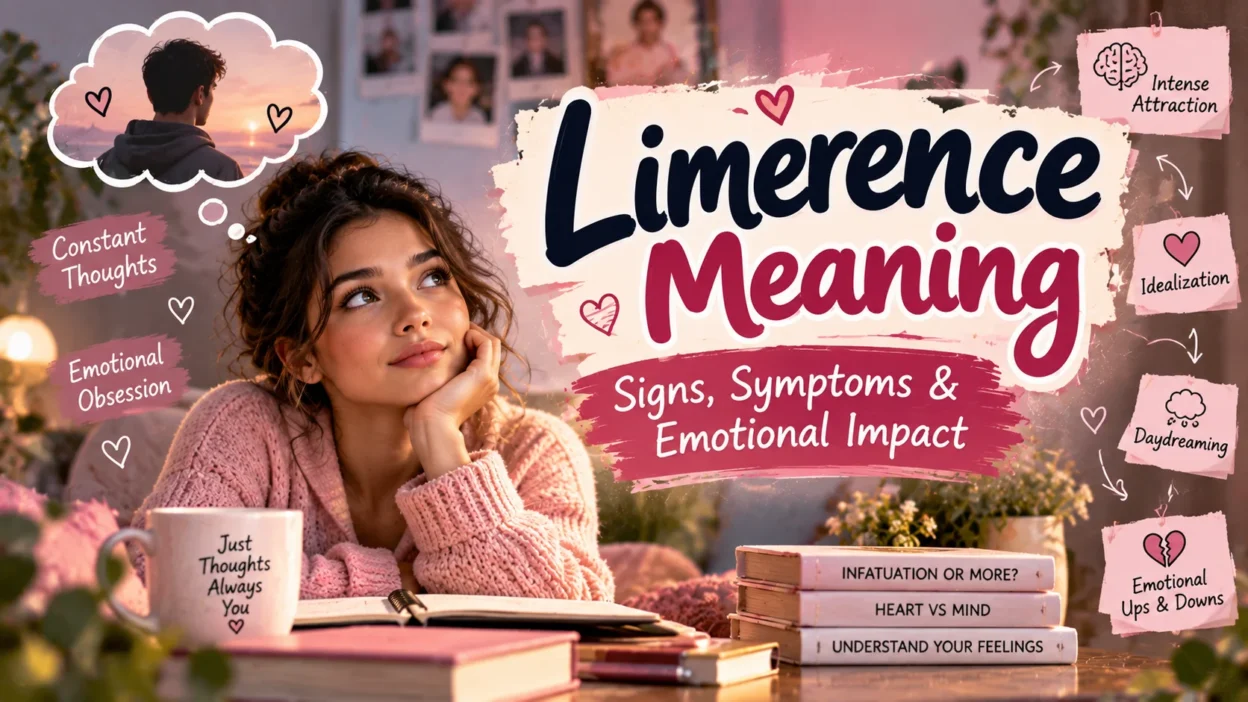
Limerence describes an intense state of romantic infatuation in which a person becomes deeply preoccupied with someone and strongly desires their affection or reciprocation. The experience can involve constant thoughts, emotional highs and lows, daydreaming, uncertainty, and a powerful need for signs that the other person feels the same way.
Unlike an ordinary crush, limerence can take up a significant amount of mental and emotional space. A text message, glance, social media interaction, or small change in someone’s behavior may feel extremely important.
The term does not simply mean being in love. Psychologist Dorothy Tennov introduced the concept in the 1970s to describe a distinctive form of intense romantic attachment marked by intrusive thinking and a strong desire for reciprocation.
💭 What Does Limerence Mean?
The simplest explanation is:
Limerence is an intense emotional state in which you become highly focused on another person and strongly want them to return your feelings.
A person experiencing limerence may think about their love interest repeatedly throughout the day. They may analyze conversations, replay memories, imagine future scenarios, and look for clues that suggest mutual attraction.
The uncertainty often makes the experience even stronger.
| Feature | What It Can Look Like |
|---|---|
| Constant thoughts | Thinking about the person repeatedly |
| Desire for reciprocation | Strong need to know they like you back |
| Idealization | Focusing heavily on their positive qualities |
| Daydreaming | Imagining romantic situations or a future together |
| Mood swings | Feeling extremely happy or disappointed based on their actions |
| Overanalyzing | Searching for hidden meanings in messages or behavior |
| Uncertainty | Not knowing where the relationship stands |
| Emotional dependency | Your mood becoming tied to their attention |
Limerence can feel exciting, beautiful, confusing, and exhausting at the same time.
🧠 Where Did the Term Limerence Come From?
Psychologist Dorothy Tennov developed the concept while researching romantic attraction and published her work in Love and Limerence: The Experience of Being in Love in 1979.
Tennov used the word to describe a particular experience rather than simply another word for love.
The concept became especially useful because romantic attraction does not always feel the same for everyone. Some relationships develop gradually through trust and familiarity, while others begin with an overwhelming fixation on one person.
The word therefore helps describe an emotional pattern that people may recognize in themselves even when ordinary terms such as crush, infatuation, or love do not fully capture the experience.
❤️ What Does Limerence Feel Like?
Limerence can feel almost like an emotional roller coaster.
When the person you like gives you attention, you may experience excitement, relief, confidence, or intense happiness. When they seem distant, your mood may drop quickly.
A simple interaction can therefore carry disproportionate emotional weight.
For example, imagine receiving a short text from someone you like. You might spend several minutes wondering why they used a particular emoji, why they took longer than usual to respond, or whether their wording sounded affectionate.
The uncertainty keeps your attention focused on the person.
Common Emotional Experiences
- Intense excitement
- Nervousness
- Anticipation
- Hope
- Jealousy
- Anxiety
- Euphoria
- Disappointment
- Emotional sensitivity
- Constant curiosity about the other person
This intensity can make the experience feel very different from ordinary romantic interest.
🔥 Signs of Limerence
Limerence does not look exactly the same for everyone, but certain patterns commonly appear.
1. You Think About Them Constantly
The person frequently enters your thoughts even when you are trying to focus on something else.
You may think about them while working, studying, exercising, eating, or preparing for sleep.
2. You Analyze Their Messages
A simple message can become something you examine repeatedly.
You may wonder:
- Why did they say it that way?
- Why did they use that emoji?
- Why did they reply so quickly?
- Why did they take so long?
- Did that message mean something romantic?
3. Their Attention Changes Your Mood
A positive interaction can make your entire day feel wonderful.
A delayed response or distant interaction can have the opposite effect.
4. You Idealize Them
You may focus heavily on their strengths while minimizing flaws or incompatibilities.
The person can begin to feel almost perfect in your imagination.
5. You Daydream About a Future Together
You may imagine dating, marriage, vacations, conversations, living together, or other romantic scenarios even when the actual relationship remains limited.
6. You Look for Signs of Mutual Interest
Every interaction can become evidence to analyze.
A smile, compliment, eye contact, social media like, or casual question may feel especially meaningful.
7. You Want Certainty
One of the strongest features involves wanting to know whether the other person feels the same way.
Ironically, uncertainty can keep the emotional cycle going.
📊 Limerence vs. Love
Limerence and love can overlap, but they are not identical experiences.
Limerence tends to center on intense desire, uncertainty, idealization, and reciprocation. Love generally develops through deeper knowledge, trust, care, and shared experience.
| Limerence | Love |
|---|---|
| Often intense and consuming | Often becomes deeper over time |
| Strong focus on reciprocation | Focuses on mutual care |
| Can involve idealization | Includes realistic understanding |
| Uncertainty can intensify feelings | Security can strengthen connection |
| Strong emotional highs and lows | Usually offers greater emotional stability |
| Fantasies may dominate | Shared experiences become important |
| Attention can become obsessive | Respect and trust play major roles |
| May exist without a real relationship | Usually develops through genuine connection |
This does not mean limerence is fake or that love is always calm. Real relationships can involve intense emotions too.
The distinction mainly concerns where the emotional focus goes and how the connection develops.
💕 Is Limerence the Same as a Crush?
Not exactly.
A crush can involve strong attraction and frequent thoughts about someone. Limerence goes further when the attraction becomes highly consuming and the person’s response becomes central to your emotional state.
For example:
Crush:
You think someone is attractive and enjoy talking to them.
Limerence:
You think about them constantly, analyze their behavior, imagine a relationship, and feel major emotional changes depending on whether they show interest.
A crush may remain light and enjoyable. Limerence can become disruptive.
🌹 Limerence vs. Infatuation
Limerence and infatuation are closely related, but the terms do not mean exactly the same thing.
Infatuation generally describes an intense but often short-lived attraction. Limerence specifically emphasizes preoccupation, uncertainty, and the desire for reciprocation.
| Infatuation | Limerence |
|---|---|
| Intense attraction | Intense emotional preoccupation |
| Often idealizes someone | Often involves idealization |
| Can be short-lived | Can persist for a long period |
| May not require uncertainty | Uncertainty often plays a major role |
| Focuses on strong attraction | Strongly focuses on reciprocation |
🌀 Why Does Uncertainty Make Limerence Stronger?
Uncertainty can create a powerful emotional cycle.
If you know exactly how someone feels, there may be less reason to analyze every interaction. But when their feelings remain unclear, your mind may keep searching for answers.
A small amount of attention can create hope.
Then uncertainty returns.
Then another positive interaction creates excitement again.
This cycle can make the person feel increasingly important.
| Situation | Possible Emotional Reaction |
|---|---|
| They text unexpectedly | Excitement |
| They compliment you | Hope |
| They become distant | Anxiety |
| They respond again | Relief |
| They mention another person | Jealousy |
| They show affection | Euphoria |
| They become unavailable | Preoccupation |
This pattern can explain why someone may remain emotionally attached even when the relationship itself has not developed significantly.
🧩 What Causes Limerence?
There is no single cause that explains every person’s experience.
Romantic attraction involves emotions, thoughts, expectations, personal history, and social circumstances. Certain situations may make intense preoccupation more likely.
Potential contributing factors can include:
- Strong initial attraction
- Uncertainty about another person’s feelings
- Emotional loneliness
- Limited romantic experience
- Idealization
- Frequent contact
- Inconsistent attention
- Fantasy and imagination
- A desire for emotional validation
- Previous relationship experiences
These factors do not automatically create limerence. Everyone responds differently to romantic uncertainty.
📱 Limerence and Social Media
Modern social media can make romantic preoccupation easier to maintain.
Instead of waiting to see someone in person, you may have constant access to their online activity.
You can see:
- Their stories
- New posts
- Likes
- Comments
- Online status
- Photos
- Follows
- Profile changes
When you already feel strongly about someone, this information can become another source of interpretation.
A person might check whether their love interest viewed a story or wonder why they liked one post but ignored another.
This constant access can make it harder to mentally disconnect.
🧠 Limerence and Intrusive Thoughts
One reason the experience can feel exhausting is that thoughts about the person may arrive without invitation.
You might decide to focus on work, only to find yourself thinking about them again minutes later.
The thought itself is not necessarily harmful. The concern arises when the preoccupation starts interfering with daily life.
For example, you might struggle to:
- Concentrate at work
- Complete schoolwork
- Sleep comfortably
- Enjoy hobbies
- Maintain friendships
- Focus on personal goals
When romantic thoughts begin interfering significantly with everyday functioning, talking with a qualified mental health professional can be helpful.
🌱 Can Limerence Turn Into Love?
Sometimes intense attraction can develop into a healthy relationship, but limerence does not automatically become love.
A relationship needs more than strong feelings.
It needs:
- Mutual interest
- Respect
- Trust
- Communication
- Compatibility
- Shared experiences
- Emotional availability
- Healthy boundaries
As two people get to know each other, fantasy can give way to a more realistic understanding of who they are.
That process may lead to genuine love.
But it may also reveal incompatibility.
Either outcome can provide valuable information.
💔 Can Limerence Happen Without a Relationship?
Yes.
A person can experience intense romantic preoccupation even when they have never dated the person involved.
This can happen when someone builds a strong emotional story around limited interactions.
For example, two coworkers might have several friendly conversations. One person may begin imagining a relationship, analyzing every interaction, and becoming emotionally invested despite the absence of a romantic relationship.
In such situations, the imagined connection can become much larger than the real-life relationship.
That is one reason fantasy and reality deserve careful separation.
🪞 How Do You Know If You Are Experiencing Limerence?
There is no simple online test that can definitively diagnose limerence.
Instead, consider your patterns.
Ask yourself:
- How often do I think about this person?
- Does their attention strongly affect my mood?
- Do I constantly analyze their behavior?
- Do I imagine a relationship more than I actually experience one?
- Am I idealizing them?
- Do I desperately want confirmation that they like me?
- Does uncertainty make my feelings stronger?
- Is this affecting my sleep, work, studies, or relationships?
If several of these questions strongly resonate with you, you may recognize elements of limerence.
🌿 How to Cope With Limerence
If intense romantic preoccupation becomes exhausting, several practical strategies can help.
Create Some Emotional Distance
Constantly checking messages, profiles, or social media can reinforce the cycle.
Reducing unnecessary checking may give your mind more space.
Focus on Reality
Separate what you know from what you imagine.
For example:
Fact: They replied to your message.
Interpretation: They must secretly have strong romantic feelings.
Keeping those two ideas separate can reduce overinterpretation.
Maintain Your Routine
Continue spending time on work, hobbies, exercise, friendships, and personal goals.
Your life should remain larger than one romantic interest.
Challenge Idealization
Remind yourself that you know only part of the person.
Everyone has strengths, weaknesses, habits, preferences, and limitations.
Stop Searching for Constant Signs
Not every emoji, glance, like, or delayed message contains a hidden romantic message.
Sometimes a message is simply a message.
Talk to Someone
A trusted friend can offer perspective. If the experience seriously affects your daily functioning or causes significant distress, a mental health professional can provide personalized support.
🕊️ Can Limerence Go Away?
Yes.
For some people, the intensity decreases naturally as they gain clarity about the relationship or redirect their attention toward other parts of life.
It may also decrease when:
- The relationship becomes clearer.
- The feelings become mutual and realistic.
- The person recognizes incompatibility.
- Contact decreases.
- Fantasy loses its appeal.
- New experiences become more important.
- Emotional boundaries become stronger.
The process does not always happen instantly. Strong emotional habits can take time to change.
📚 Limerence in Simple Words
If you need a very short definition:
Limerence is an intense romantic preoccupation with someone, especially when you strongly want that person’s feelings to be returned.
Think of it as a state where attraction becomes highly focused on the person, their attention, and the possibility of mutual love.
It can feel wonderful when you receive attention and painful when you do not.
❓ Frequently Asked Questions About Limerence
What is limerence in simple terms?
Limerence is an intense form of romantic preoccupation in which you think about someone frequently and strongly desire their affection or reciprocation.
Is limerence the same as love?
No. Limerence can involve intense attraction and emotional fixation, while love generally develops through mutual knowledge, trust, care, and shared experiences.
Is limerence a mental disorder?
Limerence is a psychological concept, not a universally recognized standalone mental disorder. If romantic preoccupation causes serious distress or interferes with daily functioning, professional support may help.
How long does limerence last?
There is no fixed timeline. Its intensity can vary greatly from person to person and may change as the relationship becomes clearer or circumstances change.
Can you experience limerence for someone you barely know?
Yes. A person can become intensely preoccupied with someone despite having limited real-life interaction with them. Idealization and fantasy can play a major role.
Can limerence become love?
It can, but it does not have to. A healthy relationship requires mutual interest, trust, communication, compatibility, and real shared experiences.
What is the biggest difference between limerence and love?
Limerence often centers on intense preoccupation and the need for reciprocation, while mature love generally involves realistic understanding, mutual care, trust, and commitment.
Can social media make limerence worse?
It can contribute to continued preoccupation because constant access to someone’s posts, stories, and activity can encourage repeated checking and interpretation.
How do you stop limerence?
Reducing unnecessary contact or checking, challenging idealized thoughts, focusing on your own life, maintaining routines, and separating facts from assumptions can help. Professional support may also be useful when the experience becomes disruptive.
Is limerence always unhealthy?
Not necessarily. Strong romantic attraction can feel exciting and meaningful. It becomes more concerning when preoccupation causes significant distress, interferes with daily life, or prevents you from seeing the relationship realistically.
🌟 Final Thoughts
The limerence meaning describes a powerful state of romantic preoccupation that goes beyond an ordinary crush. It can involve constant thoughts, idealization, emotional highs and lows, fantasy, uncertainty, and a strong desire to know that the other person feels the same.
Understanding the concept can help you separate intense attraction from genuine relationship development. Feeling overwhelmed by someone does not automatically mean you have found your perfect partner. Likewise, intense feelings are not meaningless simply because they may not become a lasting relationship.
The healthiest approach involves staying connected to reality. Pay attention to mutual actions, communication, compatibility, and respect rather than relying only on fantasy or small signs.
Romantic feelings can be powerful, but a healthy relationship grows when intense emotion meets reality, reciprocity, trust, and genuine understanding.

Lillian Hayes is a content writer focused on explaining meanings and language in a simple and clear way. She creates easy-to-understand content that helps readers learn and communicate better.