
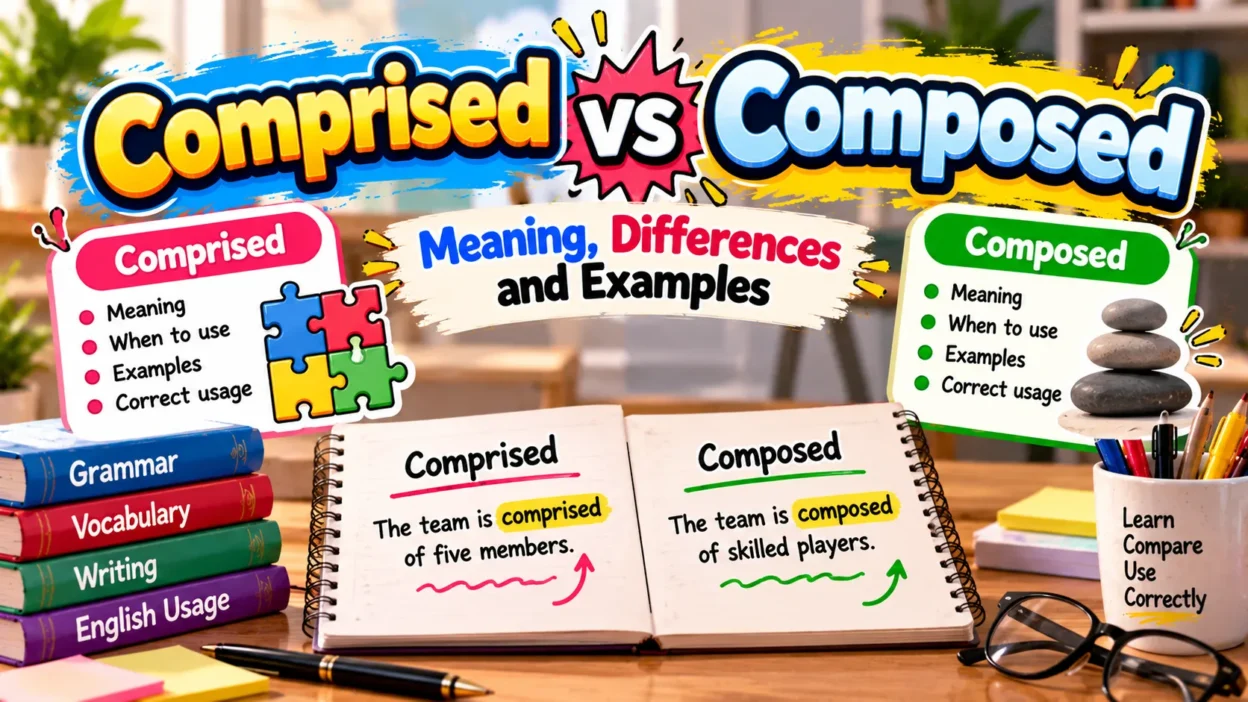
The words comprised and composed are often confused because both describe how parts relate to a whole. They frequently appear in academic writing, business reports, professional communication, and everyday English. Although their meanings overlap, understanding their grammatical patterns can help you use them accurately and write with greater clarity.
The key difference between comprised vs. composed lies in how each word describes a whole and its components. Comprised generally means “consisted of” or “included,” while composed of means “made up of.” For example, you can write, “The committee comprised five members” or “The committee was composed of five members.” Both sentences communicate the same basic idea, but their grammatical structures differ.
What Does Comprised Mean? 📘
Comprised is the past-tense and past-participle form of comprise. It means to consist of, include, or contain the parts that make up a whole. The word is commonly used to describe groups, organizations, systems, collections, and other things made up of multiple components.
In formal writing, comprise is traditionally used with the whole as the subject, followed by the parts it contains. This makes it useful when explaining the structure of a team, department, report, or organization.
Examples of comprised in sentences:
- The committee comprised seven experienced professionals.
- The course comprised twelve lessons and three practical assignments.
- The collection comprised paintings from several historical periods.
- The research team comprised scientists from four universities.
- The project comprised three major phases.
In each example, the subject represents the whole, and the words that follow identify its components.
Quick tip: A straightforward pattern is the whole + comprised + the parts.
What Does Composed Mean? 📝
Composed is the past-tense and past-participle form of compose. When describing a whole, it commonly appears in the expression composed of, meaning made up of particular parts or members.
This construction is widely used in formal writing, technical descriptions, educational materials, and business communication. It helps explain the elements that form a larger unit.
Examples of composed in sentences:
- The committee was composed of seven experienced professionals.
- The course was composed of twelve lessons and three practical assignments.
- The collection was composed of paintings from several historical periods.
- The research team was composed of scientists from four universities.
- The project was composed of three major phases.
In these examples, composed of explains the components that form the whole.
Quick tip: Use the pattern the whole + was/were composed of + the parts.
Comprised vs. Composed: Key Differences 📊
Although the two words can express similar ideas, their sentence structures are different. Understanding these patterns helps prevent awkward or grammatically incorrect phrasing.
| Feature | Comprised | Composed |
|---|---|---|
| Basic meaning | Consisted of or included | Made up of |
| Common structure | The whole comprised the parts | The whole was composed of the parts |
| Example | The team comprised ten players. | The team was composed of ten players. |
| Common context | Groups, systems, collections, organizations | Groups, structures, materials, compositions |
| Grammatical note | Usually takes the whole as its subject | Often used with of to introduce the parts |
Remember: “The team comprised ten players” and “The team was composed of ten players” are both standard constructions. The main difference is how the sentence is formed.
Comprised vs. Composed Examples in Context ✍️
Seeing the words used in comparable sentences makes their differences easier to recognize. The following examples show how both constructions can describe the same whole.
Example 1: A School Class
- Comprised: The class comprised twenty-five students.
- Composed: The class was composed of twenty-five students.
Example 2: A Business Team
- Comprised: The marketing team comprised six specialists.
- Composed: The marketing team was composed of six specialists.
Example 3: A Research Project
- Comprised: The research project comprised four stages.
- Composed: The research project was composed of four stages.
Example 4: A Music Group
- Comprised: The ensemble comprised musicians from three countries.
- Composed: The ensemble was composed of musicians from three countries.
Example 5: A Written Report
- Comprised: The report comprised an introduction, five chapters, and a conclusion.
- Composed: The report was composed of an introduction, five chapters, and a conclusion.
In each pair, the central meaning remains similar. Choose the construction that fits the rest of your sentence and maintains a natural, consistent style.
Is “Comprised Of” Grammatically Correct? 🔎
The expression “comprised of” is widely used in contemporary English, but it has historically been criticized by some editors and grammar guides. Traditional usage generally recommends comprise without of when naming the components of a whole.
For example:
- Traditional recommendation: The panel comprised five judges.
- Traditional recommendation: The panel was composed of five judges.
- Also widely used: The panel was comprised of five judges.
The third construction is common in modern usage, and many readers will understand it without difficulty. However, if you want to avoid criticism in formal or academic writing, the first two options are safer choices.
A useful distinction is that “comprised of” is not the same grammatical construction as “composed of.” The latter is a standard and widely accepted expression.
Is “Composed By” Different From “Composed Of”? 🎼
Yes. Although both expressions contain composed, they communicate different relationships.
Composed of identifies the components that make up something.
- The mixture was composed of water and salt.
- The committee was composed of five members.
- The article was composed of several sections.
Composed by identifies the person who created a piece of music or another work.
- The symphony was composed by Beethoven.
- The soundtrack was composed by a talented musician.
- The original score was composed by a contemporary artist.
The difference is straightforward: of introduces the components, while by identifies the creator or composer.
Comprised vs. Composed vs. Constituted 🧠
The word constituted can also describe the parts or elements that form a whole. It is often used in formal, legal, political, and academic contexts.
| Word or phrase | Meaning | Example |
|---|---|---|
| Comprised | Consisted of or included | The board comprised eight directors. |
| Composed of | Made up of | The board was composed of eight directors. |
| Constituted | Formed or made up | Eight directors constituted the board. |
These expressions are similar, but the grammatical structure changes. Comprised places the whole before the parts, composed of describes the parts that make up the whole, and constituted can present the parts as forming the whole.
Common Mistakes to Avoid ⚠️
Even experienced writers sometimes use these words in awkward constructions. The following examples show how to improve clarity and grammatical accuracy.
- Awkward: The team was comprised by ten players.
Better: The team comprised ten players. - Traditional recommendation: The committee comprised of six members.
Better: The committee comprised six members. - Correct: The committee was composed of six members.
This is a standard way to describe the committee’s membership. - Different meaning: The song was composed of Mozart.
Better: The song was composed by Mozart. - Unclear: The report was comprised with several sections.
Better: The report comprised several sections.
When in doubt, use comprised directly after the name of the whole or use was/were composed of to introduce its components.
When Should You Use Comprised or Composed? 💼
Both expressions can work well in professional and academic writing. Your choice should depend on sentence structure, context, and the level of formality required.
Use comprised when you want a concise sentence that names a whole and then its parts:
- The department comprised four specialized teams.
- The survey comprised twenty questions.
- The package comprised three separate documents.
Use composed of when you want to emphasize the components that form something:
- The department was composed of four specialized teams.
- The survey was composed of twenty questions.
- The package was composed of three separate documents.
For concise business writing, comprised is often effective. For explanatory descriptions, composed of can be especially natural. Consistency and clarity matter more than choosing one expression every time.
Frequently Asked Questions About Comprised vs. Composed ❓
1. What is the main difference between comprised and composed?
Comprised means consisted of or included, while composed of means made up of. For example, “The team comprised five members” and “The team was composed of five members” convey similar meanings.
2. Is comprised of grammatically correct?
The phrase is widely used in modern English, although traditional grammar guidance often recommends avoiding it. In formal writing, use “comprised” or “was composed of” to minimize potential objections.
3. Should I say comprised of or composed of?
Both are commonly understood, but composed of is the more straightforward choice when introducing the parts of a whole. For example, “The group was composed of ten volunteers.”
4. Can comprised and composed be used interchangeably?
They can express similar ideas, but their grammatical structures differ. “The team comprised five players” is standard, while “The team was composed of five players” is also standard.
5. Is it composed by or composed of?
Use composed by to identify the creator of a work, such as a song. Use composed of to identify the components of something, such as a committee or mixture.
6. Which word is better for academic writing?
Both can be appropriate. “The study comprised three experiments” is concise, while “The study was composed of three experiments” is also understandable. Follow your institution’s style guide if it specifies a preferred construction.
7. What is another word for comprised?
Depending on the context, alternatives include included, consisted of, contained, and encompassed. Choose the alternative that best matches your intended meaning and sentence structure.
8. What is another phrase for composed of?
Common alternatives include made up of, consisting of, and formed from. For example, “The team was made up of eight members” conveys the same basic idea as “The team was composed of eight members.”
Conclusion 🎯
The difference between comprised vs. composed mainly concerns sentence structure. Comprised describes the parts included in a whole, as in “The committee comprised six members.” The expression composed of describes what forms a whole, as in “The committee was composed of six members.”
For professional writing, use “comprised” when naming the whole and its parts directly, or “was composed of” when describing its components. Both constructions can communicate the intended meaning clearly when used correctly.

Lillian Hayes is a content writer focused on explaining meanings and language in a simple and clear way. She creates easy-to-understand content that helps readers learn and communicate better.