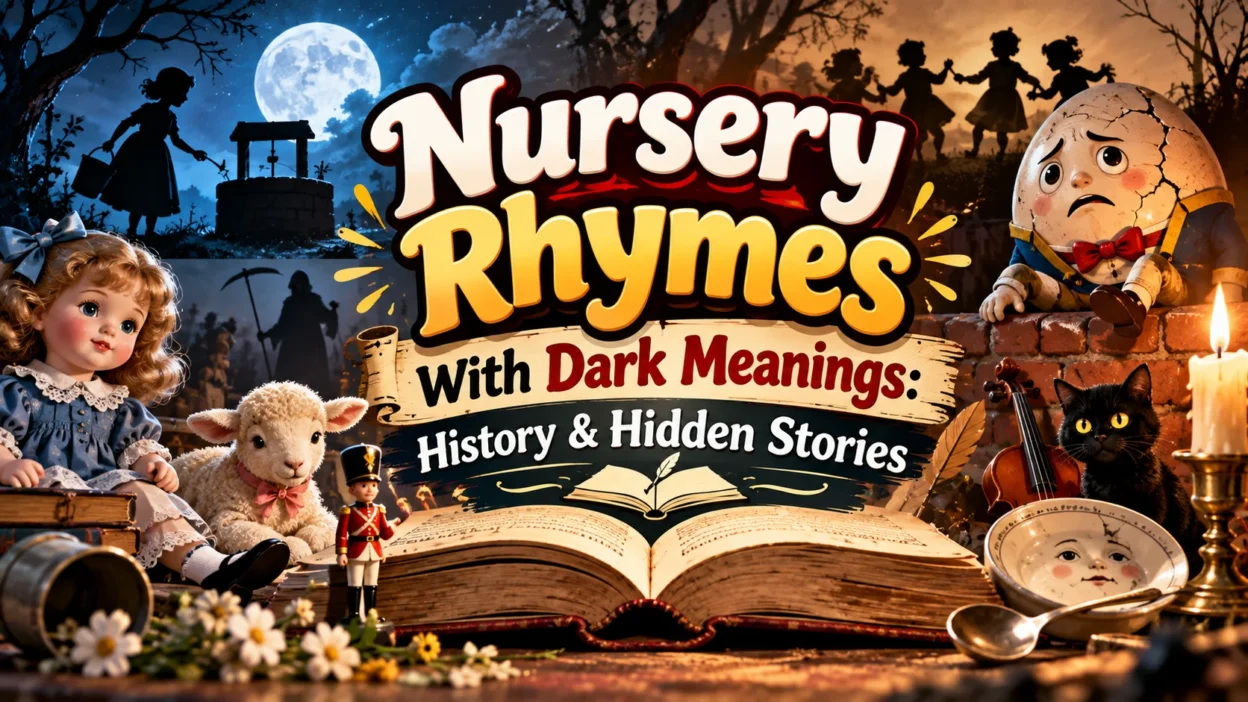
Nursery rhymes with dark meanings have fascinated readers for generations because some cheerful-sounding verses contain references to death, illness, violence, disasters, punishment, or unsettling historical events. Rhymes such as “Ring Around the Rosie,” “London Bridge Is Falling Down,” and “Three Blind Mice” are frequently presented online as having disturbing origins. However, not every popular explanation is historically proven. Some interpretations developed long after the rhymes became popular, while others remain debated by historians and folklorists. This guide explores the darker themes associated with famous nursery rhymes while separating documented evidence from intriguing but uncertain theories.
🖤 What Makes a Nursery Rhyme Dark?
A nursery rhyme can seem dark because of its lyrics, imagery, historical associations, or later interpretations. Some contain obvious references to death, illness, violence, accidents, or frightening situations, while others only appear sinister when connected with a particular historical theory.
The phrase dark nursery rhymes therefore covers several different categories, including rhymes with violent imagery, songs associated with historical tragedies, and innocent verses that later acquired unsettling interpretations.
🌹 Ring Around the Rosie
“Ring Around the Rosie” is probably the most famous example associated with a supposed dark origin. A popular theory claims that the rhyme describes the symptoms and deaths associated with the Great Plague of London or another outbreak of bubonic plague.
The interpretation points to phrases about a “rosie” and falling down as references to rashes and death. However, historians and folklorists generally regard the plague explanation as unsupported or highly questionable. Versions of the rhyme appeared in print much later than the major plague outbreaks, and the lyrics vary considerably.
Why Is Ring Around the Rosie Considered Dark?
- It includes imagery of falling down.
- Popular explanations connect it with disease.
- The word “ashes” appears in some versions.
- The rhyme has been associated with death in modern retellings.
- Its cheerful melody contrasts with the darker interpretation.
- Historical versions of the lyrics differ.
- There is no solid evidence proving a plague origin.
🌉 London Bridge Is Falling Down
“London Bridge Is Falling Down” has inspired several theories about its meaning. The most straightforward interpretation concerns the repeated destruction, rebuilding, and deterioration of bridges, but other explanations connect the rhyme to historical violence, child sacrifice, or attacks.
The famous line about the bridge falling down clearly describes destruction, but claims that the rhyme specifically records a particular historical event remain uncertain.
Dark Interpretations of London Bridge
Theories surrounding the rhyme have connected it with:
- Bridge collapses
- Warfare
- Historical destruction
- Viking attacks
- Sacrificial traditions
- Political conflict
- Repeated rebuilding
- Medieval folklore
Some of these explanations are speculative rather than established historical facts.
🐭 Three Blind Mice
“Three Blind Mice” has some of the most visibly violent imagery in traditional nursery rhyme literature. The rhyme describes three mice being blinded with a carving knife after supposedly pursuing the farmer’s wife.
The disturbing nature of the lyrics is not simply a modern interpretation—the violence is present directly in the traditional verse. Later writers have attempted to connect the mice with historical figures, particularly religious and political conflicts, but those identifications are generally treated as interpretations rather than proven origins.
Why Three Blind Mice Sounds So Disturbing
The rhyme contains:
- Blindness
- A knife
- Physical injury
- Pursuit
- Threat
- A violent punishment
- A cheerful children’s melody
The contrast between its playful rhythm and violent imagery is part of what makes it memorable.
🥚 Humpty Dumpty
Humpty Dumpty is often discussed among nursery rhymes with dark meanings, although its original subject may not have been a person at all. The familiar rhyme describes a character falling from a wall and being impossible to restore.
The verse itself does not explicitly describe death. The phrase “all the king’s horses and all the king’s men” creates a sense of irreversible damage, which has encouraged darker interpretations.
Humpty Dumpty may have originated as a riddle, with the answer traditionally being an egg. The rhyme’s modern association with a person-like character developed through illustrations and popular culture.
🖤 Rock-a-Bye Baby
“Rock-a-Bye Baby” has one of the most unsettling images in a children’s lullaby: a baby is placed in a tree, and the tree branch breaks.
The exact historical origin is uncertain, and multiple theories have been proposed. Some interpretations connect the lyrics with political events, Native American cradle traditions, or a metaphor for instability. None should automatically be treated as the definitive origin.
The literal story remains dark enough on its own because the rhyme describes a baby falling from a tree.
🐑 Baa, Baa, Black Sheep
“Baa, Baa, Black Sheep” does not have an inherently violent story, but it has attracted historical discussion because of interpretations involving medieval taxation and economic hardship.
The theory that the rhyme specifically represents the medieval wool tax is widely repeated, but scholars have questioned whether that explanation can actually be established from historical evidence.
The phrase “black sheep” can also carry meanings involving difference or social exclusion, although that interpretation is separate from the rhyme’s historical origin.
🧺 Jack and Jill
“Jack and Jill” appears simple, but the characters experience an unfortunate accident: Jack falls and injures his head, while Jill follows after him.
Some later interpretations have attempted to associate the rhyme with historical events, political figures, or taxation. These explanations are difficult to establish conclusively.
The straightforward reading is simply a short comic story about two children who go up a hill for water and suffer an accident.
🐴 Ride a Cock Horse to Banbury Cross
“Ride a Cock Horse to Banbury Cross” has inspired several historical interpretations involving royal processions, local traditions, and religious imagery.
Unlike some darker nursery rhymes, the exact meaning is uncertain. The unusual phrase “cock horse” and references to a lady riding a horse have encouraged different explanations over time.
Its mystery is part of the reason the rhyme continues to attract historical curiosity.
🐄 Little Bo-Peep
“Little Bo-Peep” begins with a lost flock of sheep and ends with their tails being discovered. Some versions contain the unsettling phrase that the sheep leave their tails behind.
The rhyme can be read simply as a humorous story about a shepherd losing animals, but its imagery has also led readers to imagine more disturbing explanations.
There is no strong historical basis for treating it as a coded account of violence, however.
🕯️ Oranges and Lemons
“Oranges and Lemons” sounds cheerful because of its melody, but its traditional ending is considerably darker. The rhyme moves through references to London churches before ending with the famous image of a person’s head being cut off.
That final section gives the rhyme a clear association with execution imagery. Various explanations have been proposed for the church references, including bells, locations, and historical traditions.
The execution ending is one reason the rhyme is often included in discussions of dark English nursery rhymes.
🔔 Ding Dong Bell
“Ding Dong Bell” tells a short story about a cat being placed in a well and a little boy who rescues it.
The rhyme has a surprisingly dark opening because the animal is deliberately thrown into the water. However, unlike some violent nursery rhymes, the story ultimately resolves with the cat being rescued.
Its structure demonstrates how older children’s verses could combine danger and humor without necessarily having a tragic ending.
🥀 Mary, Mary, Quite Contrary
“Mary, Mary, Quite Contrary” has generated substantial speculation because some readers have tried to connect it with Mary I of England, also known as Mary Tudor.
The garden imagery has been interpreted by some writers as references to executions or religious persecution. Other scholars dispute those connections and note that the historical evidence for the interpretation is weak.
The rhyme’s exact original meaning remains uncertain.
🐦 Sing a Song of Sixpence
“Sing a Song of Sixpence” contains a surprising collection of images, including a pie filled with birds and a maid whose nose is bitten off by a bird.
Its absurdity is part of the traditional nursery-rhyme style, but the physical injury at the end gives the verse a distinctly strange quality.
Some historical interpretations attempt to connect the rhyme with political figures and events, but those explanations should be treated cautiously rather than presented as established fact.
👑 Goosey Goosey Gander
“Goosey Goosey Gander” contains references to an old man being thrown down the stairs after refusing to say his prayers.
That imagery has led to theories involving religious persecution and historical conflicts. However, the exact origin and intended meaning are uncertain.
The rhyme illustrates how religious references and violence sometimes appear together in traditional children’s verses.
🩸 The Grand Old Duke of York
“The Grand Old Duke of York” describes an army marching up a hill and marching down again. Its repetitive structure makes it easy for children to memorize, but the song has often been interpreted as a commentary on military failure.
The historical identity of the duke is debated. Some versions of the theory connect the song with military campaigns, but there is no universally accepted evidence establishing one specific event as its origin.
⚔️ Wee Willie Winkie
“Wee Willie Winkie” is generally less violent than other examples, but its nighttime imagery can feel unsettling. A figure moves through the town checking whether children are asleep.
The rhyme reflects an old-fashioned childhood concern about bedtime discipline and nighttime behavior. Modern readers may interpret the mysterious nighttime visitor differently because of contemporary cultural ideas about strangers and surveillance.
🐦 Four and Twenty Blackbirds
“Sing a Song of Sixpence” includes the famous image of twenty-four blackbirds baked into a pie. The idea is obviously strange from a modern perspective, although the rhyme’s absurd imagery is part of its traditional humor.
The song also contains the maid losing her nose to a bird, giving it an additional element of bodily injury.
🏰 Historical Events and Nursery Rhymes
One reason nursery rhymes develop dark reputations is that people naturally search for historical events that might explain unusual lyrics. Plague, war, executions, political conflict, taxation, and religious persecution provide compelling explanations.
However, a rhyme’s similarity to a historical event does not prove that the event inspired it. Many popular “hidden meaning” explanations were developed centuries after the earliest versions of the rhymes.
📜 Why Are Nursery Rhyme Origins So Difficult to Prove?
Nursery rhymes were often transmitted orally before being written down. Different communities could change words, verses, characters, and endings over time.
This creates several problems for researchers. A rhyme may have multiple versions, uncertain publication dates, regional variations, and unclear authorship. Later collectors also sometimes recorded rhymes differently from how people had previously sung them.
For that reason, nursery rhyme history often requires distinguishing between the earliest documented version and later interpretations.
🧠 Myth vs. Documented History
Not every creepy explanation found online should be considered historical fact. A useful way to examine a nursery rhyme is to separate three categories: what the lyrics actually say, what historical records document, and what later writers have proposed.
For example, a rhyme may contain violent imagery without having been written about a specific historical execution. Likewise, a plague theory may sound convincing while lacking evidence connecting the words to the disease.
This distinction is especially important when researching nursery rhymes with hidden meanings.
🌙 Why Were Children’s Rhymes Sometimes Dark?
Traditional children’s literature was not always as sanitized as modern children’s entertainment. Older stories and songs frequently included death, danger, punishment, illness, accidents, frightening creatures, and social hardship.
These subjects were part of everyday life in earlier societies. Children’s songs could therefore contain themes that modern audiences find surprisingly grim while still functioning as entertainment.
The dark elements may also have helped make rhymes memorable through exaggerated images, repetition, humor, and surprise.
🎵 Why Do Dark Nursery Rhymes Sound So Cheerful?
Many traditional nursery rhymes use simple melodies, repetition, rhythm, and rhyme. Those characteristics make them easy to remember and enjoyable to sing even when the lyrics describe something unpleasant.
This creates an unusual contrast: cheerful nursery rhyme melodies can carry stories involving accidents, violence, death, or danger.
That contrast may actually make the darker verses feel more memorable to modern listeners.
🖤 Are Nursery Rhymes Actually Meant to Be Dark?
Some definitely contain dark imagery, but that does not mean every rhyme was deliberately written with a hidden sinister message.
A rhyme can have a strange or violent verse simply because traditional folklore often mixed humor, danger, nonsense, and everyday experiences. Claims about secret meanings should therefore be evaluated against historical evidence rather than accepted simply because they sound interesting.
🔎 How to Research the Meaning of a Nursery Rhyme
When investigating a nursery rhyme with a dark origin, look for the earliest known printed versions, historical references, scholarly folklore research, and differences between regional versions.
Useful questions include:
- When was the rhyme first documented?
- What did the earliest version actually say?
- Were earlier versions different?
- When did the popular dark interpretation appear?
- Is there independent historical evidence?
- Do historians agree about the proposed origin?
- Could the lyrics have developed from oral tradition?
These questions help separate fascinating folklore from documented history.
❓ FAQs About Nursery Rhymes With Dark Meanings
What nursery rhyme has the darkest meaning?
There is no objective single “darkest” nursery rhyme. “Three Blind Mice,” “Rock-a-Bye Baby,” and “Oranges and Lemons” contain notably disturbing imagery, while “Ring Around the Rosie” is famous for a dark interpretation involving plague that is not historically established.
Is Ring Around the Rosie really about the plague?
The plague explanation is extremely popular, but historians and folklorists generally do not consider it proven. The rhyme’s documented history and versions do not provide strong evidence that it originated as a description of bubonic plague.
What is the dark meaning behind Three Blind Mice?
The literal rhyme describes three mice being blinded with a knife. Some later writers have connected the mice to historical figures and religious persecution, but those identifications are interpretations rather than firmly established origins.
Why is Rock-a-Bye Baby considered creepy?
The rhyme describes a baby being placed in a tree and falling when the branch breaks. The image is unsettling when interpreted literally, although its historical origin and intended meaning remain uncertain.
Is London Bridge really about war?
London Bridge has been destroyed and rebuilt many times, and several historical theories have been proposed for the rhyme. However, there is no universally accepted evidence proving that the traditional song records one specific war or attack.
Why do nursery rhymes have violent lyrics?
Traditional children’s rhymes developed in societies where death, illness, accidents, punishment, and hardship were more visible parts of everyday life. Folklore also commonly mixed humor and frightening imagery.
Are all dark nursery rhyme meanings true?
No. Many popular explanations are theories that developed later. The lyrics themselves may be documented, while claims about their hidden historical meaning can remain uncertain or disputed.
Why do people search for hidden meanings in nursery rhymes?
Unusual lyrics naturally encourage people to look for explanations. Historical events, political conflicts, religious disputes, and folklore can provide possible contexts, but similarities alone do not establish an origin.
🖤 Conclusion
Nursery rhymes with dark meanings reveal how traditional children’s folklore can combine cheerful melodies with strange, violent, tragic, or mysterious imagery. Some rhymes contain genuinely unsettling scenes, while others have acquired darker interpretations through later historical theories. “Three Blind Mice,” “Rock-a-Bye Baby,” “Oranges and Lemons,” and “London Bridge Is Falling Down” demonstrate how varied these interpretations can be. The important distinction is between what a rhyme actually says, what historical evidence supports, and what later storytellers have suggested. Rather than assuming every nursery rhyme hides a sinister secret, examining its documented versions and historical context gives a more accurate picture of how these memorable pieces of folklore developed.

Lillian Hayes is a content writer focused on explaining meanings and language in a simple and clear way. She creates easy-to-understand content that helps readers learn and communicate better.