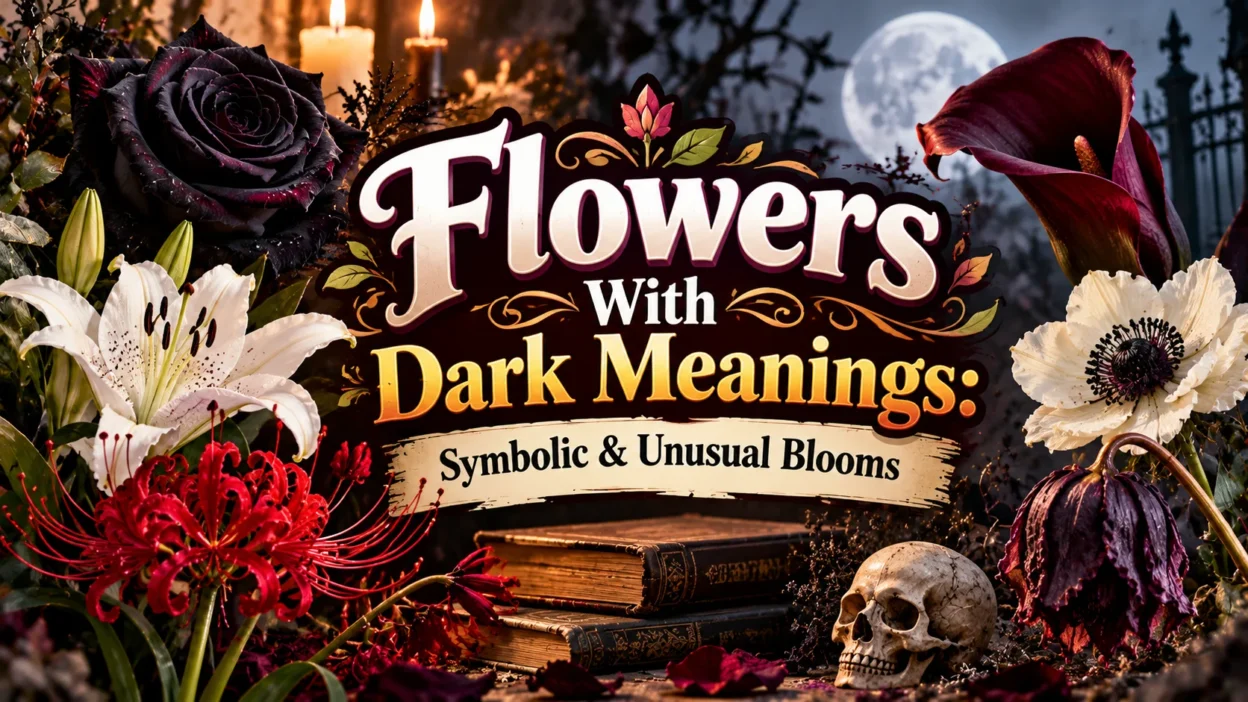
Flowers are usually associated with beauty, love, happiness, and celebration, but not every bloom carries a cheerful message. Some flowers with dark meanings have traditionally been connected with death, grief, farewell, betrayal, secrecy, heartbreak, mourning, or misfortune. Others have developed darker symbolism through mythology, literature, folklore, and cultural traditions. From black roses and chrysanthemums to foxgloves, oleander, and red poppies, these flowers can represent emotions and ideas that go far beyond ordinary floral beauty. Their meanings are not universal, so cultural context matters when interpreting a flower’s symbolism.
🖤 What Are Flowers With Dark Meanings?
Flowers with dark meanings are blooms that have been associated with difficult, mysterious, tragic, or unsettling ideas. Their symbolism may come from traditional flower language, folklore, mythology, poisonous properties, cultural customs, or the appearance of the flower itself.
A dark flower meaning does not necessarily mean the flower is dangerous or negative. In many cases, a flower associated with mourning can also represent remembrance, while a flower connected with endings can symbolize transformation or a new beginning.
🥀 Black Rose — Death, Mystery & Farewell
The black rose is one of the most recognizable symbols of dark floral imagery. Naturally occurring roses described as truly black are extremely rare; many “black roses” are actually very dark red, burgundy, purple, or specially dyed flowers.
In popular symbolism, black roses can represent death, farewell, grief, mystery, rebellion, transformation, and the ending of something important. Their meaning is highly dependent on the context in which they are used.
🌹 Red Rose — Love That Can Turn Dark
Red roses are traditionally associated with romantic love and passion, but their symbolism can become darker in certain contexts. A deep red or fading rose can represent heartbreak, obsession, sacrifice, or love that has become painful.
This makes the dark red rose meaning especially interesting in literature and art, where the same flower can represent both intense love and emotional suffering.
🥀 Wilted Rose — Fading Love & Mortality
A wilted rose represents one of the clearest visual metaphors for something beautiful that has changed. Its drooping petals can symbolize fading love, lost youth, heartbreak, aging, memories, or the passage of time.
Unlike a fresh rose, a wilted bloom carries the suggestion that a particular stage has ended. This is why wilted roses frequently appear in emotional photography, poetry, tattoos, and gothic artwork.
🖤 Black Dahlia — Mystery & Tragedy
The dahlia itself is not inherently a dark flower, but the phrase Black Dahlia has acquired a strong association with mystery and tragedy because of a famous unsolved murder case in Los Angeles in 1947.
It is important to distinguish the flower from the historical nickname. Dark dahlia symbolism in modern art can reflect mystery, elegance, tragedy, or the contrast between beauty and darkness.
🌺 Chrysanthemum — Mourning in Some Cultures
Chrysanthemums have very different meanings depending on location and color. In several European and East Asian traditions, chrysanthemums can have strong associations with funerals, mourning, or remembrance.
At the same time, chrysanthemums can symbolize joy, longevity, friendship, or celebration in other contexts. Therefore, chrysanthemum symbolism cannot be reduced to one universal meaning.
🤍 White Chrysanthemum — Remembrance & Grief
White chrysanthemums can carry particularly strong associations with mourning and remembrance in some cultures. Their clean appearance and traditional use in funeral arrangements can make them symbols of farewell.
However, white flowers can also represent purity, peace, sincerity, and innocence. The meaning depends heavily on cultural tradition and the occasion.
🌺 Red Poppy — Remembrance & War
The red poppy is strongly associated with remembrance of military service and those who died in war, particularly in countries influenced by the traditions surrounding World War I remembrance.
The flower therefore carries a serious emotional meaning: memory, sacrifice, loss, and remembrance. It is not necessarily a symbol of darkness in a negative sense; instead, its meaning reflects commemoration and historical memory.
🦊 Foxglove — Beauty, Danger & Poison
Foxglove is a striking flowering plant known for its tall spikes of bell-shaped flowers. It also contains cardiac glycosides, including compounds associated with the heart medication digitalis, making the plant potentially poisonous if improperly consumed.
This combination of beauty and toxicity has contributed to the flower’s mysterious and dangerous reputation. In folklore and literature, foxglove can therefore evoke enchantment, danger, secrecy, and the unknown.
☠️ Oleander — Beauty With Toxicity
Oleander produces attractive flowers in several colors, but the plant is highly toxic if ingested. Its poisonous nature has contributed to darker associations in literature and popular culture.
The flower can symbolize a contrast between outward beauty and hidden danger. That contrast makes oleander symbolism particularly useful in gothic art, fictional storytelling, and metaphorical writing.
🌙 Night-Blooming Flowers — Mystery & Darkness
Some flowers bloom at night or release their strongest fragrance after sunset. Although they do not necessarily have negative traditional meanings, their nighttime behavior has made them popular symbols of mystery, secrecy, dreams, and the unknown.
Examples include:
- Night-blooming jasmine
- Moonflower
- Evening primrose
- Night-blooming cereus
- Four o’clock flower
Their association with darkness comes primarily from their blooming habits rather than an inherently negative symbolism.
🥀 Dead Flowers — Loss & Impermanence
A dead flower is one of the simplest symbols of mortality and impermanence. Fresh flowers suggest life and growth, while dried or decaying flowers show that beauty changes with time.
Dead flowers can therefore represent:
- Loss
- Aging
- Memories
- Endings
- Mortality
- Fading beauty
- Forgotten love
- The passage of time
- Transformation
- Nostalgia
🌑 Dried Roses — Memories & Fading Love
Dried roses retain their recognizable shape but lose the softness and vivid color of fresh flowers. This makes them powerful symbols of memories that remain after circumstances have changed.
A dried rose meaning may involve nostalgia, lasting memories, faded romance, grief, or the desire to preserve something from the past.
🕯️ Forget-Me-Not — Remembrance & Loss
The forget-me-not has a name that directly invokes memory. It has traditionally been associated with remembrance and enduring affection.
Although not inherently dark, the flower can take on a somber meaning when connected with someone who has died or a relationship that has ended. Its symbolism often centers on remembering rather than forgetting.
🌸 Hyacinth — Sorrow in Classical Mythology
Hyacinth has a particularly interesting connection to Greek mythology. In the myth of Hyacinthus, the beautiful youth dies accidentally, and a flower grows from the tragedy.
Because of this mythological association, hyacinth symbolism can include grief, sorrow, mourning, and remembrance, although meanings differ by color and tradition.
The story gives the flower a darker literary history than its beautiful appearance might suggest.
🌿 Aconite — Poison & Danger
Aconite, also called monkshood or wolfsbane, is a highly toxic plant. Its poisonous reputation has contributed to its association with danger, death, mystery, and supernatural folklore.
Because of its toxicity, aconite appears frequently in historical and fictional discussions of poisons. Its beautiful hood-shaped flowers create a striking contrast with the plant’s dangerous nature.
🖤 Belladonna — Beauty & Poison
Belladonna, or deadly nightshade, is famous for its toxic berries and historical associations with poison. The plant’s name is linked with beauty, creating an unusual contrast between attractiveness and danger.
Its dark reputation has made belladonna symbolism popular in gothic literature, fantasy, historical fiction, and artwork.
🌺 Hemlock — Death & Historical Tragedy
Hemlock is not typically chosen as an ornamental flower, but its small white blooms and toxic reputation have given it a strong association with death.
Its historical connection with the execution of Socrates has also made hemlock an enduring symbol of poison, mortality, and philosophical tragedy.
🌹 Dark Purple Flowers — Mystery & Mourning
Purple flowers can have many positive meanings, including admiration, dignity, royalty, and spirituality. However, darker purple shades can also create associations with mystery, mourning, melancholy, and solemnity.
The interpretation often depends on the specific flower, cultural setting, and shade. A dark purple rose, for example, can feel dramatically different from a bright lavender flower.
🖤 Flowers Associated With Death
Several flowers have strong connections with funerals, remembrance, or mourning in particular cultures. These associations should not be interpreted as universal.
Common examples include:
- Chrysanthemum
- Lily
- Carnation
- Rose
- Poppy
- Marigold
- Forget-me-not
- Iris
- Dahlia
- White flowers generally
The meaning of each flower can change significantly depending on cultural tradition and context.
🌹 Flowers Associated With Heartbreak
Some flowers have become popular symbols of emotional loss because of their appearance, literary use, or connection with traditional flower language.
Examples often used in heartbreak flower symbolism include:
- Wilted rose
- Black rose
- Red rose
- Hyacinth
- Dried rose
- Forget-me-not
- Dark dahlia
- Purple iris
- White chrysanthemum
- Faded peony
These meanings are symbolic rather than universal rules.
🕸️ Gothic Flowers With Dark Aesthetics
Some flowers are popular in gothic design because their shapes, colors, or cultural associations create a mysterious visual atmosphere.
Gothic floral choices often include:
- Black rose
- Dark red rose
- Black dahlia
- Purple calla lily
- Burgundy chrysanthemum
- Deep purple iris
- Foxglove
- Belladonna
- Aconite
- Dark tulip
- Dried rose
- Black calla lily
- Red poppy
- Dark peony
- Wilted flowers
🩸 Flowers With Poisonous Meanings
Some plants have developed dark reputations because they contain toxic compounds. Their symbolism often reflects the contrast between attractive appearance and potential danger.
Notable examples include:
- Foxglove
- Oleander
- Aconite
- Belladonna
- Hemlock
- Datura
- Lily of the valley
- Nerium
- Monkshood
- Wolfsbane
A plant being poisonous does not automatically mean it has a traditional “death meaning.” Toxicity and cultural symbolism are separate concepts.
🌑 Flowers That Symbolize Mystery
Certain flowers are especially popular in mysterious or supernatural imagery. Their associations may come from nighttime blooming, unusual shapes, folklore, or dark colors.
Examples include:
- Moonflower
- Black rose
- Foxglove
- Belladonna
- Night-blooming jasmine
- Black dahlia
- Aconite
- Dark iris
- Deep purple orchid
- Night-blooming cereus
🥀 Flowers That Symbolize Endings
A flower can represent an ending without necessarily representing death. Wilted, dried, or dark-colored blooms are often used to symbolize the closing of a relationship, chapter, season, or period of life.
Flowers commonly used for this idea include:
- Wilted rose
- Dried rose
- Black rose
- Faded chrysanthemum
- Poppy
- Hyacinth
- Forget-me-not
- Dark dahlia
- Withered lily
- Fallen petals
🖤 Dark Flower Meanings in Tattoos
Flowers with darker symbolism are frequently chosen for tattoos because their meanings can be deeply personal. A black rose might represent transformation, while a wilted rose might represent a chapter that has ended.
Popular dark flower tattoo ideas include:
- Black rose
- Wilted rose
- Rose with thorns
- Black dahlia
- Dark chrysanthemum
- Gothic lily
- Foxglove
- Poppy with dates
- Dried flower bouquet
- Rose and skull
- Rose with falling petals
- Dark floral sleeve
- Botanical linework
- Black-and-gray flowers
- Flower with a butterfly
📝 Dark Flower Meanings for Writing and Poetry
Flowers are powerful literary symbols because their physical characteristics can mirror emotional experiences. A fading rose can represent lost love, while a poisonous flower can represent a beautiful but dangerous relationship.
Writers often use dark floral symbolism to explore:
- Heartbreak
- Grief
- Betrayal
- Obsession
- Mortality
- Memory
- Loneliness
- Secrets
- Transformation
- Forbidden love
- Lost innocence
- Emotional pain
🌹 Are Flowers With Dark Meanings Always Negative?
No. A dark flower meaning does not automatically represent something bad. Mourning flowers can represent love and remembrance, while a wilted flower can symbolize acceptance and transformation.
Even flowers associated with danger can be used artistically to represent courage, mystery, hidden strength, or the contrast between appearance and reality.
🌿 Why Do Flowers Develop Dark Symbolism?
Flower symbolism develops through many different influences. Cultural traditions, mythology, religion, literature, historical events, plant characteristics, colors, and common uses can all affect how a flower is interpreted.
That is why the same flower can have completely different meanings in different countries. A chrysanthemum may represent celebration in one context and mourning in another.
❓ FAQs About Flowers With Dark Meanings
What flower symbolizes death?
There is no single flower that universally symbolizes death. Chrysanthemums are strongly associated with funerals and mourning in some cultures, while lilies, roses, poppies, and other flowers can also appear in memorial traditions.
What flower represents heartbreak?
A wilted rose is one of the clearest symbolic representations of fading love or heartbreak. Dark red roses, dried roses, hyacinths, and forget-me-nots can also be used to express emotional loss or remembrance.
What flower represents betrayal?
Flower symbolism for betrayal is not universal. Yellow roses have sometimes been given negative interpretations in historical flower-language traditions, while black or wilted roses are commonly used in modern art to express broken trust or relationships.
What flower symbolizes mystery?
Black roses, moonflowers, foxgloves, dark irises, and night-blooming flowers can create strong associations with mystery. Their meanings depend on the cultural and artistic context.
What flower represents mourning?
Chrysanthemums are strongly associated with mourning and funerals in several cultures. White lilies and other flowers are also commonly used in memorial arrangements, but traditions differ by region.
What is the darkest flower?
There is no objectively darkest flower. Black roses, very dark dahlias, black calla lilies, and deep purple flowers are often described as dark because of their appearance and use in gothic aesthetics.
What flower symbolizes lost love?
Wilted roses and dried roses are commonly used as symbols of lost or fading love. Their physical transformation from fresh to faded makes them especially effective metaphors for relationships that have changed.
What flower represents danger?
Foxglove, aconite, belladonna, oleander, and hemlock are associated with danger because they contain toxic compounds. Their botanical toxicity is different from symbolic flower language, so the two should not be confused.
🖤 Conclusion: The Beauty Behind Dark Flowers
Flowers with dark meanings show that floral symbolism is much more complicated than simply associating flowers with happiness and romance. Black roses can evoke mystery and endings, wilted roses can represent fading love, chrysanthemums can symbolize mourning in certain cultures, and poisonous plants such as foxglove and aconite can represent the contrast between beauty and danger. At the same time, many so-called dark meanings are culturally specific rather than universal. That complexity is what makes these flowers so fascinating for art, literature, tattoos, photography, and personal symbolism. Even a flower associated with grief or endings can represent remembrance, transformation, or a new beginning. 🥀🖤

Lillian Hayes is a content writer focused on explaining meanings and language in a simple and clear way. She creates easy-to-understand content that helps readers learn and communicate better.