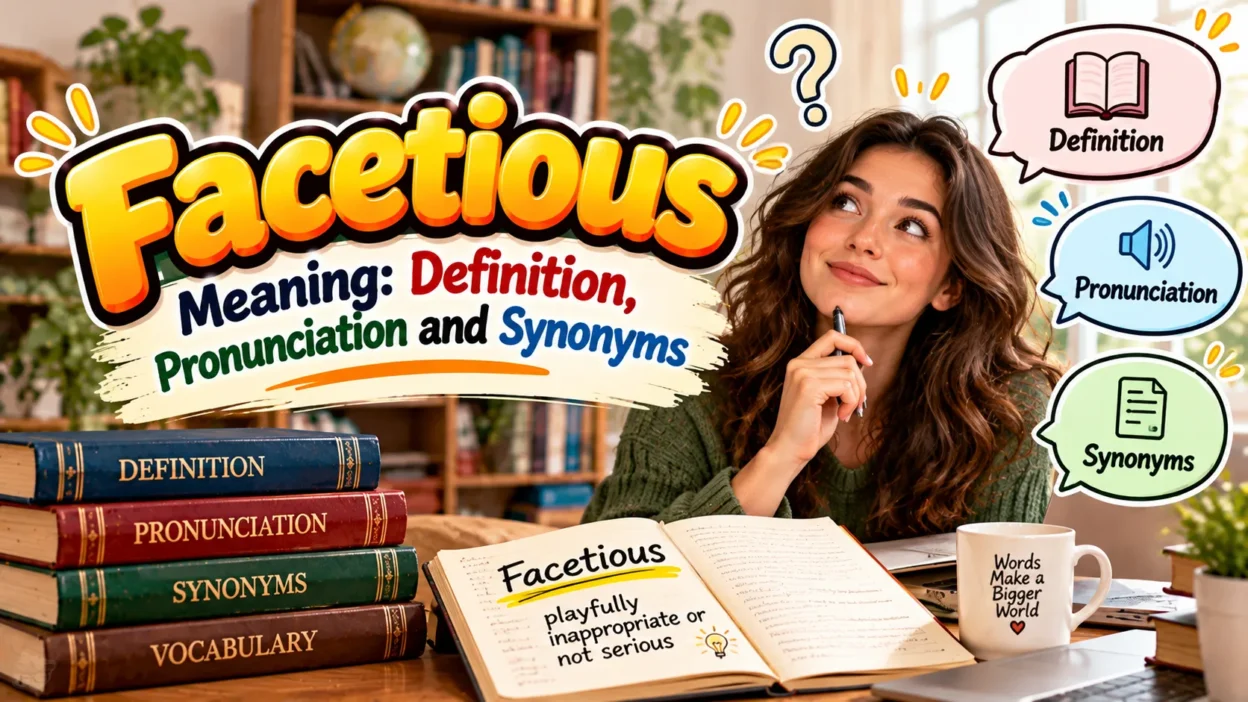
Have you ever made a joke during a serious conversation and someone misunderstood your intention? The word facetious describes this kind of humor, especially when someone makes a playful or sarcastic remark in a situation that may call for a serious response.
Facetious means treating a serious subject with inappropriate or playful humor, often by making jokes when others expect a sincere answer. The word can describe a witty comment, a teasing response, or a remark that makes light of something important.
For example, if your friend asks why you’re late and you reply, “I stopped to accept my award for the world’s most punctual person,” you’re being facetious. Your friend knows you aren’t serious; you’re using humor to answer the question.
People often confuse facetious with sarcastic, ironic, and flippant. Although these words have related meanings, each describes a slightly different kind of communication. Understanding these differences can help you use facetious correctly in everyday conversations, professional writing, and social situations.
📖 What Does Facetious Mean?
Facetious is an adjective that describes speech, writing, or behavior intended to be humorous, playful, or joking, particularly when the subject or situation is serious.
A facetious person may deliberately give an exaggerated, ridiculous, or unserious answer to make someone laugh. However, the humor may sometimes seem inappropriate if the topic involves something sensitive.
Consider this example:
“Are you worried about tomorrow’s difficult exam?”
“No, I’m planning to write my answers in invisible ink.”
The second response is facetious because the speaker uses an obviously absurd joke instead of giving a serious answer.
Facetious remarks can be clever and entertaining when people understand the joke. However, they may create confusion or frustration when someone genuinely needs help or expects an honest response.
The word does not automatically mean that someone is rude or disrespectful. Its effect depends on the topic, tone, timing, and relationship between the people involved.
📝 Facetious Meaning at a Glance
This quick reference table explains the word’s essential features, making it easier to remember and use correctly.
| Feature | Explanation |
|---|---|
| Word | Facetious |
| Part of speech | Adjective |
| Simple meaning | Joking or humorous, especially about something serious |
| Pronunciation | fuh-SEE-shuhs |
| Tone | Playful, witty, teasing, or sometimes inappropriate |
| Common usage | Conversations, jokes, essays, reviews, and informal writing |
| Similar words | Flippant, witty, joking, humorous, sarcastic |
| Opposite words | Serious, sincere, earnest, solemn |
| Example | “His facetious reply made everyone laugh.” |
In simple words: Facetious means making a joke or giving a humorous response instead of taking a subject seriously.
🔊 How to Pronounce Facetious
The word facetious is pronounced fuh-SEE-shuhs.
You can break it into three parts:
- Fuh — the opening sound.
- SEE — the stressed syllable.
- Shuhs — the ending sound.
The emphasis falls on the second syllable: fuh-SEE-shuhs.
The word has four syllables in its written form, but its common English pronunciation is usually represented by three spoken parts. Practicing the word in a sentence can make it easier to remember.
For example: “I was being facetious when I said I could finish the entire project in five minutes.”
💬 Facetious Examples in Everyday Sentences
The easiest way to understand facetious is to see how people use it in different situations. These examples show how a playful or exaggerated comment can communicate humor rather than a literal meaning.
Casual Conversation
- “My facetious answer was that I became a millionaire by finding a dollar on the sidewalk.”
- “He made a facetious remark about needing a vacation after one busy morning.”
- “She gave me a facetious explanation for why her room was messy.”
- “I was being facetious when I said my alarm clock had personally betrayed me.”
- “His facetious response turned an ordinary conversation into a comedy show.”
School and Workplace
- “The teacher recognized the student’s facetious comment and continued the lesson.”
- “My colleague made a facetious suggestion that we solve every problem by taking a longer lunch break.”
- “The manager ignored the facetious remark and returned to the meeting agenda.”
- “Her facetious response lightened the mood after a stressful presentation.”
- “The employee’s facetious email confused a client who expected a serious explanation.”
Friends and Family
- “My brother made a facetious claim that he was the smartest person in our family.”
- “She gave a facetious answer when I asked whether she had finished cleaning.”
- “Dad jokingly said he deserved a medal for making breakfast.”
- “His facetious comment made everyone laugh at the dinner table.”
- “I told my friend, facetiously, that his cooking deserved a five-star restaurant review.”
Serious Situations
- “The lawyer warned his client against making facetious remarks during the hearing.”
- “Her facetious response seemed inappropriate during the serious discussion.”
- “The reporter avoided a facetious tone while covering the emergency.”
- “He realized that his facetious comment had hurt someone’s feelings.”
- “Although the question was serious, she answered facetiously to hide her nervousness.”
These sentences demonstrate that facetious remarks can entertain people, ease tension, or cause misunderstandings. The surrounding situation helps determine which effect the speaker intends.
🎭 Facetious vs. Sarcastic vs. Ironic
Facetious, sarcastic, and ironic are related words, but they do not mean exactly the same thing. Knowing the differences can help you choose the most accurate word.
| Word | Meaning | Example |
|---|---|---|
| Facetious | Making a joke, especially about a serious subject | “Sure, I’ll finish this 100-page report during my five-minute break.” |
| Sarcastic | Using cutting or mocking language, often to criticize | “Great job arriving only an hour late.” |
| Ironic | Involving a contrast between what is expected and what happens or is meant | “The fire station caught fire.” |
| Flippant | Treating something serious with too little respect | “It’s only a tiny problem,” he said about a major crisis. |
| Witty | Showing cleverness through quick or amusing remarks | “I’m on a seafood diet: I see food, and I eat it.” |
A facetious remark is generally intended as a joke. Sarcasm often carries criticism or mockery, while irony involves a contrast or unexpected outcome. Flippancy emphasizes a lack of appropriate seriousness, and wit emphasizes cleverness.
These qualities can overlap. A single comment may be both facetious and sarcastic, depending on the speaker’s intention and delivery.
🔄 Synonyms of Facetious
Synonyms are words with similar meanings. The best alternative to facetious depends on whether you want to emphasize humor, cleverness, teasing, or a lack of seriousness.
- Joking: Saying something for amusement rather than as a serious statement.
- Humorous: Causing or expressing amusement.
- Witty: Clever and amusing, often through intelligent wordplay.
- Playful: Lighthearted and fun rather than serious.
- Flippant: Treating a serious matter too casually.
- Sardonic: Expressing dark, mocking, or cynical humor.
- Sarcastic: Using sharp or mocking remarks, often to criticize.
- Tongue-in-cheek: Expressing something humorously without intending it to be taken literally.
- Lighthearted: Cheerful and not overly serious.
- Teasing: Making playful remarks about someone or something.
Although these words overlap, they are not interchangeable in every sentence. For example, witty usually praises someone’s clever humor, while flippant often criticizes a person’s lack of seriousness.
↔️ Antonyms of Facetious
Antonyms are words with opposite or contrasting meanings. These words are useful when describing someone who communicates sincerely or treats a subject with appropriate seriousness.
- Serious: Not joking or treating a matter lightly.
- Sincere: Expressing genuine feelings or beliefs.
- Earnest: Showing serious intention or sincere commitment.
- Solemn: Deeply serious, often in a formal or emotional situation.
- Grave: Serious and important, especially when circumstances are concerning.
- Genuine: Real, honest, and not pretending.
- Straightforward: Direct and clear without joking or unnecessary ambiguity.
- Thoughtful: Showing careful consideration of a subject or another person’s feelings.
For example, “She gave a sincere answer” contrasts with “She gave a facetious answer.” The first suggests honesty and seriousness, while the second suggests that she responded with humor.
✍️ How to Use Facetious in a Sentence
Because facetious is an adjective, it describes a noun, such as a remark, comment, response, tone, or person.
You can place it before a noun:
- “He made a facetious comment about the weather.”
- “Her facetious response surprised the audience.”
- “The article included a facetious observation about office life.”
You can also use it after a linking verb:
- “His answer was facetious.”
- “The remark sounded facetious.”
- “I wasn’t being serious; I was being facetious.”
The adverb form is facetiously, which describes how someone says or does something.
For example: “She facetiously suggested that we hire a team of penguins to manage the office.”
The noun form is facetiousness, which refers to the quality or behavior of being facetious.
For example: “His facetiousness made the conversation entertaining, but it distracted everyone from the main issue.”
Using these forms correctly helps you express the same idea in different sentence structures.
🧠 What Is the Difference Between Facetious and Funny?
Something funny makes people laugh or feel amused. Something facetious involves joking or treating a subject humorously, often when a serious response might be expected.
A comedian telling a funny story during a performance is not necessarily being facetious because humor is expected in that setting.
However, a person who responds to a serious question with an absurd joke may be facetious.
Consider these examples:
- Funny: “The comedian told a story about his dog stealing his socks.”
- Facetious: “When asked how he planned to pay his bills, he said he would open a bank on the moon.”
Both examples involve humor, but the second illustrates an unserious response to a practical question.
In short, something can be funny without being facetious. Facetiousness depends more on how humor relates to the subject and situation.
⚠️ Is Being Facetious a Good or Bad Thing?
Being facetious can be positive or negative, depending on the circumstances. Humor often helps people connect, reduce tension, and make difficult conversations more comfortable. A well-timed facetious comment can bring relief to an otherwise stressful situation.
However, facetiousness can become a problem when people need clear answers, emotional support, or respectful communication.
For example, joking with a friend about a minor inconvenience may be harmless. Making jokes when someone shares painful news may appear insensitive, even if you intend to lighten the mood.
Before making a facetious remark, consider three things:
- The subject: Is the topic appropriate for humor?
- The audience: Will the other person understand your intention?
- The timing: Is this a moment for a joke or a sincere response?
Facetiousness works best when the humor fits the situation and does not dismiss another person’s concerns.
❓ Frequently Asked Questions About Facetious Meaning
What does facetious mean in simple terms?
Facetious means making jokes or using humor instead of responding seriously, especially when the subject calls for a serious answer.
Is facetious a positive or negative word?
It can be either. It may describe clever, playful humor, but it can also suggest that someone is being inappropriate or not taking an important matter seriously.
Does facetious mean sarcastic?
Not exactly. Facetious means joking or treating something humorously, while sarcastic usually involves mocking or criticizing someone or something. A remark can be both.
What is an example of a facetious remark?
If someone asks, “How did you become so successful?” and you answer, “I found a secret instruction manual inside a cereal box,” your response is facetious because it is intentionally absurd.
What is the opposite of facetious?
Common antonyms include serious, sincere, earnest, solemn, and straightforward.
What is the difference between facetious and flippant?
Both can describe a lack of seriousness. However, facetious emphasizes joking or humor, while flippant more strongly suggests that someone is treating a serious subject too casually or disrespectfully.
What is the adverb form of facetious?
The adverb is facetiously. For example: “He facetiously claimed that he could run a marathon without training.”
Can facetious be used to describe a person?
Yes. Calling someone facetious suggests that the person often makes jokes or responds humorously, sometimes when others expect a serious answer.
Is facetious the same as ironic?
No. Facetious describes joking or humorous behavior, while ironic refers to a contrast between expectations and reality or between the literal and intended meaning of a statement.
✅ Conclusion
The word facetious means joking or using humor, especially when a situation might normally call for a serious response. It can describe a playful comment, an exaggerated answer, or a deliberately ridiculous statement.
Although facetious humor can make conversations more enjoyable, its effectiveness depends on timing, tone, and context. It differs from sarcasm, irony, and flippancy, even though these concepts sometimes overlap.
Remember this simple definition: A facetious person makes a joke when someone might expect a serious answer.

Lillian Hayes is a content writer focused on explaining meanings and language in a simple and clear way. She creates easy-to-understand content that helps readers learn and communicate better.