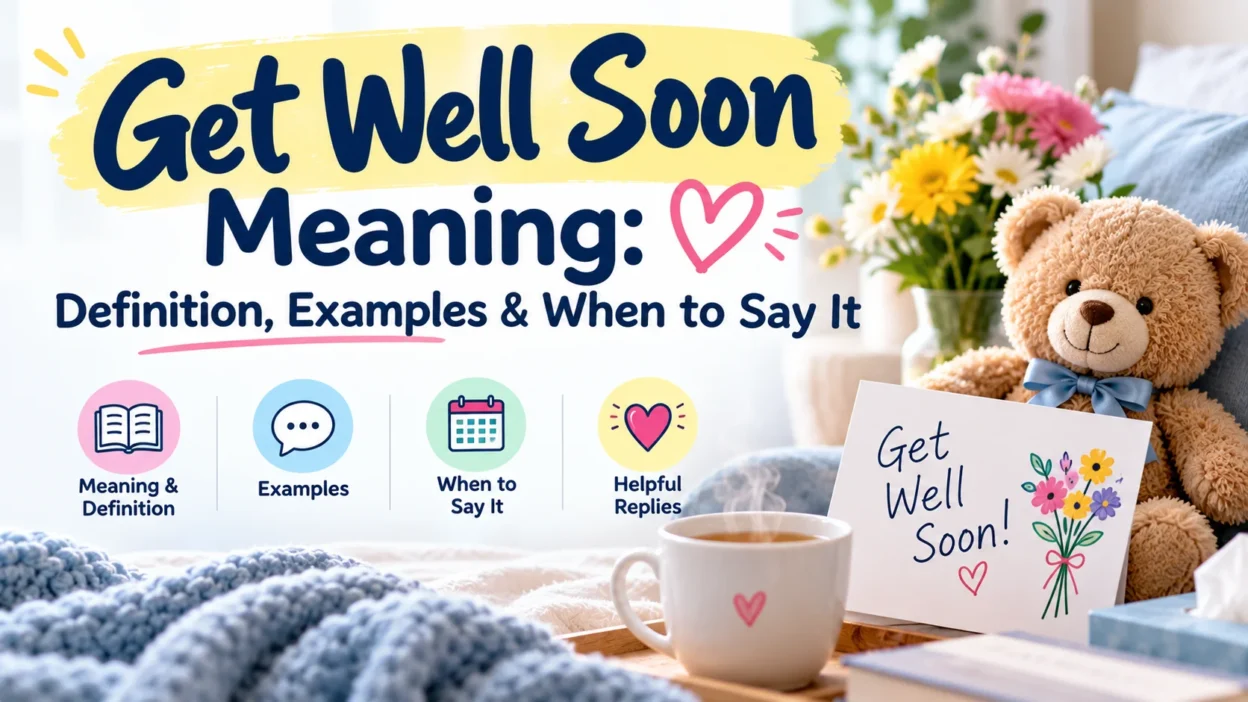
Have you ever wondered what get well soon means or when you should say it to someone? This common English expression is a warm way to wish someone a quick recovery when they are sick, injured, or not feeling their best.
The phrase get well soon meaning is simple: you hope the person feels better and returns to good health as quickly as possible. People use it in everyday conversations, text messages, greeting cards, emails, and social media posts to show kindness and support.
Whether a friend has a cold, a family member is recovering from surgery, or a coworker is taking time off because of illness, saying get well soon is a thoughtful way to let them know you care.
💐 What Does Get Well Soon Mean?
Get well soon means I hope you recover quickly and feel better soon. It is a friendly expression people use when someone is ill, injured, or recovering from a health problem.
For example, if your friend has the flu, you might say, Get well soon! This tells your friend that you hope their illness passes quickly and they return to their usual routine.
The phrase does not promise that recovery will happen immediately. Instead, it expresses a kind wish for the person’s health and comfort.
| Expression | Meaning |
|---|---|
| Get well soon | I hope you recover quickly |
| Feel better soon | I hope you start feeling better |
| Wishing you a speedy recovery | I hope you recover quickly |
| Take care | Look after yourself |
| Hope you recover soon | I hope you regain your health soon |
❤️ Why Do People Say Get Well Soon?
People say get well soon to express care, sympathy, and encouragement when someone is experiencing an illness or injury.
A few simple words can help a person feel remembered and supported, especially when they are spending time at home, staying in a hospital, or recovering from a difficult medical procedure.
You can use the phrase with friends, family members, coworkers, classmates, neighbors, and acquaintances. The wording may change depending on how close you are to the person, but the central message remains the same.
For example:
- A friend has a cold.
- A family member is recovering after surgery.
- A coworker is home sick.
- A classmate has been injured.
- A neighbor is recovering from an illness.
In each situation, get well soon communicates a sincere wish for recovery.
🗣️ How to Use Get Well Soon in a Sentence
The expression usually appears on its own or as part of a longer sentence.
Here are some natural examples:
- Get well soon! We miss seeing you.
- I hope you get well soon and feel like yourself again.
- Sending you warm wishes to get well soon.
- Please rest well and get well soon.
- Everyone at work hopes you get well soon.
- Get well soon! Take good care of yourself.
- I heard you were feeling unwell. I hope you recover soon.
- Wishing you a quick recovery and better days ahead.
- Get well soon, and let me know if you need anything.
- Sending positive thoughts and hoping you feel better soon.
These examples work in conversations, greeting cards, and text messages.
📱 Get Well Soon Meaning in Text Messages
In text messages, get well soon has the same meaning as it does in spoken English. It is a quick, caring way to tell someone you hope they recover.
You might receive the message after telling a friend that you have a fever or after sharing that you are recovering from an injury.
For example:
Friend: I’ve been sick all week and still don’t feel great.
You: I’m sorry to hear that. Get well soon! Make sure you get some rest.
The phrase is generally friendly and supportive. It does not automatically carry a romantic meaning, although someone who cares about you deeply may use it to show affection.
💌 Get Well Soon vs. Feel Better Soon
Both expressions communicate good wishes, but they have slightly different tones.
Get well soon focuses on recovery and returning to good health. Feel better soon focuses more directly on the person’s current discomfort and the hope that it will improve.
| Get well soon | Feel better soon |
|---|---|
| Emphasizes recovery | Emphasizes feeling better |
| Common after illness or injury | Common for illness, pain, stress, or discomfort |
| Works in cards and formal messages | Often sounds conversational and personal |
| Example: Get well soon after your surgery. | Example: I hope your headache goes away soon. |
Both are appropriate when you want to express care.
🌷 Get Well Soon vs. Speedy Recovery
Get well soon is a familiar, everyday expression. Wishing you a speedy recovery sounds slightly more formal and is common in greeting cards, workplace messages, and professional communication.
For example:
- Casual: Get well soon! Hope you’re back on your feet soon.
- Formal: Wishing you a speedy recovery and continued good health.
- Professional: We hope you recover comfortably and look forward to seeing you again.
The best choice depends on your relationship with the person and the situation.
😊 Is Get Well Soon Formal or Informal?
Get well soon is a friendly expression that works in both informal and many professional settings.
With a friend, you might say, Get well soon! Hope you feel better tomorrow.
With a coworker, you could write, Wishing you a smooth recovery. We hope to see you back when you’re feeling better.
For a manager, client, or someone you do not know well, a slightly more polished message may feel appropriate.
| Situation | Suggested wording |
|---|---|
| Close friend | Get well soon! Miss you. |
| Family member | Sending love and wishing you a quick recovery. |
| Coworker | Wishing you a speedy recovery. |
| Teacher | I hope you feel better soon. |
| Client | Wishing you a comfortable and speedy recovery. |
| Hospital patient | Sending warm wishes for your recovery. |
🫶 How to Reply to Get Well Soon
If someone tells you to get well soon, a simple thank-you is usually enough. You can also acknowledge their concern or return the kindness.
Here are some natural replies:
- Thank you so much!
- Thanks, I really appreciate it.
- Thank you for thinking of me.
- Thanks! I’m hoping to feel better soon.
- That’s so kind of you. Thank you.
- Thank you for your lovely message.
- I appreciate your good wishes.
- Thanks for checking on me.
- Thank you! I’m taking some time to rest.
- Thanks, that means a lot.
A short response is perfectly appropriate. You do not need to provide medical details unless you want to share them.
💖 Is Get Well Soon a Romantic Message?
Not necessarily. Get well soon is usually a general expression of kindness rather than a romantic message.
A friend, relative, coworker, or acquaintance can say it without implying romantic interest. However, a romantic partner might use the phrase as part of a more affectionate message.
For example:
General: Get well soon! Hope you’re feeling better.
Romantic: Get well soon, sweetheart. I wish I could be there to help you feel more comfortable.
The surrounding words and the relationship between the people help determine the tone.
✨ Get Well Soon Messages for Different Situations
You can personalize the phrase depending on the person and circumstances.
For a friend: Get well soon! I hope you’re back to your cheerful self very soon.
For family: Sending you lots of love and wishing you a smooth recovery.
For a coworker: Wishing you a speedy recovery. Take the time you need to rest.
For a child: Feel better soon! Sending you a big smile and lots of happy wishes.
For someone after surgery: Wishing you comfort, strength, and a smooth recovery.
For a serious illness: Thinking of you and wishing you comfort and support through your recovery.
When someone’s condition is serious, a gentle message that avoids promising a quick recovery may feel more thoughtful.
📝 Is It Correct to Write “Get Well Soon”?
Yes. Get well soon is the standard and natural expression in English.
It is commonly written without punctuation inside the phrase. You can add an exclamation mark to make it warmer or more enthusiastic:
- Get well soon.
- Get well soon!
- I hope you get well soon.
- Wishing you a speedy recovery.
When using it in a greeting card, you can write it as a heading or as part of a complete sentence.
❓ Frequently Asked Questions About Get Well Soon Meaning
What does get well soon mean in simple words?
It means I hope you recover quickly and feel better soon. People say it to someone who is sick, injured, or recovering.
What does get well soon mean in a text?
In a text message, it expresses care and wishes the recipient a quick recovery. It is usually friendly and supportive.
What should I reply when someone says get well soon?
You can simply reply, Thank you! Other options include Thanks for thinking of me or I really appreciate your kind wishes.
Is get well soon a good wish?
Yes. It is a common, polite way to express concern and hope that someone recovers comfortably.
Can I say get well soon to a coworker?
Yes. It is appropriate for many workplace situations. For a more formal message, you can write, Wishing you a speedy recovery.
What is the difference between get well soon and feel better soon?
Get well soon emphasizes recovery, while feel better soon emphasizes improvement in how someone feels. Both are commonly used for people who are unwell.
Can I say get well soon after surgery?
Yes. You can say get well soon after surgery, or use a more specific message such as, Wishing you a smooth and comfortable recovery.
Does get well soon mean someone is seriously ill?
No. People use the phrase for minor illnesses, injuries, and more serious medical conditions. The expression itself does not tell you how severe someone’s condition is.
Is get well soon romantic?
Usually not. It is a general expression of care, although a romantic partner may use it in an affectionate message.
Is get well soon grammatically correct?
Yes. Get well soon is a standard English expression used to wish someone a quick recovery.
🌟 Final Thoughts on Get Well Soon Meaning
The get well soon meaning is simple and heartfelt: you hope someone recovers quickly and starts feeling better. It is a widely used expression of kindness that works in personal conversations, text messages, greeting cards, and professional communication.
You can keep the message short or add personal words to make it more meaningful. Whether you are wishing a friend, family member, or coworker well, the most important thing is to express genuine care and respect for their recovery.

Lillian Hayes is a content writer focused on explaining meanings and language in a simple and clear way. She creates easy-to-understand content that helps readers learn and communicate better.