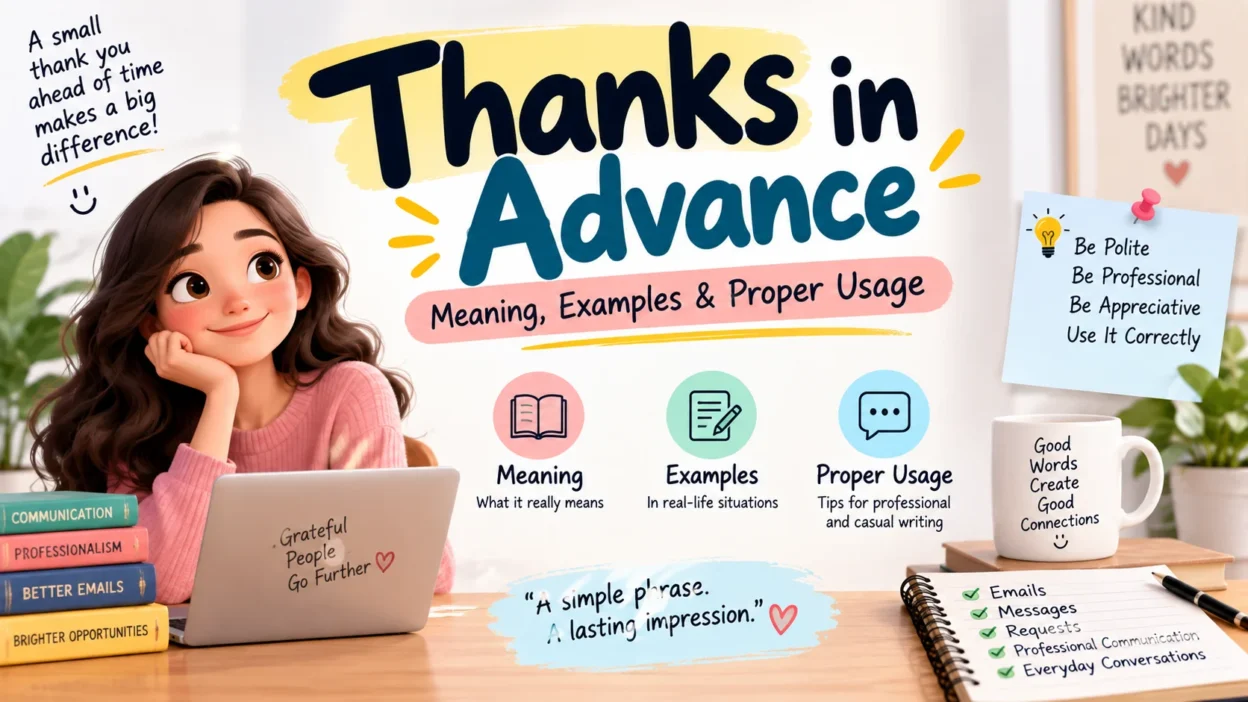
Thanks in advance is a common English expression used when you thank someone before they have completed a favor, request, or action. The phrase usually appears in emails, messages, requests, and professional communication when you expect or hope that another person will help you.
For example, if you ask a coworker to send you a document, you might write, Thanks in advance for your help. The thank-you comes before the person actually sends the document. That is the main idea behind the expression.
The phrase is grammatically correct and widely understood in modern English. However, its tone can depend on the situation. In a friendly message, it can sound warm and natural. In a professional email, it can be perfectly acceptable, although some readers may prefer a softer expression such as Thank you for your help or I appreciate your assistance.
Understanding the thanks in advance meaning also requires knowing when to use it, how to punctuate it, whether it sounds polite, and what alternatives are available. Let us look at each point clearly.
📖 What Does Thanks in Advance Mean?
Thanks in advance means thank you beforehand for something you are asking someone to do.
The word advance means something that happens before a particular event or action. Therefore, when you say thanks in advance, you are expressing gratitude before receiving the requested help.
Simple meaning:
Thanks in advance = Thank you beforehand for your help or action.
For example:
- Thanks in advance for sending me the details.
- Thanks in advance for your help.
- Thanks in advance for taking the time to review this.
- Thanks in advance for your response.
In each example, the speaker has not received the help yet. The person is thanking the recipient ahead of time.
✍️ Is Thanks in Advance Grammatically Correct?
Yes, thanks in advance is grammatically correct.
It is an established English expression used to show appreciation before a requested action takes place. You will commonly see it at the end of emails, letters, online requests, and messages.
The expression can stand alone:
Thanks in advance!
Or it can be followed by information about the requested action:
Thanks in advance for your help.
The second form is often clearer because it tells the reader exactly what you are appreciating.
The expression itself is not a complete sentence. It functions as a polite expression of gratitude.
🧩 What Is the Grammar of Thanks in Advance?
The phrase contains two important parts:
- Thanks — an expression of gratitude
- In advance — an adverbial phrase meaning beforehand
The phrase in advance describes when the thanks are being given. The speaker is expressing gratitude before the expected help happens.
A common grammatical structure is:
Thanks in advance + for + noun/gerund
Examples:
- Thanks in advance for your help.
- Thanks in advance for your assistance.
- Thanks in advance for checking this.
- Thanks in advance for sending the file.
- Thanks in advance for letting me know.
Notice that when for is followed by an action, the verb normally takes the -ing form.
Correct:
Thanks in advance for helping me.
Not:
Thanks in advance for help me.
🙏 Thanks in Advance vs. Thank You in Advance
Thanks in advance and thank you in advance have essentially the same meaning, but their tone can differ slightly.
Thanks in advance is generally more conversational and shorter.
Thank you in advance sounds a little more formal or polished.
Compare:
- Thanks in advance for your help.
- Thank you in advance for your help.
Both are grammatically correct.
In a casual message, thanks in advance may feel natural. In a formal business email, thank you in advance can sound slightly more traditional.
However, the context matters more than the small difference in wording.
💼 Is Thanks in Advance Polite?
Yes, thanks in advance can be polite, but its effect depends on the situation.
When used appropriately, it communicates appreciation and acknowledges that the other person is doing you a favor.
For example:
Could you please send me the report by Friday? Thanks in advance for your help.
This sounds polite because the request is clear and the expression shows appreciation.
However, the phrase can occasionally sound as if you are assuming that the other person will definitely agree to your request. This is especially possible when the request is large, inconvenient, or not something the recipient is obligated to do.
For a softer tone, you can say:
I would appreciate your help with this.
or:
Thank you for considering my request.
📧 How to Use Thanks in Advance in an Email
Thanks in advance is frequently used at the end of emails when the sender is asking the recipient to take an action.
A basic structure looks like this:
Request + Thanks in advance + closing
For example:
Could you please send me the updated schedule when you have a chance? Thanks in advance for your help.
In professional communication, it is usually better to make the request specific before using the phrase.
Professional email examples:
- Could you please review the attached document? Thanks in advance for your feedback.
- Please let me know if you need any additional information. Thanks in advance.
- Could you send me the updated figures by Thursday? Thanks in advance for your assistance.
- Would you mind checking these details? Thanks in advance for your time.
- Could you please confirm the meeting time? Thank you in advance for your response.
🏢 Thanks in Advance in Professional Communication
In workplace English, thanks in advance is common in emails and internal messages. It can be useful when you are making a straightforward request.
For example:
Could you please forward the invoice to the accounting team? Thanks in advance.
However, professional writing often benefits from matching the expression to the seriousness of the request.
For a simple favor:
Thanks in advance for your help.
For a more formal request:
Thank you in advance for your assistance with this matter.
For a particularly sensitive request:
I would greatly appreciate your assistance with this request.
These alternatives can sound more considerate because they do not imply that the recipient is already committed to helping.
💬 Thanks in Advance in Text Messages
The expression is also suitable for texting and casual online communication.
For example:
- Can you send me the address? Thanks in advance!
- If you find the file, please send it to me. Thanks in advance.
- Can you check whether the store is open? Thanks in advance!
- Please let me know what time you are coming. Thanks in advance.
In casual conversations, the shorter thanks in advance often sounds perfectly natural.
You can also use an exclamation mark when the tone is friendly:
Thanks in advance!
📝 Examples of Thanks in Advance
Here are examples showing how the expression works in different situations.
Asking for help
Could you help me with this assignment? Thanks in advance for your help.
Asking for information
Could you please send me the address? Thanks in advance.
Asking someone to review something
Please review the document when you have time. Thanks in advance for your feedback.
Asking for a response
Please let me know whether you can attend. Thanks in advance for your response.
Asking for a favor
Could you pick up the package for me? Thanks in advance!
Workplace communication
Could you please update the spreadsheet before the meeting? Thank you in advance for your assistance.
Customer service
Please let me know if you need any additional information. Thank you in advance for your attention to this matter.
🔤 Thanks in Advance or Thanks in Advanced?
The correct expression is:
Thanks in advance
Not:
Thanks in advanced
This is a common grammar and spelling mistake.
The word advance is correct because in advance is a fixed English expression meaning beforehand.
Correct:
Thanks in advance for your help.
Incorrect:
Thanks in advanced for your help.
The word advanced has a different meaning. It is generally used as an adjective to describe something developed, complex, or at a high level.
Examples:
- advanced mathematics
- advanced technology
- an advanced course
So remember:
in advance = beforehand
❓ Can You Say Thanks in Advance for Your Help?
Yes. Thanks in advance for your help is one of the most common and natural ways to use the expression.
The structure is:
Thanks in advance + for + noun
Here, your help is the noun phrase.
You can also use a gerund:
Thanks in advance for helping me.
Both forms are grammatically correct.
Other examples include:
- Thanks in advance for your assistance.
- Thanks in advance for your time.
- Thanks in advance for checking this.
- Thanks in advance for answering my questions.
- Thanks in advance for your support.
⚖️ When Should You Use Thanks in Advance?
Use thanks in advance when:
- You are making a request.
- You expect someone may help you.
- You want to acknowledge their effort beforehand.
- The communication is casual or moderately formal.
- The requested action is relatively straightforward.
For example:
Could you please send me the information? Thanks in advance.
The phrase is particularly common when requesting:
- information
- documents
- feedback
- assistance
- confirmation
- advice
- a response
- a favor
- a review
🚫 When Should You Avoid Thanks in Advance?
Although the expression is correct, there are situations where another phrase may sound more natural.
If the request is extremely demanding, thanks in advance may sound as though you expect the person to accept it.
For example, asking someone to spend several hours completing a task and immediately saying thanks in advance may feel presumptive.
Instead, you could write:
I would really appreciate your help if you have the time.
Another option is:
Thank you for considering my request.
These expressions leave more room for the recipient to decide whether they can help.
🌟 Alternatives to Thanks in Advance
There are many ways to express appreciation before receiving help.
Thank you in advance
This is the closest direct alternative.
Thank you in advance for your assistance.
I appreciate your help
This sounds warm and professional.
I appreciate your help with this matter.
I would appreciate your assistance
This is useful for formal communication.
I would appreciate your assistance with the report.
Thank you for your time
This is appropriate when someone is reviewing, discussing, or considering something.
Thank you for your time and consideration.
Many thanks
This is friendly and appreciative.
Many thanks for helping me with this.
I appreciate your consideration
This works particularly well for formal requests.
I appreciate your consideration of my request.
🗣️ Thanks in Advance vs. I Appreciate It
These expressions are related but are not always interchangeable.
Thanks in advance is normally used before the requested action happens.
I appreciate it is generally used after or around the time someone has agreed to help.
For example:
Could you send me the document? Thanks in advance.
After the person agrees:
Thanks, I appreciate it.
This distinction can help you choose the most natural phrase.
💡 Thanks in Advance vs. Thank You for Your Help
These two expressions differ mainly in timing.
Thanks in advance for your help means you are thanking someone before they help.
Thank you for your help normally suggests that the person has already helped you.
Compare:
Could you check this document? Thanks in advance for your help.
The checking has not happened yet.
Now compare:
Thank you for your help with the document.
This normally refers to help that has already been provided.
📚 Is Thanks in Advance Formal or Informal?
Thanks in advance is neither strictly formal nor strictly informal. It can be used across many communication settings.
It is common in:
- emails
- work messages
- school communication
- customer requests
- online forums
- personal messages
- professional correspondence
For highly formal writing, thank you in advance for your consideration or I would appreciate your assistance may sound more polished.
For casual communication, thanks in advance! is completely natural.
✏️ Punctuation: Does Thanks in Advance Need a Comma?
Usually, thanks in advance does not require a comma when it appears as a complete expression.
Correct:
Thanks in advance for your help.
Correct:
Thanks in advance!
You generally do not need to write:
Thanks, in advance, for your help.
The commas are unnecessary in the normal construction.
However, punctuation can vary when the phrase is inserted into a longer sentence. In most everyday emails and messages, keeping the expression simple is the clearest option.
📖 Is Thanks in Advance a Complete Sentence?
Strictly speaking, thanks in advance is not a conventional complete sentence because it does not contain a subject and finite verb in the usual sentence structure.
It functions as a conventional expression of gratitude.
This is similar to expressions such as:
- Thanks!
- Many thanks!
- Thank you!
- Best wishes!
In emails and messages, these expressions are completely acceptable as standalone closings.
🎓 Thanks in Advance in Academic Writing
Students sometimes use thanks in advance when asking teachers, professors, classmates, or other students for assistance.
For example:
Could you please explain how to solve this problem? Thanks in advance for your help.
This is grammatically correct.
However, in formal academic writing itself, such as an essay or research paper, the phrase usually does not belong in the main body of the text. It is more appropriate in an email or message requesting assistance.
For a professor, a more polished version might be:
I would appreciate your guidance on this question. Thank you for your time.
🌎 Thanks in Advance Meaning in Simple English
In very simple English, thanks in advance means:
I am thanking you now for something I am asking you to do later.
For example:
Please send me the photo. Thanks in advance.
The person has not sent the photo yet. The speaker is expressing gratitude beforehand.
Another simple example:
Can you help me with this? Thanks in advance!
The requested help is expected in the future.
🧠 Common Mistakes With Thanks in Advance
Several mistakes appear frequently when people use this expression.
Using advanced instead of advance
❌ Thanks in advanced.
✅ Thanks in advance.
Forgetting the word for
When talking about a specific action, for is commonly needed.
❌ Thanks in advance your help.
✅ Thanks in advance for your help.
Using the wrong verb form
After for, an action is normally expressed with the -ing form.
❌ Thanks in advance for help me.
✅ Thanks in advance for helping me.
Using it after the help is already completed
If someone has already helped you, Thank you for your help is generally more appropriate.
Sounding demanding
If the request is significant, consider a softer expression such as:
I would appreciate your help if you have the time.
💬 More Natural Examples for Everyday English
Here are some natural examples you can use in real conversations.
- Thanks in advance for your help with this.
- Thanks in advance for getting back to me.
- Thanks in advance for taking a look.
- Thanks in advance for your time.
- Thanks in advance for checking.
- Thanks in advance for letting me know.
- Thanks in advance for your response.
- Thanks in advance for sending the information.
- Thanks in advance for considering my request.
- Thanks in advance for your assistance.
❓ Frequently Asked Questions About Thanks in Advance
What does thanks in advance mean?
Thanks in advance means thank you beforehand. It is used when you express gratitude for help or an action before the person has actually completed it.
Is thanks in advance grammatically correct?
Yes. Thanks in advance is a standard and grammatically acceptable English expression. It is commonly used in emails, messages, requests, and professional communication.
Is it better to say thanks in advance or thank you in advance?
Both expressions are correct. Thanks in advance is slightly shorter and more conversational, while thank you in advance can sound a little more formal.
Is thanks in advance polite?
Yes, it can be polite when used appropriately. However, with a large or demanding request, it can sometimes sound as though you already expect the person to agree. A softer alternative may be more suitable in that situation.
What is the correct phrase: thanks in advance or thanks in advanced?
The correct phrase is thanks in advance. The word advance is part of the fixed expression in advance, which means beforehand.
Can I use thanks in advance in a professional email?
Yes. Thanks in advance is commonly used in professional emails, especially when making a simple request. For highly formal communication, you may prefer thank you in advance for your assistance or I would appreciate your assistance.
What comes after thanks in advance?
You can use for + noun or for + gerund after the expression.
Examples include:
Thanks in advance for your help.
Thanks in advance for helping me.
What is another way to say thanks in advance?
Alternatives include thank you in advance, I appreciate your help, I would appreciate your assistance, thank you for your time, and thank you for considering my request.
🎯 Conclusion
The thanks in advance meaning is simple: you are thanking someone before they complete the action you have requested. It is a common English expression that appears frequently in emails, messages, workplace communication, and everyday requests.
The most important grammar point is remembering the correct phrase in advance, not in advanced. You can also naturally use for + noun or for + -ing verb, as in Thanks in advance for your help and Thanks in advance for helping me.
While the phrase is generally polite and useful, your choice should match the situation. For a simple favor, thanks in advance works naturally. For a more formal or sensitive request, expressions such as I would appreciate your assistance or Thank you for considering my request may sound more considerate.
Once you understand the meaning, grammar, punctuation, and appropriate context, thanks in advance becomes an easy and useful expression to add to your everyday English vocabulary.

Lillian Hayes is a content writer focused on explaining meanings and language in a simple and clear way. She creates easy-to-understand content that helps readers learn and communicate better.