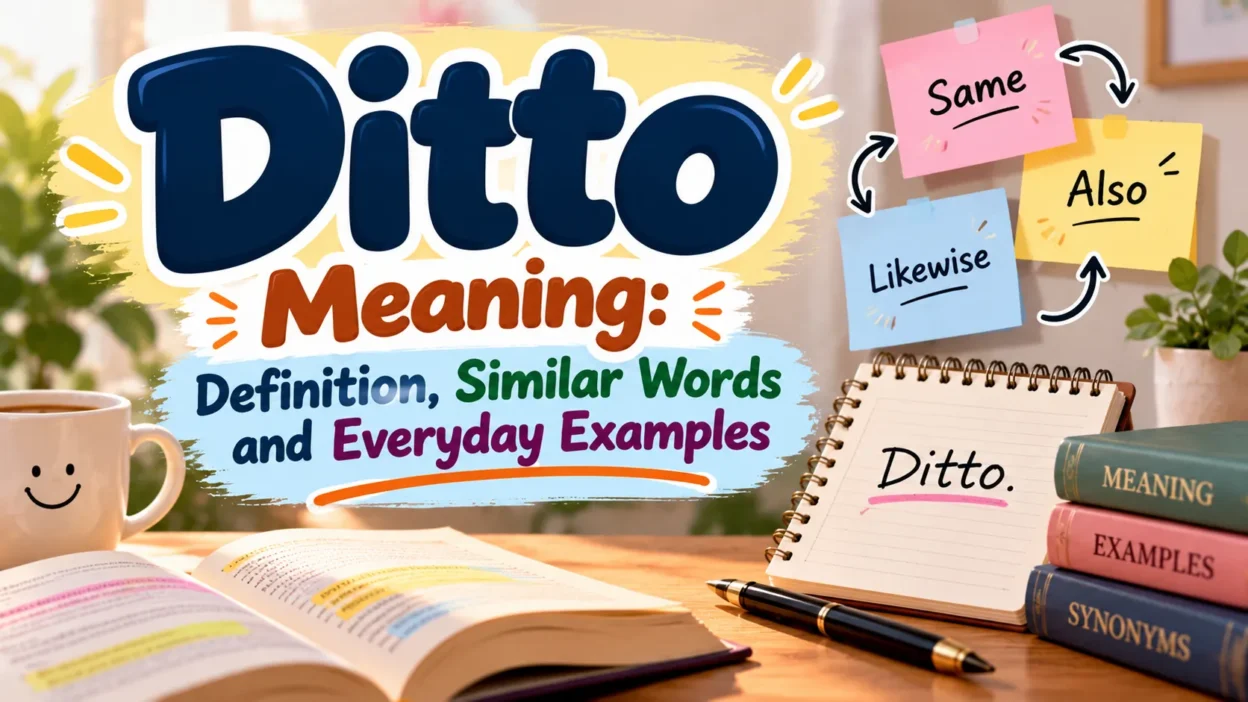
Have you ever agreed with someone so completely that you wanted to say, “Same here,” without repeating their entire statement? That’s where the word ditto comes in. It’s a short, convenient expression people use to show that they have the same opinion, feel the same way, or want to repeat something already mentioned.
The word ditto commonly means “the same as what was said or written before.” People use it in everyday conversations, text messages, emails, and even informal workplace discussions. It can save time, prevent repetition, and make communication feel more natural.
For example, if your friend says, “I’m exhausted after today’s meeting,” you can simply reply, “Ditto!” This tells your friend that you feel exhausted too.
However, ditto has more than one use. It can express agreement, repeat information, or indicate that something is identical to a previous item. Understanding these meanings will help you use the word correctly in different situations.
📖 What Does Ditto Mean?
Ditto means the same as something that has already been said, written, or mentioned. It allows you to repeat an idea without stating the entire thing again.
In everyday conversation, people often use ditto to express agreement or shared feelings. In written material, it can indicate that the information in one entry is the same as the information above it.
For example:
- Person A: “I love this movie!”
- Person B: “Ditto!”
Person B means, “I love this movie too.”
The word can also appear in a list. Imagine a table that records the same city for several people. Instead of repeatedly writing the city name, a writer might use ditto marks to indicate that the entry matches the one above.
The main idea is simple: ditto refers back to something already expressed. The exact meaning depends on whether someone is speaking, texting, or writing information in a document.
📝 Ditto Meaning at a Glance
Here’s a quick overview of the word and its common uses.
| Feature | Explanation |
|---|---|
| Word | Ditto |
| Part of speech | Noun, pronoun-like response, or adverbial expression depending on usage |
| Simple meaning | The same as before |
| Pronunciation | DIT-oh |
| Common texting meaning | Same here; I agree |
| Informal example | “I’m ready for the weekend.” “Ditto!” |
| Written usage | Indicating that information repeats a previous entry |
| Similar expressions | Same here, likewise, me too, same |
| Opposite idea | Different, otherwise, not the same |
In simple words: Ditto means “the same thing” or “I feel the same way.”
🔊 How to Pronounce Ditto
The word ditto is pronounced DIT-oh.
You can divide the pronunciation into two parts:
- DIT: The first syllable sounds like “dit.”
- Oh: The second syllable sounds like “oh.”
The stress falls on the first syllable. The word is easy to pronounce and commonly appears in informal conversations.
For example, you might say, “Ditto! I was thinking exactly the same thing.”
When speaking, the tone can change how the word feels. A cheerful “Ditto!” may show enthusiastic agreement, while a quick response may simply mean “same here.”
💬 What Does Ditto Mean in Texting?
In texting, ditto usually means “same here,” “me too,” or “I feel the same way.” It allows you to agree with someone without repeating their entire message.
Imagine your friend sends you this text:
“I’m so excited about our vacation next week!”
You could reply:
“Ditto! I can’t wait!”
Your response shows that you share your friend’s excitement.
Here are more examples of ditto in text messages:
- “This is my favorite song.” — “Ditto!”
- “I really need a day off.” — “Ditto.”
- “That restaurant was amazing.” — “Ditto! The dessert was incredible.”
- “I miss our old school days.” — “Ditto. Those were great times.”
- “I’m ready to go home.” — “Ditto!”
Ditto works especially well when the previous message expresses an opinion, feeling, preference, or experience you share.
However, it does not always mean complete agreement with every detail. In some conversations, it may simply refer to the most recent statement.
📱 How to Use Ditto on Social Media
People use ditto on platforms such as Instagram, TikTok, Facebook, Snapchat, and other messaging services to show agreement or shared feelings.
It can appear in comments, replies, captions, and group chats. Because it is short and familiar, it works well when someone wants to respond without writing a lengthy message.
For example:
- Someone posts, “Coffee makes every morning better.” You comment, “Ditto!”
- A friend writes, “I need a vacation.” You reply, “Ditto, more than ever.”
- Someone shares a favorite movie recommendation. You comment, “Ditto! One of my all-time favorites.”
- A group member says, “That was the best part of the trip.” You reply, “Ditto!”
In these examples, ditto communicates that you share the same opinion or experience.
The word is casual rather than highly formal. It generally fits friendly conversations, social media interactions, and informal messages better than official correspondence that requires a detailed response.
✍️ Ditto Examples in Everyday Sentences
Understanding the word becomes easier when you see how it works in different situations.
Casual Conversations
- “I’m hungry.” “Ditto! Let’s get something to eat.”
- “I love rainy days.” “Ditto, especially when I can stay home.”
- “This week feels incredibly long.” “Ditto!”
- “I’m looking forward to the concert.” “Ditto. It’s going to be amazing.”
- “I could use a little more sleep.” “Ditto, I barely slept last night.”
School and Work
- “I think we should review the presentation once more.” “Ditto.”
- “The deadline is approaching quickly.” “Ditto. We need to finish our part today.”
- “That meeting could have been an email.” “Ditto!”
- “I agree with the proposed schedule.” “Ditto.”
- “The new project looks challenging.” “Ditto, but I’m excited to start.”
Friends and Family
- “I miss everyone getting together on Sundays.” “Ditto.”
- “Grandma’s cooking is the best.” “Ditto, especially her homemade bread.”
- “I’m excited to see you this weekend.” “Ditto!”
- “We should plan another family trip.” “Ditto. Last year’s trip was wonderful.”
- “I wish we had more time to relax.” “Ditto!”
In each example, ditto refers to something already said. It works because both speakers understand the statement being repeated.
🔄 Ditto vs. Me Too vs. Likewise
Ditto, me too, and likewise have similar meanings, but they can sound slightly different depending on the conversation.
| Expression | Meaning | Example |
|---|---|---|
| Ditto | The same as what was just said | “I love this book.” “Ditto!” |
| Me too | I share the same feeling or experience | “I’m excited.” “Me too!” |
| Likewise | The same applies to me; often used in polite exchanges | “Nice to meet you.” “Likewise.” |
| Same here | I feel or think the same way | “I’m tired.” “Same here.” |
| I agree | I share your opinion | “This plan makes sense.” “I agree.” |
Ditto is brief and informal. Me too sounds natural in everyday conversations, while likewise often fits polite exchanges or situations where you return a sentiment.
For instance, if someone says, “It was a pleasure working with you,” replying “Likewise” often sounds more natural than replying “Ditto.”
The best choice depends on the message and the tone you want to convey.
📚 What Does Ditto Mean in Writing?
In writing, ditto can mean that something is identical to an item mentioned previously. It has historically appeared in lists, tables, registers, and other documents where repeating the same information would be unnecessary.
For example:
| Name | City |
|---|---|
| Anna | Chicago |
| James | Ditto |
| Maria | Ditto |
In this simplified example, “Ditto” indicates that James and Maria have the same city listed for Anna: Chicago.
Ditto marks can also be used to repeat information in certain tabular or handwritten records. Their exact appearance and suitability depend on the document’s format and conventions.
In modern professional documents, it is often clearer to repeat the actual information rather than write “ditto,” particularly when readers need to interpret a spreadsheet or form without confusion.
The word also appears in ordinary prose when a writer wants to refer back to an earlier statement. However, using it too often may make writing feel repetitive or vague.
🕰️ Where Does the Word Ditto Come From?
The word ditto comes from Italian detto, meaning “said” or “aforementioned.” It is related to the Italian verb dire, meaning “to say.”
English adopted the word to refer to something already mentioned, especially in writing and recordkeeping. Over time, people also began using it in spoken conversations as a short way to say “the same thing.”
This history explains why ditto works in both written and spoken English. In a table, it can repeat an earlier entry. In a conversation, it can communicate that the speaker shares the previous person’s thought or feeling.
Today, the word remains useful because it conveys a familiar idea with very little effort.
⚠️ When Should You Avoid Using Ditto?
Although ditto is useful, it does not fit every situation. Because it relies on something said or written earlier, it may confuse readers when the reference is unclear.
Here are a few situations where another expression may work better:
- Formal business correspondence: A complete sentence may sound more professional than “Ditto.”
- Sensitive conversations: Saying “I understand” or responding thoughtfully may show more care than a one-word reply.
- Legal or official documents: Repeating the exact information may avoid ambiguity.
- Unclear conversations: If several ideas have been mentioned, ditto may leave people unsure about which idea you mean.
- Situations requiring explanation: If you agree with only part of someone’s statement, explain which part you agree with.
For example, if a colleague says, “I agree with the timeline, but the budget needs changes,” replying “Ditto” may not make your position clear. A more specific response would help avoid misunderstandings.
❓ Frequently Asked Questions About Ditto Meaning
What does ditto mean in simple words?
Ditto means “the same thing” or “I feel the same way.” People use it to repeat or agree with something already mentioned.
What does ditto mean in texting?
In texting, ditto usually means “same here,” “me too,” or “I agree.” For example, if someone says, “I’m exhausted,” replying “Ditto” means you feel exhausted too.
Is ditto a slang word?
Ditto is an established English word, not merely internet slang. However, people often use it informally in texting and everyday conversations.
Is ditto rude?
No, ditto is not inherently rude. It can sound friendly and natural, although a one-word reply may seem dismissive if the conversation requires a thoughtful response.
What is another word for ditto?
Common alternatives include “same here,” “me too,” “likewise,” “the same,” and “I agree.” The most suitable alternative depends on the context.
What does ditto mean in a document?
In a document, ditto can indicate that an entry is the same as the information listed previously. This usage is common in tables and records, although repeating the information may be clearer in some modern documents.
Can I use ditto in a professional email?
You can use it in a casual workplace exchange, but a complete response often sounds more professional. For example, “I agree with your recommendation” is clearer than simply writing “Ditto.”
What does ditto mean when someone says “I love you”?
If someone says “I love you” and the other person replies “Ditto,” they are generally indicating that they feel the same way. However, because it can sound casual or impersonal, some people may prefer a more direct response.
✅ Conclusion
The word ditto means “the same as what was said or written before.” In everyday conversations and text messages, people commonly use it to express agreement, shared feelings, or a similar experience without repeating an entire statement.
The word also appears in written records and tables to indicate that information matches a previous entry. Although ditto is convenient and widely understood, its informal tone makes it more suitable for casual communication than for every professional or sensitive situation.
Remember this simple example: If your friend says, “I love this song,” and you reply, “Ditto,” you’re saying that you love it too.

Lillian Hayes is a content writer focused on explaining meanings and language in a simple and clear way. She creates easy-to-understand content that helps readers learn and communicate better.